News Desk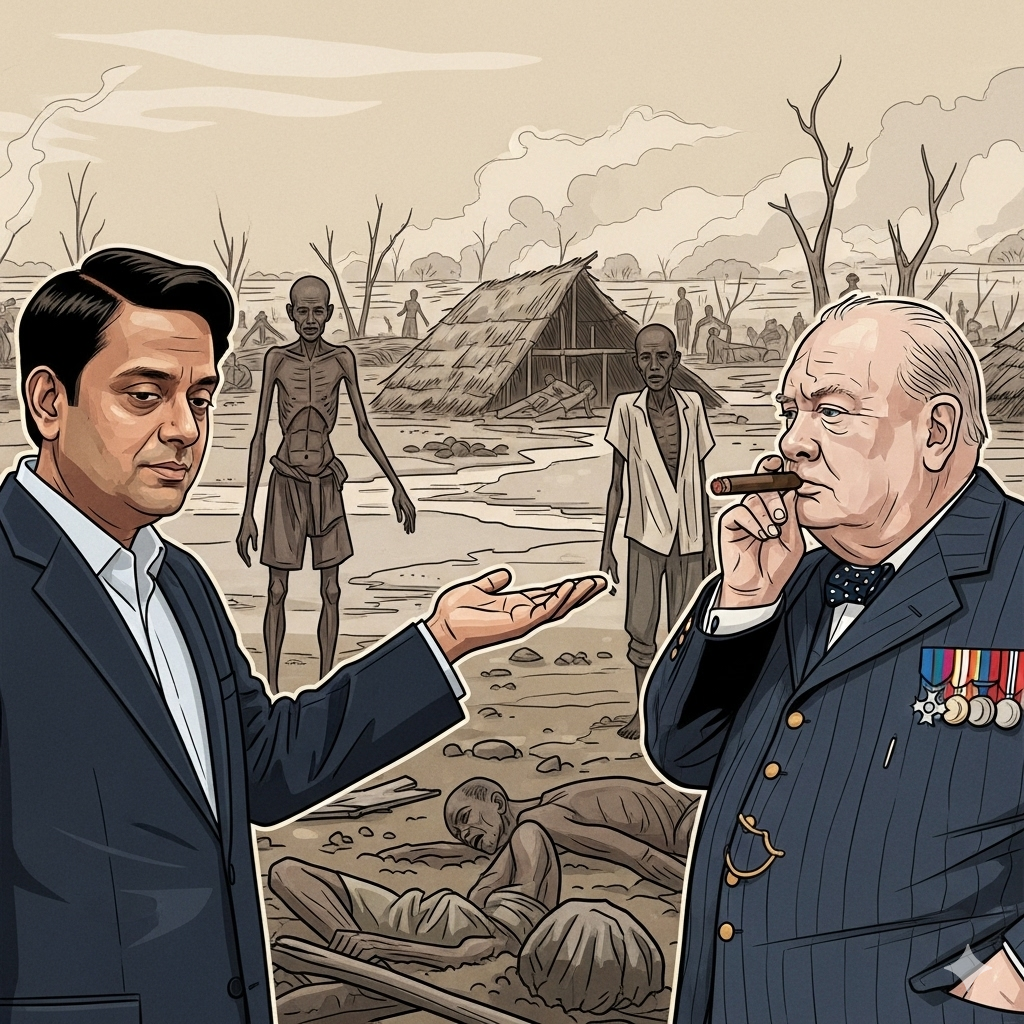
LONDON — For decades, Britain has wrapped its colonial past in gauzy nostalgia, invoking the railways, the English language, and parliamentary institutions as supposed gifts to its former colonies. Yet behind these comforting myths lies a brutal record of plunder, repression, and calculated cruelty; a history that, as Shashi Tharoor, the Indian parliamentarian and historian, has forcefully argued, left one of the world’s wealthiest civilizations in ruins.
In 1700, India accounted for 27 percent of global GDP, a thriving hub of textiles, trade, and learning. By 1947, at independence, that share had collapsed to barely 3 percent. Ninety percent of the population lived below the poverty line; life expectancy was just 27; literacy barely 17 percent. This was not a natural decline, nor simply a missed turn in the Industrial Revolution. It was, as Tharoor puts it, being “thrown under its wheels.”
The British systematically dismantled India’s industries. The textile trade, once the envy of Rome, was deliberately crushed. Weavers had their looms smashed, their livelihoods taxed into oblivion, and in notorious cases, their thumbs cut off to ensure they could never work again. Murshidabad, Dhaka, and other once-bustling centers of craftsmanship were left depopulated. This was not the invisible hand of markets, but the mailed fist of imperial policy.
Education, often cited by apologists as a benevolent British contribution, was in reality starved of resources. Will Durant, the American historian, noted that Britain’s total annual expenditure on Indian education, from nursery school to university, was less than half the high school budget of New York State in the 1930s. The famed Indian Institutes of Technology and engineering achievements of modern India were creations of independent governments, not colonial rulers.
Britain drained India’s wealth not only in material goods but in human dignity. From 1900 to 1947, the growth rate of British India was a near-stagnant 0.001 percent. This was economic strangulation, not stewardship.
At the center of this moral indictment stands Winston Churchill, lionized in Britain as a wartime savior, but remembered in India as an architect of famine. In 1943, as millions in Bengal starved, Churchill diverted grain to stockpile reserves for possible future campaigns in Europe. Australian ships carrying wheat docked in Calcutta were ordered to sail away, leaving skeletal bodies to collapse on the streets. “I hate Indians,” Churchill sneered, dismissing the catastrophe as the fault of a people who “breed like rabbits.” On one famine memorandum, he scrawled a chilling aside: “Why hasn’t Gandhi died yet?”
Tharoor is unsparing: “Churchill has as much blood on his hands as some of the worst genocidal dictators of the 20th century.” Yet in Britain he remains venerated, his statue standing tall in Parliament Square, a symbol of “freedom and democracy.” The paradox is glaring: a man complicit in mass starvation hailed as an apostle of liberty.
This selective memory is not accidental. As one British interlocutor admitted, even students who excel in history often “never learned a line of colonial history.” Colonial crimes, from loot to famine, are elided from the curriculum, replaced by tales of valor at Dunkirk or the romance of empire. The result is a collective amnesia that leaves many Britons bewildered by postcolonial anger.
The irony, as Tharoor and others point out, is sharp: when Britons voted for Brexit, many cited fears that foreigners would “come to our country and take our things.” Few paused to reckon with the fact that the British Empire itself was built on precisely that principle — going abroad and taking the things of others, at gunpoint if necessary.
India’s rise since independence underscores the scale of what was lost. Its educational institutions, industrial base, and democratic structures were not colonial inheritances but hard-won national projects built from the wreckage of empire. As Tharoor reminds us, modern India is a story of resilience after devastation, not gratitude for colonial tutelage.
Britain, meanwhile, continues to resist a full reckoning. There has been no apology, no reparations, and scant willingness to integrate the truths of empire into national memory. The comfort of nostalgia still outweighs the discomfort of history.
Yet as statues are defaced, archives unearthed, and voices like Tharoor’s grow louder, the myths fray. The legacy of empire is not railways or cricket, but famine, impoverishment, and the deliberate destruction of flourishing societies. For India, independence meant liberation from a suffocating yoke. For Britain, it may yet require the courage to confront the truth about its so-called “civilizing mission.”