
 News Desk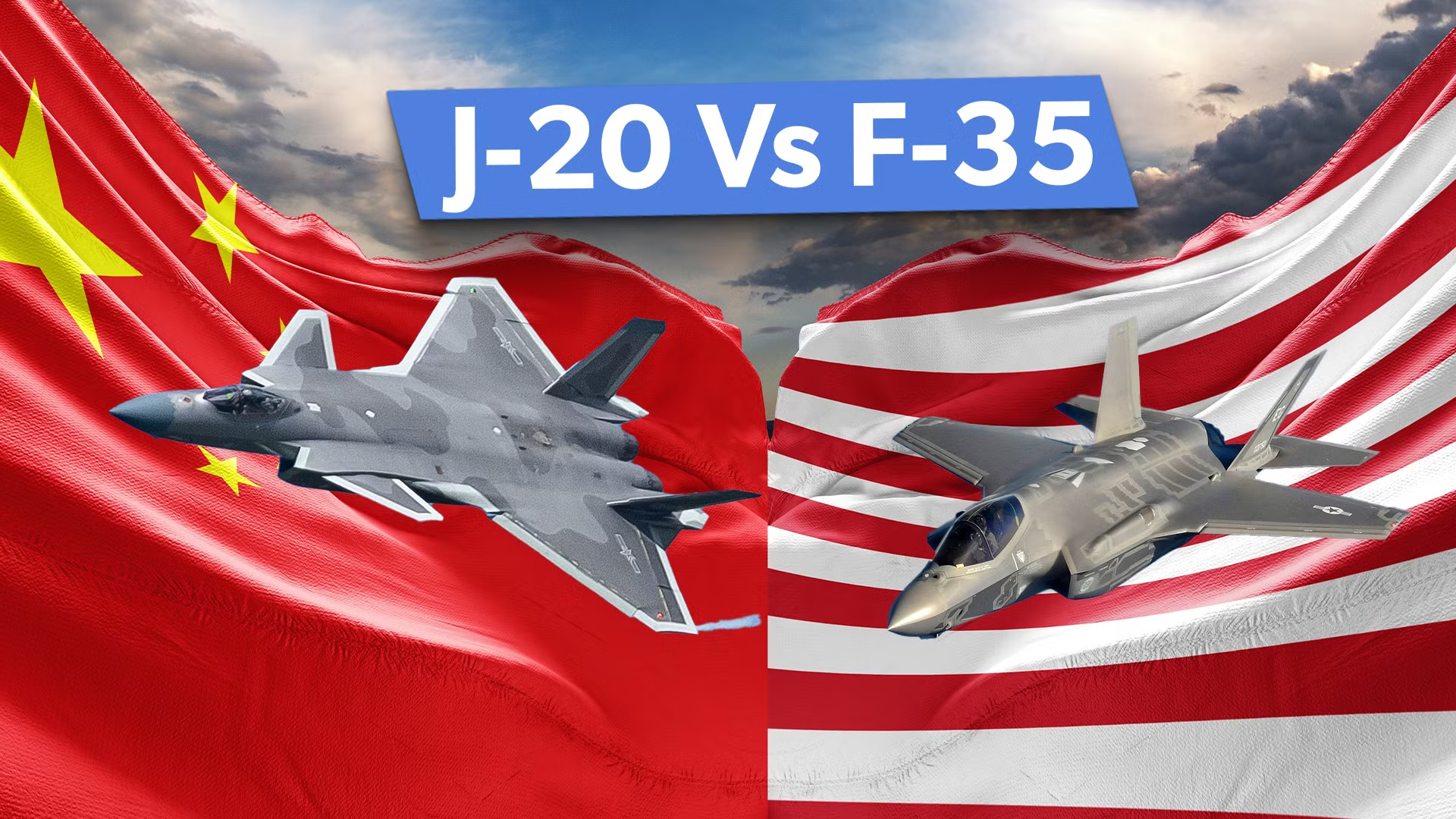
As the geopolitical rivalry between India and China continues to shape the balance of power in Asia, India’s potential acquisition of the American F-35 Lightning II marks a transformative moment in its strategic and defense capabilities. This decision not only addresses India’s security concerns vis-à-vis China and Pakistan but also reinforces its role as a key player in the Indo-Pacific.
When juxtaposed against China’s J-20 Mighty Dragon and Pakistan’s JF-17 Thunder, the F-35’s inclusion in India’s arsenal could tilt the scales in the highly contested Indian Ocean theater.
Origins and Strategic Purpose
The F-35, introduced in 2015, epitomizes American technological superiority and is designed to serve as a multi-role stealth fighter capable of dominance in various operational environments. India’s decision to consider the F-35 aligns with its ambitions to bridge gaps in aerial warfare technology and improve interoperability with Quad allies such as the United States, Japan, and Australia.
On the other hand, China’s Chengdu J-20 Mighty Dragon, which entered service in 2017, is a cornerstone of Beijing’s anti-access/area denial (A2/AD) strategy, aimed at countering U.S. forces and asserting dominance over contested zones like the South China Sea. Its extended range also positions it as a potential threat in the Indian Ocean region, where China’s naval presence is expanding.
Stealth and Survivability: F-35 vs. J-20
The F-35 is optimized for stealth across multiple dimensions, making it difficult to detect from all angles. This is a critical advantage in the Indian Ocean theater, where India’s defense strategy hinges on projecting power while avoiding detection by adversaries like China or Pakistan.
The J-20, while impressive in its frontal stealth capabilities, has noticeable vulnerabilities in rearward stealth. This limitation could prove significant in the expansive and diverse terrains of South Asia, where aerial engagements might require extended operations far from home bases.
Range and Operational Reach
India’s vast borders and maritime responsibilities demand a fighter with significant range and operational flexibility. The F-35’s ability to operate from land-based airfields and aircraft carriers (F-35C variant) makes it a valuable asset for securing the Indian Ocean and deterring potential threats from China and Pakistan.
The J-20’s range is one of its strongest attributes, designed to strike high-value targets deep within enemy territory. This capability aligns with China’s ambition to project power into South Asia and the Indian Ocean, challenging India’s maritime dominance.
Meanwhile, Pakistan’s reliance on the JF-17 Thunder and Chinese-supplied J-10C fighters limits its ability to compete with the F-35 or J-20 in terms of stealth and advanced avionics.
Avionics and Sensor Fusion
The F-35’s sensor fusion, powered by the AN/APG-81 AESA radar and the Distributed Aperture System (DAS), offers unparalleled situational awareness, enabling it to act as an airborne command center. For India, this capability enhances its ability to conduct joint operations with allies and maintain a technological edge over adversaries.
In contrast, the J-20’s avionics remain less transparent. While it employs advanced radar and electro-optical systems, experts argue that it may lack the seamless integration and interoperability seen in the F-35, a critical shortcoming in joint operational contexts.
Geopolitical Implications in the Indian Ocean
The Indian Ocean is emerging as a critical battleground for influence, with China’s growing presence through its “String of Pearls” strategy and military bases like Djibouti. The F-35 would bolster India’s ability to counter these moves, offering a credible deterrent against Chinese ambitions and ensuring security in vital sea lanes.
China’s J-20, while a formidable adversary, may face logistical and operational challenges in sustained deployments far from its home bases. This contrasts with India’s geographical advantage and potential use of the F-35 to project power across the region.
Pakistan’s reliance on less advanced platforms like the JF-17 and its limited economic capacity to field stealth aircraft in large numbers diminishes its ability to compete in this high-stakes environment.
India’s Strategic Leap Forward
India’s acquisition of the F-35 represents more than just an upgrade in its aerial capabilities, it signals a deepening partnership with the United States and a commitment to preserving a free and open Indo-Pacific. By integrating the F-35 into its defense strategy, India stands to counterbalance China’s assertive posturing and maintain its edge in the Indian Ocean theater.
While the J-20 and China’s broader military modernization efforts pose significant challenges, the F-35’s technological superiority, combined with India’s geographic and strategic advantages, offers a compelling case for optimism in securing regional stability.
References
- RAND Corporation analysis on stealth and survivability.
- Center for Strategic and International Studies reports on Chinese military modernization.
- Lockheed Martin official specifications for the F-35.
- Royal United Services Institute commentary by Justin Bronk on J-20 avionics and design.
- Aviation Week coverage of WS-15 engine developments.
- Official statements and reports from the U.S. Department of Defense and Chinese military sources, websites.









