News Desk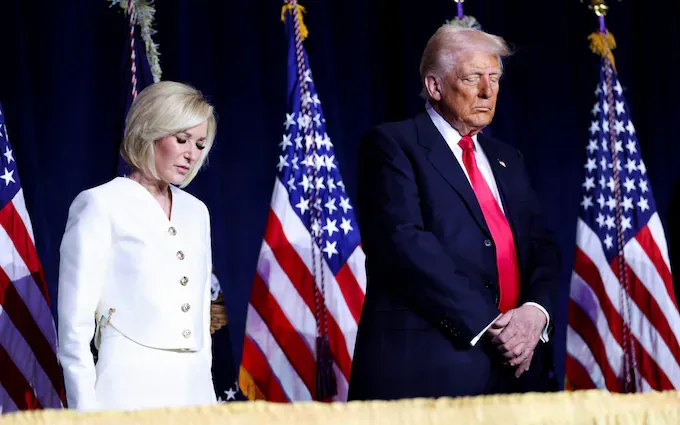
Paula White, a televangelist with a history of personal and financial controversies, became Trump’s spiritual advisor in the White House, embodying the fusion of evangelical Christianity and the MAGA movement.
Her role in Trump’s circles was both symbolic and strategic, leveraging her influence over religious conservatives to bolster his appeal to this crucial voter base. White’s prosperity gospel, promising material blessings in exchange for faith and donations, aligned seamlessly with Trump’s brand of success-driven populism. Figures like White gain prominence because they offer a spectacle: theatrical sermons, bold proclamations, and a promise of divine favor that resonates with followers yearning for hope or validation. For many, showmanship often outweighs the expectation of moral consistency, creating a dynamic where charisma and the appearance of success eclipse the foundational virtues of humility and accountability. In such a world, fear of God takes a backseat to the allure of the performance.
There’s a saying: “Charity begins at home.” But what happens when the home is riddled with hypocrisy? Enter Paula White, a self-proclaimed spiritual advisor and emblem of a strand of evangelical Christianity that’s as opulent as it is contradictory.
White’s public persona thrives on the intersection of religion and politics. In a now-infamous marathon sermon, White decried a “demonic confederacy against the election,” calling for angels to deliver Trump a victory. She invoked dramatic imagery, declaring, “Take the sword of the Lord and strike… until you have victory,” while pounding her fist on the podium at the City of Destiny church. Her sermon, which included moments of speaking in tongues, went viral, epitomizing the theatricality that defines her ministry.
As Trump’s spiritual advisor and chair of his evangelical advisory board during the 2016 campaign, White’s unwavering dedication led to her appointment as head of the White House Faith Office. For White, faith and politics are inseparable, as she famously claimed, “To say no to President Trump would be saying no to God.” Her relationship with Trump dates back two decades when he praised her “it factor” after watching her televised sermons.
White’s career is a mosaic of controversies. From her roots as a self-described “messed-up Mississippi girl” who “lived in a trailer… daddy committed suicide, got pregnant out of wedlock, been married, been divorced,” to becoming a prosperity gospel preacher, White’s life story is one of reinvention. Yet her ministry, marked by financial scandals, remains contentious.
The Without Walls International Church she co-founded was embroiled in a U.S. Senate inquiry for misusing tax-exempt funds, including nearly $900,000 for a mansion and a private jet.
Her polarizing statements, such as praying for “all satanic pregnancies to miscarry” or declaring, “Wherever I go, God rules… When I walk on White House grounds, God walks on White House grounds,” add fuel to her critics’ claims of opportunism and performative faith. Yet, for her followers, these declarations affirm her divine authority, and for Trump, they reinforce his connection to a key voter bloc.
White’s life reads like a tabloid exposé dressed up as a sermon. She met her first husband, Dean Knight, and had a child out of wedlock—a personal decision that surely clashes with the “family values” banner so often waved by evangelicals.
Her second husband, Randy White, was a fellow pastor already married with children when their year-long affair began. They divorced their respective spouses to tie the knot, building a ministry together over 18 years before their own marriage unraveled.
Their ministry, incidentally, became a textbook case of financial mismanagement. Millions of dollars in church funds were allegedly spent on luxury items, including plastic surgery, a mansion, a private jet, and even a Bentley for Bishop T.D. Jakes’ birthday.
Somewhere in the mix, she also had an affair with televangelist Benny Hinn, which resulted in legal disputes due to a breached morality clause.
And then there’s Jonathan Cain, keyboardist for Journey and White’s third husband. Their relationship reportedly began as an affair while Cain was married with three children.
For those keeping score, the Bible condemns adultery 54 times. It’s enshrined in the Ten Commandments, right alongside prohibitions against theft and murder. Yet this explicit moral directive doesn’t seem to garner the same focus in evangelical circles as, say, homosexuality, which is mentioned all of six times in the Bible. Nor does it generate the same fervor as debates over abortion—a subject the Bible notably doesn’t mention at all.
This selective outrage exposes a glaring inconsistency. While certain sins are magnified and weaponized, others—especially those closer to home—are conveniently downplayed or ignored. How else can one explain the evangelical community’s enduring support for figures whose personal lives directly contradict the values they preach?
The fixation on external “sins” often functions as a distraction from internal reckoning. It’s far easier to condemn others than to confront the rot within. But the Bible, for all its complexity, is clear on certain priorities: loving the poor, aiding the sick, helping prisoners, and welcoming the stranger and immigrant. These commandments are not optional, nor are they buried in obscure verses—they are central to the teachings of Christ.
And yet, many who claim persecution in the name of Christianity seem more concerned with policing others than embodying these principles. Public figures like Paula White aren’t anomalies; they are emblematic of a broader cultural failure. When Christianity becomes more about power and moral grandstanding than about humility and service, it’s not the faith being persecuted—it’s the faith being betrayed.
So, let’s ask the hard questions. Is the real threat to Christianity coming from outside critics, or is it emanating from within, cloaked in self-righteousness and hypocrisy? Until evangelicals address the latter, their cries of persecution will continue to ring hollow.