
 News Desk
India’s digital economy is no longer just an emerging force—it’s on the brink of becoming the country’s primary economic driver. By fiscal year 2029-30, it is expected to contribute nearly 20% of India’s GDP, surpassing both agriculture and manufacturing. In 2022-23, the sector accounted for 11.74% of GDP, valued at INR 31.64 trillion ($402 billion), according to the Ministry of Electronics and Information Technology.
What makes India’s digital transformation particularly striking is its scale and speed. The ‘State of India’s Digital Economy Report 2024’ highlights key trends that underscore this shift:
- A Global Digital Powerhouse: India ranks third globally in economy-wide digitalization and twelfth among G20 nations in individual adoption.
- A Productivity Engine: With 14.67 million workers, the digital sector employs 2.55% of the workforce but is nearly five times more productive than the broader economy.
- AI and Cloud as Catalysts: Artificial intelligence (AI), cloud computing, and global capability centers (GCCs) are fueling expansion—India now hosts 55% of the world’s GCCs.
- Women in the Workforce: Digital platforms are creating more opportunities for women, breaking barriers in industries where safety and mobility were challenges.
- Evolving Sectors: Retail is shifting toward an omnichannel model, banking is nearing full digital adoption, and education has embraced hybrid learning. Meanwhile, hospitality and logistics are integrating AI and metaverse technologies.
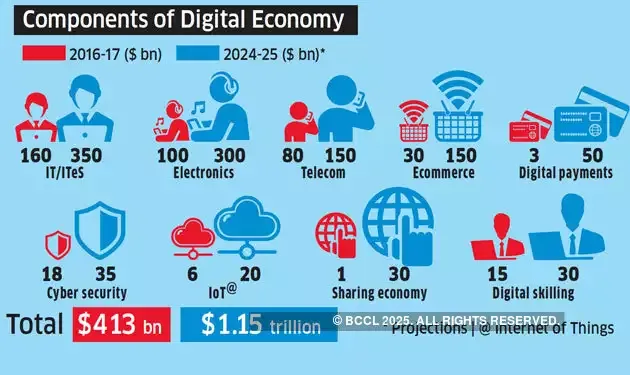
India’s rapid digital transformation presents both opportunities and challenges. The question now is not whether digitalization will reshape the country’s economy, but how quickly and inclusively it will do so.









