
 News Desk
NEW DELHI — Facing its slowest growth in four years and persistent inflation pressures, India is turning to its vast middle class to drive economic momentum. The government unveiled significant tax cuts in its annual budget on Saturday, aiming to boost domestic demand at a time of global economic uncertainty and potential new tariff barriers.
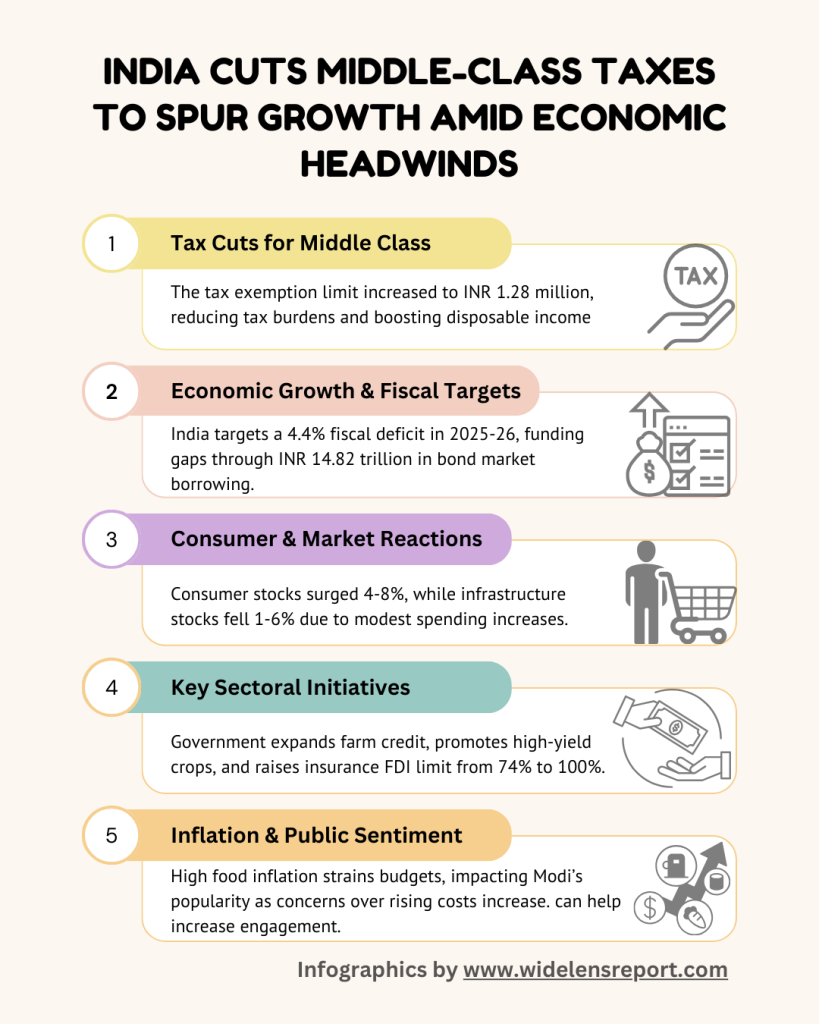
The new tax structure raises the income threshold for tax exemption to 1.28 million Indian rupees ($14,800) per year, up from 700,000 rupees. Rates have also been lowered for earners above the threshold, a move that Finance Minister Nirmala Sitharaman said would “reduce taxes on the middle class and leave more money in their hands, boosting household consumption, savings, and investment.” The tax relief, however, comes at a cost—an estimated 1 trillion rupees ($11.6 billion) loss in government revenue.
The world’s fifth-largest economy is bracing for slower urban demand and weak private investment in the coming year, even as inflation, particularly in food prices, continues to weigh on disposable incomes. Rising living costs have also dented Prime Minister Narendra Modi’s popularity, with surveys suggesting growing public pessimism about economic prospects.
Economists see the tax cuts as a stimulus for middle-class spending, which has been constrained by high inflation and sluggish wage growth. “This is likely to spur consumer demand and savings,” said Sakshi Gupta, an economist at HDFC Bank. Investors reacted accordingly, with consumer-focused stocks such as Maruti Suzuki, Godrej Consumer Products, and Prestige Estates rallying between 4% and 8% after the budget announcement.
To offset revenue losses, the government is planning a modest increase in capital spending, allocating 11.21 trillion rupees ($129 billion) for infrastructure in the 2025-26 fiscal year, up from a revised 10.18 trillion this year. But the incremental spending fell short of investor expectations, leading to declines in infrastructure stocks, including Larsen & Toubro, NBCC, and IRB Infra, which dropped between 1% and 6%.
Despite the expanded spending, the government remains committed to fiscal consolidation, targeting a deficit of 4.4% of GDP next year, down from 4.8% this year. It plans to borrow 14.82 trillion rupees ($171 billion) through bond markets to finance the shortfall.
With food inflation straining household budgets, the budget includes measures to boost agricultural productivity. The government will launch a national mission focused on high-yielding crops, particularly pulses and cotton, while increasing subsidized credit limits for farmers from 300,000 rupees to 500,000 rupees ($5,778).
Manufacturing and exports—longstanding priorities for India—also received attention, though Sitharaman provided few details beyond plans for new industrial and trade initiatives. Manufacturing remains a stubbornly small share of the economy at around 17%, far from the government’s target of 25%.
In a notable move for financial markets, the government raised the foreign direct investment (FDI) limit in the insurance sector from 74% to 100%, signaling a push for deeper global capital inflows.
While the budget lays out measures to strengthen domestic demand, it remains silent on the potential impact of new tariffs from the United States under a possible second Trump administration. Instead, the government focused on lowering certain input costs for high-growth industries, such as electronics.
India, the world’s most populous country, is at an economic crossroads. With per capita income at around $2,700 and roughly a third of its 1.4 billion population classified as middle class, the government is banking on consumer-driven growth to weather an uncertain global climate. Whether this bet pays off will depend on how much relief the tax cuts provide in the face of inflation and economic headwinds. (Agencies)









