 News Desk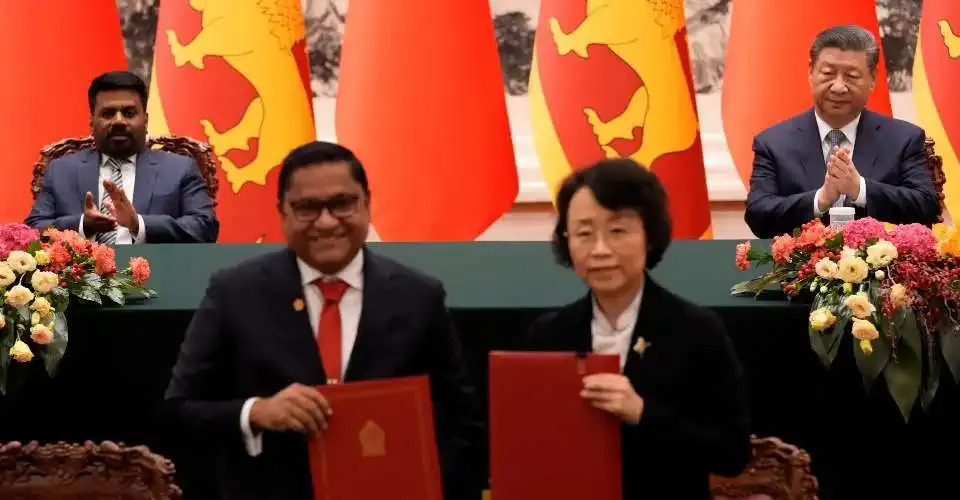
COLOMBO, Sri Lanka — Sri Lanka’s recent decision to sign media cooperation agreements with China has raised alarm among journalists and press freedom advocates, who fear Beijing’s growing influence could further erode the country’s already fragile media landscape.
The agreement, part of a broader package of deals signed between the two nations in recent weeks, remains shrouded in secrecy. “Its details have not been disclosed to the public,” said Dharmasiri Lankapeli, a prominent rights activist, addressing journalists in Colombo on Jan. 30.
Sri Lankan President Anura Kumara Dissanayake, on his first official visit to Beijing from Jan. 14-17, signed at least 15 agreements with China, covering trade, education, health, and media cooperation. Among them, Sri Lanka’s Ministry of Health and Mass Media signed memorandums of understanding with China’s National Radio and Television Administration (NRTA) and the state-owned Xinhua News Agency, allowing China to provide “capacity-building programs” for Sri Lankan officials and journalists.
Critics, however, see the agreements as yet another attempt by Beijing to expand its grip on Sri Lanka’s institutions. “This is deeply concerning, as Sri Lankan journalists are already struggling for reforms to protect press freedom,” said Anthony Sanjeewa, a senior journalist in Colombo. He warned that the pact could allow China’s state-controlled media to operate in Sri Lanka, while local journalists could be subjected to training aligned with Beijing’s censorship-heavy media model.
“This will be a setback for press freedom,” Sanjeewa added. “It could compromise local media integrity and align it with foreign interests.”
China’s growing economic and political leverage over Sri Lanka is no secret. Between 2004 and 2014, Beijing poured nearly $7 billion into loans and infrastructure projects in the island nation, tightening its hold on critical assets. Sri Lanka, now reeling from its worst economic crisis in decades, is struggling under a $64 billion debt burden, with 95 percent of state revenues reportedly spent on loan repayments.
Despite the debt crisis, China continues to invest aggressively. A recent $3.7 billion deal to establish an oil refinery in the China-controlled Hambantota region is the latest in a series of major investments, which also include a renewed currency swap agreement and the expansion of Belt and Road Initiative (BRI) projects, such as a seaport in Colombo and an airport in Hambantota.
Journalists point to a worrying decline in press freedom, with Sri Lanka’s ranking in the 2024 World Press Freedom Index plummeting 15 places to 150th, according to Reporters Without Borders. Lankapeli and other media advocates argue that Sri Lanka has long suffered under a repressive media environment, with prominent journalists targeted for their work.
The killing of senior journalist Mylvaganam Nimalarajan in 2000, the assassination of government critic Lasantha Wickrematunga in 2009, and the disappearance of cartoonist Prageeth Eknaligoda in 2010 remain glaring examples of the dangers journalists face. Tamil-language media outlets, such as the Uthayan newspaper, have been attacked multiple times.
As the Sri Lankan government deepens its media ties with China, press freedom advocates warn that any partnership with Beijing’s tightly controlled media system could further restrict independent journalism. “If the government is serious about press freedom, it must ensure transparency and safeguard journalists from foreign influence,” Lankapeli said.