News Desk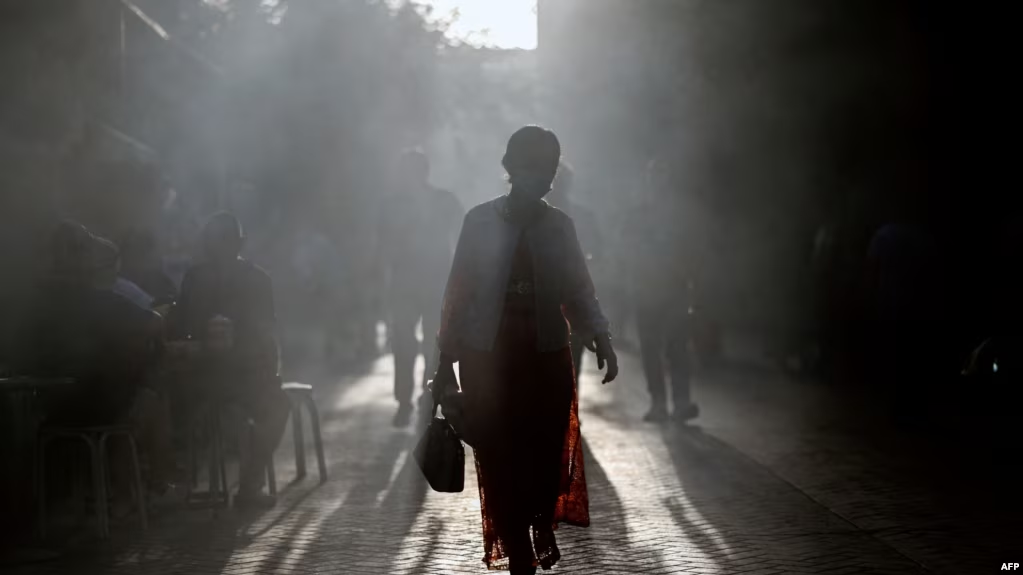
WASHINGTON— Each year, as February arrives, Zubayra Shamseden finds herself gripped by grief and defiance. The first week of the month marks the anniversary of a massacre that took the lives of loved ones nearly three decades ago. But for Shamseden and countless others, the pain is not merely historical. It is an ever-present reminder of the ongoing repression of Uyghurs in China.
“For the past 28 years, every February 5, I have commemorated this day and protested,” Shamseden said in an interview. “The Ghulja massacre in 1997 was the beginning of today’s ongoing genocide of Uyghurs.”
On a cold Wednesday in Washington, Shamseden stood outside the Chinese Embassy, leading a small yet resolute demonstration. She and a dozen activists gathered to remember what they call the Ghulja Massacre, a violent government crackdown on Uyghur demonstrators in China’s far-western region of Xinjiang. The protest was both a tribute to the past and a call for accountability, as Uyghur advocacy groups warn that the brutality of that day foreshadowed the mass detentions and cultural erasure taking place today.
The plight of the Uyghurs has become an international human rights issue, with the United States officially recognizing China’s policies in Xinjiang as genocide. Reports from the United Nations and independent human rights organizations have documented mass incarcerations, forced labor, and severe restrictions on religious and cultural practices.
Beijing, however, denies these allegations. Chinese officials insist that their measures in Xinjiang are aimed at countering extremism and maintaining stability. The Chinese Embassy in Washington, responding to inquiries about the Ghulja protest, dismissed it as a “so-called massacre” and instead described it as a necessary response to violent unrest.
“Xinjiang was once a major area where extremist groups infiltrated and carried out violent terrorist activities,” said Liu Pengyu, a spokesperson for the Chinese Embassy. “China’s policies are in place to counter terrorism and safeguard national security.”
Despite these claims, rights groups argue that China’s repression is systemic and targeted at erasing Uyghur identity. According to the Washington-based Campaign for Uyghurs, the policies that led to the Ghulja Massacre have since escalated into full-scale persecution.
“The Ghulja Massacre was a pivotal moment when the world had an opportunity to recognize China’s trajectory toward mass atrocities—and failed to act,” said Rushan Abbas, the group’s executive director. “Today, as Uyghurs endure genocide, history repeats itself.”
The events of February 5, 1997, began as a peaceful march. Hundreds of young Uyghurs in Ghulja, a city near the Kazakh border, took to the streets demanding religious and cultural freedoms. Their grievances stemmed from government crackdowns on Meshrep, a traditional Uyghur gathering recognized by UNESCO as an intangible cultural heritage.
“These youths marched peacefully, unarmed, asking the government to respect their Islamic religious freedom and Uyghur cultural practices,” said Shamseden, who now serves as Chinese outreach coordinator for the Uyghur Human Rights Project.
Witnesses say the Chinese government responded with disproportionate force. Security forces fired live ammunition into crowds, killing and injuring scores of demonstrators. Many were arrested in the ensuing crackdown, with reports of torture and long prison sentences. Some, like Shamseden’s brother, Sadirdin, and nephew, Hemmat Muhammet, would not survive the ordeal. Another brother, Abdurazzak, was sentenced to life in prison.
According to a 1997 Human Rights Watch report, the government’s response was guided by a classified directive known as “Document No. 7,” which laid out strategies to strengthen state control over Xinjiang. The document called for increased military presence, restrictions on religious practices, and harsh penalties for dissent.
“The Chinese government should release all prisoners, including my brother, who were unjustly imprisoned,” Shamseden said. But nearly three decades later, she still does not know Abdurazzak’s fate.
At the time, the world largely looked away. The late 1990s saw China’s integration into the global economy, and few governments wanted to jeopardize relations over human rights concerns.
Today, the consequences of that inaction are visible across Xinjiang. Reports of forced assimilation programs, mass surveillance, and internment camps have drawn international condemnation. Chinese authorities have been accused of systematically erasing Uyghur heritage, with evidence of destroyed mosques, banned religious practices, and re-education camps where detainees are forced to renounce their cultural identity.
For Shamseden, these measures are not just policy—they are deeply personal. She has spent years searching for answers about her family’s fate. Her brother’s prison sentence was reportedly commuted in 2016, with a release date set for 2036, but she has been unable to verify whether he is still alive.
“My family is just one example,” she said. “There are thousands of Uyghurs who have disappeared into China’s prison system. Their families have no way of knowing if they will ever come home.”
As the world grapples with how to respond to China’s treatment of Uyghurs, Shamseden and others continue their fight for recognition and justice. The Ghulja Massacre, once an overlooked event, is now viewed by many activists as the precursor to an unfolding tragedy.
For those who remember the events of 1997, the wounds have not healed. But their voices, long silenced, are growing louder.
“This is not just about the past,” Shamseden said. “It’s about stopping the atrocities that are still happening today.”