News Desk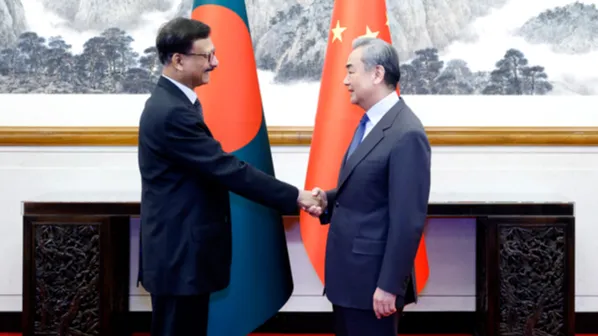
DHAKA — When Bangladesh’s interim Foreign Affairs Adviser Touhid Hossain wrapped up his five-day trip to China last month, ending January 24, the optics were all about deepening ties. A delegation of 22 officials followed this week, underscoring Beijing’s eagerness to cement its influence over Dhaka’s post-Hasina regime. For years, Bangladesh has bankrolled this partnership with billions in military hardware purchases from China — submarines, fighter jets, tanks — betting on cut-rate gear to bolster its defenses. But as the dust settles, a harsh truth emerges: much of this arsenal is plagued by defects, and China’s spare parts pipeline is more mirage than lifeline.
The numbers tell part of the story. Over the past decade, Bangladesh has sunk roughly $2.9 billion into Chinese arms, making Beijing its top supplier — 74 percent of its weapons imports, dwarfing rivals like Russia and India. The haul includes two Ming-class submarines ($203 million), F-7 fighter jets, K-8W training aircraft, and MBT-2000 tanks from China’s North Industries Corporation (NORINCO). On paper, it’s a bargain: cheaper than Western alternatives, no pesky human rights strings attached. In practice, it’s a mess. The Bangladesh Air Force has flagged F-7 jets for technical glitches and inaccurate radars, while K-8W planes struggled to fire ammunition soon after delivery in 2020. The navy’s Type 053H3 frigates — BNS Umar Farooq and Abu Ubaidah — arrived in 2020 with faulty navigation and gun systems. Even the submarines, hailed as a strategic coup, turned out to be refurbished relics, barely seaworthy.
Spare parts? That’s where the real sting lies. NORINCO has stumbled in supplying components for tank maintenance, leaving Bangladesh’s army scrambling. When the navy’s BNS Nirmul warship reported issues with its C704 system, China Vanguard Industry Co. offered an upgrade — for a price. Two frigates needed repairs shortly after docking, and Chinese firms demanded extra cash to fix their own shoddy work. A 2023 RAND Corporation report nailed it: Bangladesh lacks the trained personnel to troubleshoot these breakdowns, and China’s after-sales support is a ghost town. The result? A military limping along on half-functional gear, draining its $3.8 billion defense budget to patch up Beijing’s hand-me-downs.
Dhaka’s leaders aren’t blind to this. Complaints have piled up — faulty corvettes, dud tank ammo rejected in 2022, a Type-59G tank reportedly wrecked during testing last year. Yet, the interim government keeps doubling down, lured by China’s strategic opportunism and a souring rift with India. It’s a reckless choice. “You’re buying cheap, but you’re paying twice,” said Imtiaz Ahmed, a Dhaka University professor. “The hardware’s unreliable, and the spares are a chokehold.” Contrast this with Sri Lanka, where China’s largesse morphed into a debt trap; Bangladesh risks a similar bind — except its collateral is a rusting navy and a grounded air force.
Why stick with it? Politics and price. China doesn’t care about Dhaka’s domestic chaos or its 10% inflation woes — it just wants a foothold in the Bay of Bengal. Bangladesh, meanwhile, gets a patron to offset India’s sway. But functionality matters more than geopolitics when your jets can’t fly straight. The interim regime’s silence on these failures — Hossain didn’t even broach the Brahmaputra dam, let alone hardware woes — smacks of denial or desperation. Either way, Bangladesh is learning the hard way: China’s arms come cheap, but the cost of keeping them running could break the bank.