News Desk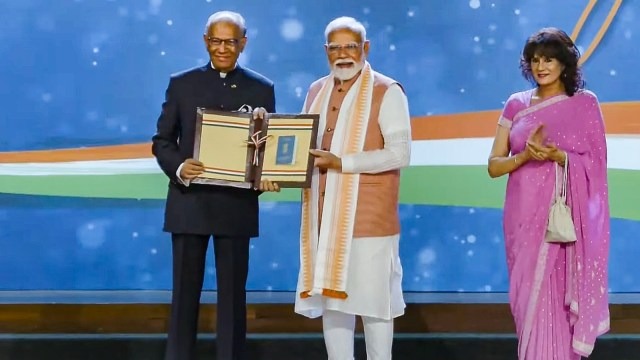
NEW DELHI — For millions of people of Indian origin scattered across the globe, the Overseas Citizen of India (OCI) card is more than a document. It’s a bridge, a tangible link to a homeland many have never lived in but still call their own. Introduced in 2005 as an innovative experiment in diaspora engagement, the OCI program has grown into a cornerstone of India’s outreach to its 32 million-strong global community, offering a unique blend of privileges that stop just short of full citizenship. And nowhere was its symbolic power more evident than in Mauritius this week, where Prime Minister Narendra Modi handed out OCI cards to the island nation’s top leaders, cementing ties with a country where nearly 70 percent of the population traces its roots to India.
The OCI card, a brainchild of India’s Ministry of External Affairs, emerged from a decades-long demand by the Indian diaspora for recognition of their heritage. Unlike traditional citizenship, it doesn’t grant voting rights or the ability to hold public office, but it offers something equally coveted: the right to live, work, and study in India indefinitely, coupled with visa-free travel and parity with non-resident Indians in economic and educational spheres. For a nation that once grappled with a “brain drain” as professionals emigrated en masse, the OCI program is a way to say, “You may have left, but you’re still ours.”
The origins of the OCI scheme trace back to August 2005, when India amended its Citizenship Act to merge the earlier Persons of Indian Origin (PIO) card with a more robust framework. Eligibility was broad but precise: anyone who was a citizen of India on or after January 26, 1950 (the day the Indian Constitution took effect), or who was eligible to become one, could apply, along with their descendants up to the fourth generation. Spouses of Indian citizens or OCI cardholders, married for at least two years, were later included. Citizens of Pakistan, Bangladesh, or other nations specified by the government were excluded, a nod to India’s fraught regional history.
For holders, the benefits are practical and profound. An OCI cardholder can open a business in Mumbai, enroll their child in a Delhi university, or visit the Taj Mahal without the bureaucratic hassle of visas or registration with local authorities—a requirement for most foreigners staying longer than 180 days. They enjoy the same entry fees as Indian nationals at national monuments and wildlife sanctuaries, a small but symbolic perk.
Yet, the card comes with limits: OCI holders cannot vote, run for office, or buy agricultural land, preserving a distinction between overseas loyalty and domestic sovereignty.
Since its inception, over 4 million OCI cards have been issued worldwide, with significant uptake in countries like the United States, the United Kingdom, and Australia—home to large Indian diasporas. But it’s in places like Mauritius, a speck in the Indian Ocean with outsized ties to India, where the card’s emotional and diplomatic resonance shines.
On Tuesday, March 11, Mr. Modi stood before a crowd of more than 3,500 people in Port Louis, Mauritius’ capital, and announced a gesture that drew cheers: the issuance of OCI cards to Mauritian Prime Minister Navinchandra Ramgoolam and his wife, Veena Ramgoolam.
Earlier that day, during the first leg of his two-day state visit, he had presented cards to Mauritius’ President Dharambeer Gokhool and First Lady Vrinda Gokhool. The moment was more than ceremonial—it was a reaffirmation of a bond forged by history and nurtured by strategy.
Mauritius, with a population of 1.3 million, is a diaspora success story. Nearly 70 percent of its people are of Indian descent, many tracing their lineage to indentured laborers brought by the British in the 19th century to work sugarcane fields. Today, the island is home to 22,188 Indian nationals and 13,198 OCI cardholders, a testament to its enduring connection to India.
Last year, during President Droupadi Murmu’s visit in March 2024, India expanded OCI eligibility for Mauritians to the seventh generation of Indian lineage—a move hailed as a “game-changer” by community leaders. Mr. Modi’s decision to personally hand cards to Mauritius’ leaders took that commitment a step further.
“This is not just an honor for me, but for the 1.4 billion people of India,” Mr. Modi said at the community event, flanked by Mauritian officials and diaspora members waving Indian flags.
The visit is packed with diplomatic heft: the signing of eight Memorandums of Understanding on maritime security, culture, and development, and the inauguration of 23 India-funded projects, from hospitals to housing.
Mr. Ramgoolam, in turn, bestowed upon Mr. Modi the Grand Commander of the Order of the Star and Key of the Indian Ocean, Mauritius’ highest civilian honor, making him the first Indian recipient and the fifth foreign dignitary to receive it since the nation became a republic in 1992.
The OCI card’s rollout in Mauritius isn’t just about sentiment—it’s geopolitics. India has long viewed the Indian Ocean as its backyard, a region where it jostles with China for influence. Mauritius, strategically perched along key shipping lanes, is a linchpin in India’s SAGAR (Security and Growth for All in the Region) initiative, launched by Mr. Modi in 2015.
By deepening ties with Port Louis—through OCI cards, $100 million in credit lines, or vaccine aid during the Covid-19 pandemic—India bolsters its soft power while countering Beijing’s Belt and Road ambitions.
For Mauritians, the OCI card opens doors. Since 2004, the island has offered visa-free entry to Indian tourists for up to 30 days; India reciprocates with gratis visas for Mauritians. The card takes this exchange further, allowing holders to tap into India’s booming economy—projected to be the world’s third-largest by 2030—or pursue education at institutions like the Indian Institutes of Technology. “It’s a pleasant surprise for me and my wife,” Mr. Ramgoolam said, clutching his new card, a sentiment echoed by diaspora members who see it as a dual identity made official.
Back in India, the OCI program continues to evolve. Critics argue it’s a halfway measure—lacking the full rights of citizenship yet demanding loyalty to a nation some holders barely know. Others point to logistical hiccups: cards must be reissued when holders turn 20 or 50 to update biometric data, a process that can snarl in red tape. Yet, for many, the card’s value transcends practicality. “It’s about belonging,” said Priya Patel, an OCI holder in New Jersey whose grandparents emigrated from Gujarat. “I can’t vote in India, but I can walk its streets as one of its own.”
As Mr. Modi’s plane prepares to depart Mauritius on today, carrying the weight of another diplomatic win—his 21st international honor—the OCI card stands as a quiet triumph of India’s global vision. From Port Louis to London, it’s a reminder that identity, like the ocean between India and Mauritius, can stretch vast distances yet remain unbroken.