 News Desk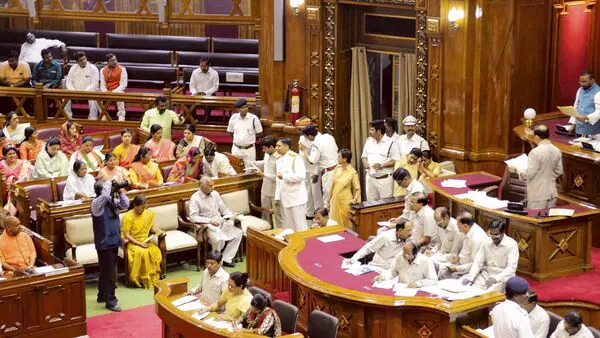
NEW DELHI — Picture this: a Mumbai politician lounging in a sea of riches worth $405 million, while a lawmaker from West Bengal scrapes by on a mere $20. That’s the jaw-dropping divide laid bare in a new report from the Association for Democratic Reforms (ADR), peeling back the curtain on India’s wealthiest and poorest elected officials. It’s a story of opulence and austerity, where the nation’s state assemblies reveal a financial chasm as wide as the subcontinent itself.
At the top of the heap sits Parag Shah, a Bharatiya Janata Party (BJP) MLA from Mumbai’s Ghatkopar East. His fortune? A staggering 3,400 crore rupees — that’s $405 million USD — making him India’s richest legislator. Hot on his heels is Congress heavyweight DK Shivakumar, who rules the roost in Karnataka’s Kanakapura with assets topping 1,413 crore rupees, or $168 million. These aren’t just numbers; they’re empires built from real estate, business ventures, and political clout, dwarfing the wildest dreams of most Indians.
The ADR’s deep dive into self-sworn affidavits — filed by MLAs before their latest elections — paints a vivid portrait of India’s political elite. Spanning 4,092 lawmakers across 28 states and three Union Territories, the report skips only a handful whose paperwork was too blurry to read or whose seats sit empty. What it uncovers is a pecking order of power and privilege, with some states emerging as veritable gold mines of legislative wealth.
Take Andhra Pradesh, a southern dynamo that boasts four of the top 10 richest MLAs — and seven in the top 20.
Chandrababu Naidu, the state’s chief minister, clocks in at 931 crore rupees ($111 million), while his predecessor, YS Jagan Mohan Reddy, trails with 757 crore ($90 million). Then there’s P Narayana and V Prashanthi Reddy, both from the Telugu Desam Party (TDP), raking in 824 crore ($98 million) and 716 crore ($85 million), respectively. Add in IT Minister Nara Lokesh and Hindupur’s N. Balakrishna, and Andhra’s lawmakers look more like tycoons than public servants.
Karnataka, not to be outdone, flexes its own muscle. Beyond Shivakumar, there’s KH Puttaswamy Gowda, an independent with 1,267 crore ($151 million), and Congress’s Priyakrishna with 1,156 crore ($138 million). Collectively, its 223 MLAs hoard 14,179 crore rupees — $1.69 billion — the highest stash of any state.
Maharashtra follows with 12,424 crore ($1.48 billion) across 286 members, while Andhra’s 174 MLAs hold 11,323 crore ($1.35 billion).

These figures aren’t just impressive; they outstrip the annual budgets of entire states like Nagaland, Tripura, and Meghalaya combined, which limp along at $2.76 billion together.
But for every gilded MLA, there’s a stark counterpoint. Meet Nirmal Kumar Dhara, a BJP representative from West Bengal’s Indus, whose declared assets total a paltry 1,700 rupees — about $20. It’s a sum so small you could spend it on a single meal in Mumbai’s swankier neighborhoods.
States like Tripura (60 MLAs, 90 crore rupees, or $10.7 million), Manipur (59 MLAs, 222 crore, or $26.4 million), and Puducherry (30 MLAs, 297 crore, or $35.4 million) anchor the bottom, their lawmakers’ wallets a whisper compared to the southern giants.
The averages tell a tale of their own. Andhra Pradesh MLAs enjoy a cushy $7.75 million each, with Karnataka close behind at $7.57 million and Maharashtra at $5.17 million.
Flip the map north, and Tripura’s lawmakers average just $179,000, West Bengal’s $333,000, and Kerala’s $373,000. It’s a gradient of wealth that mirrors India’s broader disparities — dazzling prosperity in some corners, grinding modesty in others.
All told, the 4,092 MLAs command a collective fortune of 73,348 crore rupees — $8.73 billion USD — enough to make small nations blush. For context, that’s more than the combined 2023-24 budgets of Nagaland ($2.75 billion), Tripura ($3.2 billion), and Meghalaya ($2.62 billion). It’s a staggering haul, and it raises a question that hangs heavy over India’s democracy: when the people’s representatives amass wealth on this scale, who are they really serving?
In the corridors of power, from Mumbai’s bustling streets to Manipur’s misty hills, the ADR report is a spotlight on a fractured reality. Shah and Shivakumar might share the same title as Dhara — MLA — but their worlds couldn’t be further apart. One man’s pocket change is another’s kingdom, and in India’s statehouses, that divide is as real as it gets.