News Desk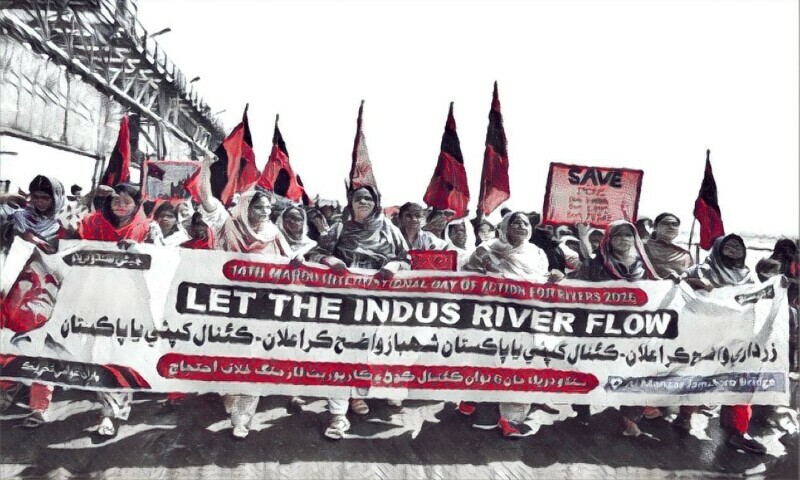
JAMSHORO, Pakistan — On March 4, the Indus Highway pulsed with defiance. Saqlain Sindhi’s voice cut through the clamor of students and farmers, raw and unyielding. “They’re robbing our river!” he roared, rallying a crowd furious over Pakistan’s latest scheme to siphon the Indus River’s lifeblood.
As head of the Jeay Sindh Students Federation, he’s long fought Islamabad’s neglect, but this time it’s personal. “The Green Pakistan Initiative isn’t progress—it’s an attack on our survival,” he said, eyes blazing with the stakes: Sindh’s land, its future, its soul.
The trouble erupted weeks after Punjab’s elite—Chief Minister Maryam Nawaz and army boss Gen. Asim Munir—kicked off the Cholistan project on February 15, a glitzy affair touting canals to turn desert into farmland.
Pakistan’s government calls it a food-security win, funneling $25 billion USD (211.34 billion rupees) to irrigate 1.2 million acres in Punjab’s south. But in Sindh, it’s a betrayal. The Indus, their artery, can’t spare a drop—not when dams are drying and the delta’s gasping in the rising heat. Protesters hit the streets in Jamshoro, thousands strong, only to meet batons and tear gas as police turned a peaceful stand into a war zone.
Sindh’s case is stark. The Sukkur Barrage waters 8.2 million acres across 5,800 kilometers of canals—vital for a province that feeds Pakistan’s breadbasket. Yet the Green Initiative’s six new canals threaten to choke it, pulling water Punjab’s way. “Our economy’s agriculture,” said Diljan Laghari, a federation vice-president, voice tight with worry. “No water, no life—we won’t let them take it.”
Sindh’s leaders, from caretaker chief Maqbool Baqar to current boss Syed Murad Ali Shah, have screamed foul, citing the 1991 Water Accord. They’ve hauled it to the Council of Common Interests, but Pakistan’s rulers keep stalling.
The numbers don’t lie—Pakistan’s water math is a mess. The Indus Delta’s flow has crashed from 40.69 million acre-feet decades ago to 14.035 now. Mangla Dam’s dead, Tarbela’s teetering at 1,405 feet, and Chashma’s an inch from empty.
Environmentalist Zulfikar Ali Bhutto Jr. puts it blunt: “They’re draining 20,000 cusecs when we’ve got 18,000 left—we’re in the red.”
Naseer Memon, a climate expert, piles on: “Cholistan needs triple what Guddu Barrage can give—where’s the water coming from?” Pakistan’s bosses shrug, banking on India’s Sutlej scraps, but that river’s a ghost, forcing them to pump from elsewhere—a desperate, doomed fix.
For Sindh, it’s more than crops at risk—it’s everything. Karachi’s 85 percent hooked to the Indus via Keenjhar Lake; Hyderabad and Sukkur drink straight from the river.
Less flow means more poison—Hyderabad’s water’s already at 790 milligrams of junk per liter, way past safe. A 2004 outbreak killed 55 there; another’s brewing.
The delta’s dying too—seawater’s salting fields, mangroves are fading, and the Indus River dolphin, a global rarity, faces oblivion. “This is cultural genocide,” Bhutto Jr. spat, calling the river “Maa”—mother—to Sindhis.
Pakistan’s pitch—corporate farming for profit—stinks of greed. Zulfikar Jr. sees through it:
“They’re kicking farmers off for cash crops to China and Saudi Arabia—not for us.” With $6 billion dangled from Gulf states, Islamabad’s eyeing 1.5 million new acres while 18 million in Sindh lie fallow, starved of water diverted north. Critics like Dr. Riaz Shaikh smell a land grab masked as development—next come highways and villas, not bread.
Hammad Naqi Khan of WWF-Pakistan nails it: “Elite capture’s the game—profit over people.”
India, watching from across the border, handles its rivers smarter—same land, better yields. Pakistan? It’s a federation fraying. Sindh’s assembly just voted to halt the canals, but Islamabad’s deaf.
Protests swell daily—strikes, riots, rage—and the mainstream barely blinks. “This isn’t Punjab versus Sindh,” Zulfikar Jr. insists. “It’s the powerful screwing the powerless.”