News Desk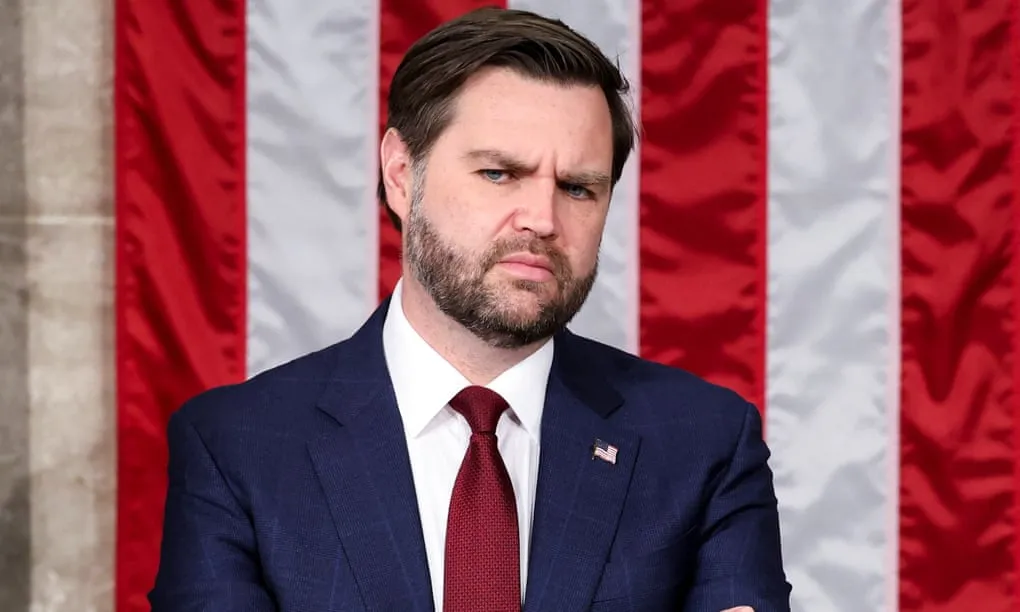
NEW DELHI — As Vice President JD Vance stepped off Air Force Two in New Delhi, he carried the weight of a high-stakes mission: to cement a trade deal with India amid a bruising tariff war with China. Accompanied by his wife, Usha, an Indian-American, and their three children, Vance’s four-day visit was meant to blend diplomacy with personal resonance, a nod to Usha’s Telugu roots. But in the churn of global politics and digital culture, an unlikely subplot emerged—one involving eyeliner, online mockery, and the cultural currents that bind and divide.
The story began some weeks ago, when AI-generated memes targeting Vance’s appearance flooded social media. The images, which exaggerated his eyeliner into dramatic, kohl-like strokes, were gleefully shared across platforms like X, where they were dubbed “devastating” by some commentators.
As Vance arrived in India, the memes had resurfaced with a vengeance. Analysts pointed to China, smarting from U.S. tariffs championed by Vance and President Trump, as a likely amplifier of the trolling. The goal? To embarrass a key American figure at a delicate moment in geopolitics.
In India, the memes landed differently. Here, kohl—known as soorma or kajal—is no mere cosmetic. For centuries, it has adorned the eyes of men, women, and children, valued for its aesthetic allure and supposed medicinal properties. To many Indians, the caricature of Vance’s “eyeliner” was less a scandal than a cultural misfire.
On X, users pushed back with humor and pride: “JD Vance with kajal? He’s just channeling desi vibes,” one post read. Another quipped, “China’s trolling him with soorma memes while he’s in India. They didn’t read the room—kajal’s a tradition here.”
Vance’s visit, which began on April 21, was tightly packed with diplomatic engagements. In meetings with Prime Minister Narendra Modi, issues of bilateral trade agreement to shield India from new U.S. tariffs, a move aimed at countering China’s economic influence will be highlighted. Beijing, in turn, warned of “countermeasures,” casting a shadow over the talks. Yet the Vances’ itinerary also included cultural stops—Jaipur’s Amber Fort, Agra’s Taj Mahal—designed to connect their children to their mother’s heritage.
The eyeliner saga, trivial as it seemed, underscored the broader collision of cultures and agendas. For Vance, whose political rise has leaned on a populist, America-first ethos, the memes were a distraction from his mission to strengthen ties with a key ally. For India, they highlighted a disconnect in how its traditions are perceived abroad. And for China, they offered a low-cost way to needle a rival, even if the jab missed its mark in Delhi’s cultural context. The memes, meanwhile, continued to circulate, a digital sideshow to the real stakes.
Back on X, the conversation rolled on. “Vance in India, owning the kajal memes,” one user wrote. “China tried to troll, but India’s got his back.” In a world of trade wars and digital barbs, it was a fleeting moment of cultural clarity—one that proved, perhaps, that a well-lined eye can see beyond the noise.