News Desk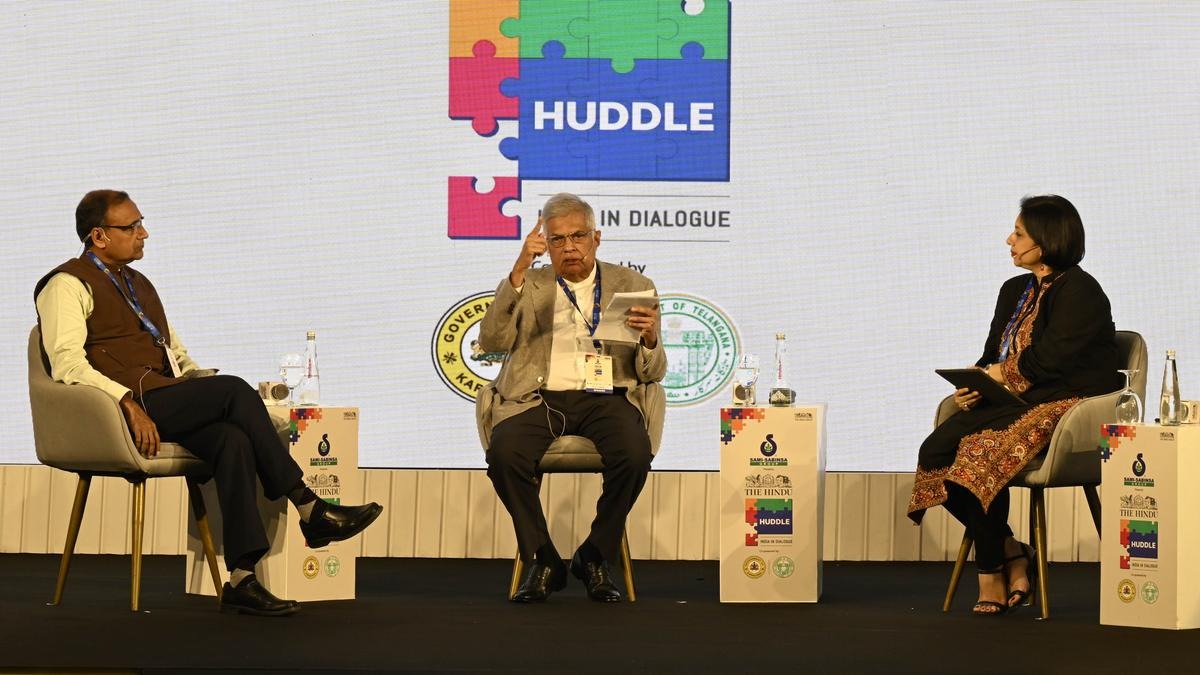
BENGALURU, India — In a world increasingly defined by shifting alliances and regional power blocs, a bold vision for South Asia’s ascendancy emerged at The Hindu Huddle 2025, an annual summit hosted by The Hindu Group. Former Sri Lankan President and Prime Minister Ranil Wickremesinghe, speaking at a session titled “In the Hood: The New Forces Shaping Subcontinental Geopolitics,” urged India to take the helm in transforming South Asia into the world’s most powerful region. His remarks, delivered with the gravitas of a seasoned statesman, underscored India’s potential to lead not just its immediate neighbors but the broader Global South, positioning the country as a linchpin in the emerging world order.
Wickremesinghe’s proposal is rooted in the region’s staggering demographic and economic weight. South Asia, home to 2.7 billion people in a global population of 9.8 billion, is a demographic powerhouse. Its combined economy, projected to reach $43 trillion, rivals the scale of global giants. Yet, what binds the region, Wickremesinghe argued, transcends mere numbers. Shared threads of religion, culture, civilization, literature, and philosophy weave South Asia into a tapestry richer than the British Commonwealth, with India as its natural leader. “Regionalism is the future,” he declared, envisioning a South Asian bloc that could redefine global influence.
For India, this call to leadership comes at a pivotal moment. Under Prime Minister Narendra Modi, the country has already flexed its diplomatic muscle, championing initiatives like the International Solar Alliance and positioning itself as a voice for the Global South at forums like the G20. India’s economic rise, coupled with its cultural soft power and technological prowess, makes it uniquely suited to galvanize South Asia. From the bustling tech hubs of Bengaluru to the vibrant markets of Dhaka, the region pulses with potential, yet it remains fragmented by historical rivalries and uneven development.
Wickremesinghe’s vision is not without challenges. India’s recent diplomatic overtures—such as its “Neighborhood First” policy and investments in connectivity projects like the India-Myanmar-Thailand trilateral highway—signal a commitment to collective progress. By fostering trade, infrastructure, and cultural exchange, India could transform South Asia into a cohesive force, much as the European Union did for its member states.
The significance of India’s potential leadership extends beyond South Asia. As the Global South seeks to assert itself against the backdrop of a multipolar world, India’s role as a democratic, pluralistic powerhouse offers a counterpoint to authoritarian models of development. Its ability to navigate tensions between Western powers and rising economies like China positions it as a bridge-builder, capable of advocating for equitable global governance. At The Hindu Huddle, Wickremesinghe’s remarks resonated with an audience eager for a narrative of empowerment, one where South Asia, led by India, emerges as a beacon of innovation and resilience.
India’s path forward will require deft diplomacy and inclusive growth. By prioritizing regional cooperation—through platforms like SAARC or new frameworks—it can harness South Asia’s collective strengths. Investments in education, renewable energy, and digital infrastructure could unlock the region’s potential, creating a model for the Global South. As Wickremesinghe’s speech made clear, the opportunity is immense, and India, with its rich history and dynamic present, is poised to seize it.
In Bengaluru, a city that embodies India’s global ambitions, the call for South Asian unity struck a chord. If India embraces this mantle, it could not only reshape its neighborhood but also redefine the Global South’s place in the world. The future, as Wickremesinghe envisions it, is one where South Asia, under India’s leadership, stands as a testament to the power of shared dreams and collective action.