News Desk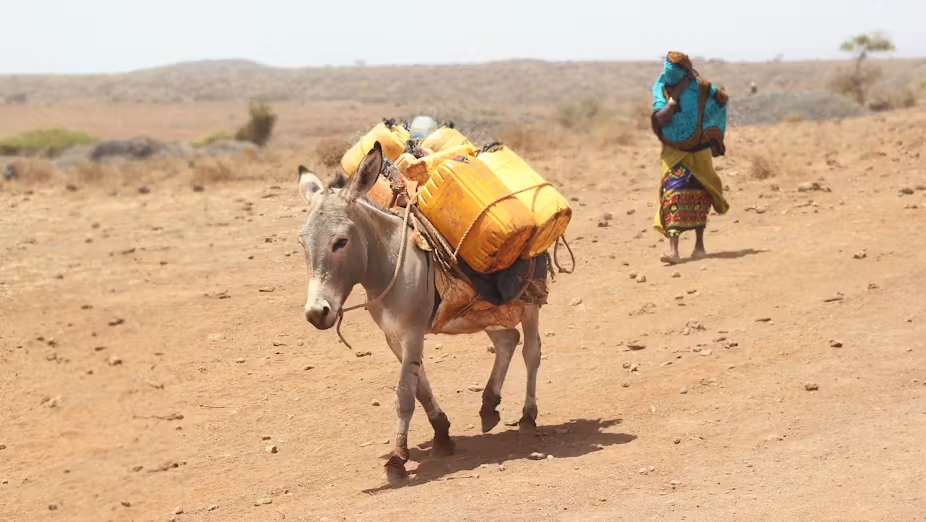
Donkeys, domesticated in Africa 5,000 years ago, remain vital to 500 million marginalized people worldwide, with Pakistan hosting 5.9 million working donkeys, one of the largest populations globally, behind Ethiopia and Sudan. These animals are indispensable in industries like brick kilns, agriculture, waste collection, and transport, supporting an estimated 36 million Pakistanis. A single donkey can generate 1,000 to 4,000 rupees daily, depending on the task, sustaining families. But this lifeline is under threat as China’s ejiao industry—a gelatin derived from donkey hides used in traditional Chinese medicine—drives up demand and prices, reshaping Pakistan’s donkey economy.
Ejiao, a 3,000-year-old tonic from Shandong province, is prized for its purported anti-fatigue, immune-boosting, and blood-enhancing properties, particularly for women with blood deficiency syndrome, a condition distinct from anemia in traditional Chinese medicine. A 2021 study in Frontiers in Pharmacology found ejiao alleviated dizziness and improved blood metrics in 187 female patients out of 220 studied, reinforcing its cultural appeal. Its popularity surged globally after product placements in the 2011 Chinese TV series Empresses in the Palace, with the United States alone importing $12 million in ejiao annually, according to the Animal Welfare Institute. But this demand comes at a cost: China’s donkey population has plummeted 80 percent since 1990, from 5.6 million to 860,000 by 2022, forcing reliance on foreign suppliers like Pakistan.
Pakistan’s proximity to China and close diplomatic ties, cemented by trade agreements and the China-Pakistan Economic Corridor, make it a prime target. In 2023, Pakistan exported 157,094 equine and bovine hides to China, per China’s General Administration of Customs, and became a top supplier in 2024 after the African Union banned donkey skin exports. This shift followed a devastating trade that saw African donkeys—two-thirds of the global population—slaughtered en masse, disrupting poor households. “Donkeys are critical for water transport and labor in remote African villages,” says Dr. Lauren Johnston, a China-Africa expert at the University of Sydney. “Their loss forced children out of school to fetch water, deepening poverty.”
In Pakistan, the donkey trade is a double-edged sword. In April 2025, Federal Minister Rana Tanveer Hussain welcomed Chinese interest in establishing donkey farms, citing economic benefits like job creation. Yet, the trade raises ethical and practical concerns. Donkeys reproduce slowly, with a year-long gestation yielding one foal, making mass breeding challenging without depleting local stocks. Dr. Kavesh, director at the South Asia Research Institute, warns that Pakistan lacks the infrastructure for sustainable donkey production, unlike cattle or poultry. “Slaughtering donkeys could disrupt the emotional bonds owners form with these animals, creating an ethical dilemma,” he says. Veterinary experts also highlight risks like zoonotic diseases—tetanus, anthrax—and environmental harm, recalling a 2019 equine influenza outbreak in Nigeria that killed 60,000 donkeys, partly linked to illegal trade.
The trade’s impact is stark in Karachi’s donkey markets, like Lyari and Bhains Colony, where Chinese buyers purchase even unhealthy animals for as little as 800 rupees. “They buy in bulk, no questions asked,” says Majeed, a local seller. This indiscriminate demand threatens the donkey cart racers, a cultural institution in Karachi. Abdul Hussain Pattak, a 62-year-old racer, cherishes his donkeys, Jalebi and Naya Daur, feeding them almonds and milk for races that draw thousands. “I refused 300,000 rupees for my late Dumper,” he says proudly. These races, held weekly across the city, are a source of pride and community, but rising donkey costs could erode this tradition.
Pakistan’s government has oscillated on the trade. A 2015 ban on donkey hide exports, prompted by fears of donkey meat entering local markets (considered inedible in Islamic tradition), was lifted by 2023, with protocols signed to export hides and other products to China. Proposals like the KP-China Sustainable Donkey Development Programme fizzled due to concerns over private Chinese firms exploiting local donkeys. Muhammad Akram, a former animal husbandry commissioner, insists exports via facilities like Gwadar’s slaughterhouse will be tightly controlled, but weak regulations—like the outdated 1890 Prevention of Cruelty to Animals Act with its paltry fines—offer little protection.
Animal welfare advocates, like Sian Edwards of The Donkey Sanctuary, urge awareness and bans to curb exploitation, pointing to alternatives like lab-grown collagen. Yet, ejiao’s cultural weight in China, where it’s seen as a “rich placebo,” per Dr. Johnston, makes such shifts unlikely. A 2024 petition with 370,000 signatures failed to stop ejiao sales on Amazon, where products linger with low engagement. Cellular agriculture, while promising, remains nascent and may not satisfy traditionalists.
For millions, the donkey is more than a commodity—it’s a partner in survival. As China’s demand pulls Pakistan deeper into the ejiao trade, the risk grows that these families will lose their lifeline. Without robust protections and sustainable breeding, Pakistan’s donkey population could follow China’s into decline, leaving laborers stranded. The economics of the donkey business, once a humble trade, now teeters on the edge of a global controversy, where cultural heritage and economic gain clash with human and animal welfare.