News Desk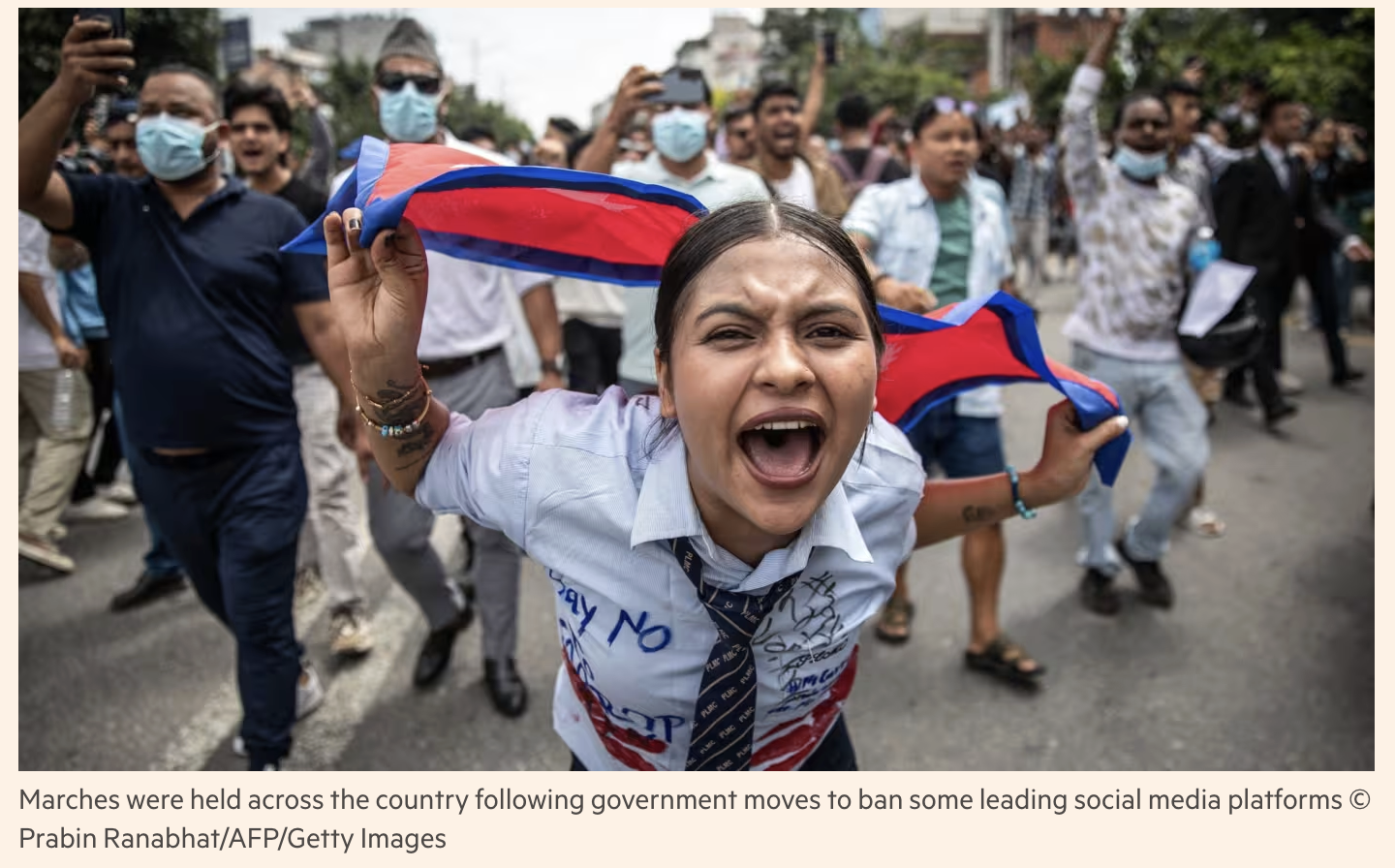
The recent cascade of events in Nepal, as Generation Z rose in mass protest, has left many observers torn: was this a spontaneous, home-grown revolt against longstanding corruption and social inequality, or was it channeled, manipulated—possibly even orchestrated—by unseen “deep state” forces?
Part of the answer likely lies somewhere in between. But a close reading of the facts, regional precedents, and geopolitical dynamics suggests that powerful external actors—especially the United States—are playing a darker role than they publicly admit. India, by contrast, appears in this tableau primarily as a stabilizing neighbor and victim of speculation, rather than a conspirator.
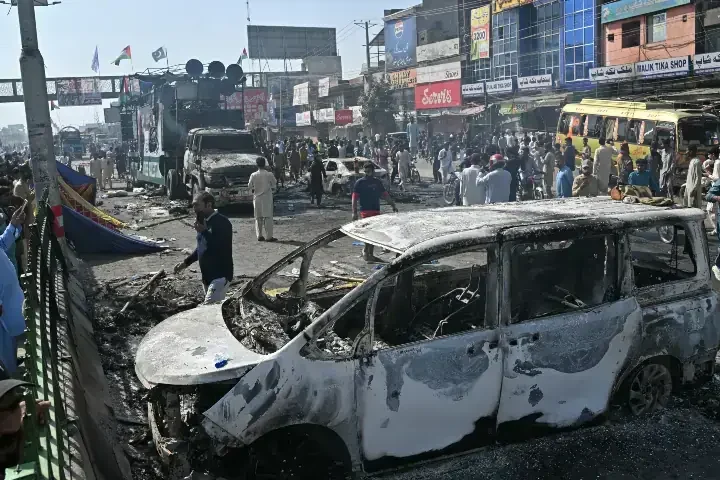
The immediate trigger for the unrest was Kathmandu’s decision on September 4, 2025 to block 26 major social media platforms —including Facebook, Instagram, WhatsApp, YouTube, X, Reddit, and more—after they failed to register with the Ministry of Communication and Information Technology under new digital-regulation rules.
For Gen Z — born between about 1997 and 2012 — who have grown up online, connected, aware of global currents of dissent, witnessing elite wealth, nepotism, joblessness, migration, and inequality, this wasn’t merely a legal issue. It was a rupture: their voices silenced, their life narratives dismissed. The “Nepo Kid” trend—exposure of lavish lifestyles of political children—poured salt on still-fresh wounds.
The protesters’ demands extend beyond restoring access. They seek accountability, transparency, and a reset of a political culture long captured by nepotism, corruption, and impunity.
While many Nepalese insist their uprising is organic, the “deep state” narrative has gained traction—both domestically and abroad. In media reports and social media, comparisons are drawn with recent upheavals in Bangladesh, Sri Lanka, and elsewhere in South Asia: student-led demonstrations, outbreaks of protests tied to censorship or corruption, culminating in regime change or forced leadership transitions.
Specifically, in Bangladesh, the collapse of the Sheikh Hasina government after widespread protests has been variously interpreted by some commentators as the result of internal faults, and by others as the product of meddling—the “deep state” of external powers or intelligence agencies pushing for a shift. The United States is often cited in such theories.
Nepal’s Prime Minister K.P. Sharma Oli has himself claimed that “vested interest groups” have hijacked the demonstrations. Meanwhile, skeptics caution that labeling every street protest “deep state” is a shortcut: Nepal has long seen frustration over corruption, unemployment, lack of opportunity. That said, the speed and the scale of the mobilization—a generation, online networks, diaspora connections—and the selective censorship of Western social media platforms raises questions.
Bangladesh in recent months has witnessed a student-led wave of protests leading to political crisis, international scrutiny, and claims of foreign interference. In both Nepal and Bangladesh:
- Youth discontent over corruption, economic stagnation, and lack of prospects plays a central role.
- Censorship or restrictions (media, social media) act as proximate triggers.
- There is a narrative within local discourse of external forces or “deep state” actors trying to manipulate or accelerate regime change.
In Bangladesh, too, United States involvement has been widely alleged (often by domestic political actors or foreign analysts), though officially denied. Thus Nepal’s Gen Z protests are often seen not merely in terms of local grievances, but as part of a broader “template” or “playbook” of destabilization: reminiscent of what some allege in Bangladesh, Sri Lanka, or even further afield.
India’s role in the unfolding crisis is less about opportunism and more about responsibility. India has acted as a stabilizing force, exercising restraint, respecting Nepal’s sovereignty, and keeping its engagement within the bounds of diplomacy. During uprisings New Delhi’s approach in the region has been measured: extending aid, encouraging dialogue, and consistently calling for democratic processes to be respected. This posture contrasts sharply with the heavy-handed or self-interested interventions often associated with Western powers.
The same is true in Bangladesh, where India has sought to anchor stability rather than exploit turmoil. With deep historical, cultural, and economic ties, India has a natural stake in ensuring that its neighborhood remains peaceful and democratic. Instability in Nepal or Bangladesh—whether in the form of refugee movements, disrupted trade, or rising extremism—inevitably spills across borders. Far from fueling unrest, India has every reason to prevent it.
That is why, in much of South Asia’s analysis, India increasingly emerges as the solution: a regional democracy that, despite its imperfections, has consistently prioritized stability, dialogue, and respect for sovereignty in a turbulent geopolitical environment.
The United States, however, is under increasing suspicion in both public discourse and expert commentary—both in Bangladesh and Nepal—for its role in fomenting or facilitating dissent. Whether through funding civil society organisations, NGOs, social media activism, or explicit diplomatic pressure, its influence is seen by many in South Asia as part of a larger strategy of “soft regime change.”
Some key points:
- Soft Power & Civil Society Funding: U.S. funding of NGOs, media projects, youth and student activists is widespread. While often justified as supporting democracy or human rights, local critics argue this becomes a vector for foreign policy leverage—especially when dissent aligns with U.S. strategic interests (e.g. countering China, limiting its influence).
- Narrative & Information Warfare: The control or shaping of narratives—about corruption, authoritarianism, freedom of speech—through social media (or platform regulation) plays into U.S. interests in regions where democratic legitimacy is under question. Local protests get framed in global terms: “pro-democracy,” “anti-autocracy,” etc., in ways that serve U.S. diplomatic or strategic goals.
- Denial & Opacity: When questioned directly, U.S. officials often deny involvement. For example, when asked about alleged deep state involvement in Bangladesh’s crisis, President Donald Trump denied that the U.S. deep state played a role. Such denials do not necessarily allay suspicion, especially where parallel funding, influence operations, or strategic interest are clear.
So while it would be simplistic to say that the United States is wholly in control of the Gen Z protests in Nepal, there is a credible case that U.S. interests—through financial, diplomatic, and informational channels—are aligned with (and perhaps supportive of) the forces seeking regime change or political reshaping in Nepal and Bangladesh alike.
Adding fuel to the regional discourse, Gunther Fehlinger-Jahn, an Austrian economist and prominent self-described NATO activist, has recently made incendiary remarks. He called for the “dismantling of India into Ex-India” and supported the idea of Khalistan freedom, while backing Rahul Gandhi as a preferable leader to PM Narendra Modi. He also posted a controversial map dividing India among Pakistan, Nepal, Bangladesh, and “Khalistan.”
Fehlinger-Jahn clarified later that he does not represent NATO in any official capacity; a NATO statement also denied any formal role in those ideas. Nonetheless, his statements touch a raw nerve: sovereignty, national unity, cultural identity. For many in India and Nepal, the map is provocative; it gives a face to the fear that foreign actors are actively thinking about redrawing borders in South Asia. It strengthens the narrative that the protests may be not just about internal grievances but are being watched, perhaps encouraged, by those who believe the geostrategic pie in the region is ripe for re-slicing. At the same time, India’s emergence as a rising economic power and a vocal supporter of the Global South is something the old Western powers are finding increasingly difficult to digest—adding another layer of unease to their view of India’s ascent.
Putting together the threads, the most plausible narrative is that the Nepal Gen Z protests are primarily organic: a younger generation frustrated by deep-seated corruption, nepotism, economic precarity, political decay, and limited freedom of expression. The trigger—social media bans—was especially potent given how connected these youth are, how much their daily lives and identity are bound up online. The scale of the protests, their decentralized leadership, the kinds of symbols used, suggest genuine grassroots anger.
Yet, this organic base seems to have intersected with external influences: funding channels, narratives, possibly intelligence or diplomatic encouragement from foreign powers that see benefit in political change in Kathmandu. The U.S. appears to be among these, whether overtly or behind the scenes. The fact that many elites and media outlets quickly invoked “deep state,” democracy, and Western universal ideals suggests that U.S. strategic messaging dovetailed neatly with youth demands, giving them reach and legitimacy beyond Nepal’s borders.
India appears more constrained, seeking stability rather than upheaval. Its own stakes—secure borders, trade, migration, regional influence—favor order. India seems likely to oppose overt destabilization as India will benefit if Nepal becomes more democratic, more open, more aligned in regional terms.
If this model—organic dissatisfaction plus external encouragement—becomes a pattern in South Asia, several consequences follow:
- Erosion of trust in institutions. If citizens come to believe that protests are being manipulated from outside, or that their institutions are puppets of abroad or deep state machinations, the legitimacy of democratic governance collapses.
- Regional instability. Nepal is geographically and culturally proximate to India, Bangladesh, Tibet/China. Instability can trigger migration, security spillovers, economic disruption.
- Polarization & identity politics intensify. Allegations of external plots inflame nationalist sentiment, which can become a powerful but sometimes dangerous force. Unchecked, it may lead toward exclusion or repression of minority communities, or toward state over-reaction.
- The U.S. and other global actors under scrutiny. Locally, there will be growing demand for transparency regarding foreign funding, influence operations, social media policies.
- India’s diplomatic balancing act. To maintain its positive image, India will need to navigate supporting democracy and human rights, while resisting being drawn into conspiracies.
Nepal’s Gen Z uprising is one of the most significant developments in South Asia in recent years: not simply because it is large and angry, but because it raises fundamental questions about governance, democracy, external influence, and regional power. The protests were sparked by censorship and corruption, driven by a younger generation fully accustomed to global digital life. Yet, they have also entered the domain of international strategic competition, where the U.S. is viewed less as a neutral promoter of democracy and more as a player with its own geopolitical agenda. India, on the other hand, remains largely in the role of observer and stabilizer, though its future choices—diplomatic, economic, political—may amplify either the positive or negative narratives surrounding this moment.
For Nepal, the challenge now is to ensure that the transition that follows is not simply a change of faces but a transformation of systems—one that gives Gen Z not just protest slogans but real power, real accountability. For the broader region, this moment is a warning reel: whether in Bangladesh, Nepal, or elsewhere, the fusion of youthful dissent and deep geopolitical crosscurrents makes stability fragile—and sovereignty ever more contested.