 News Desk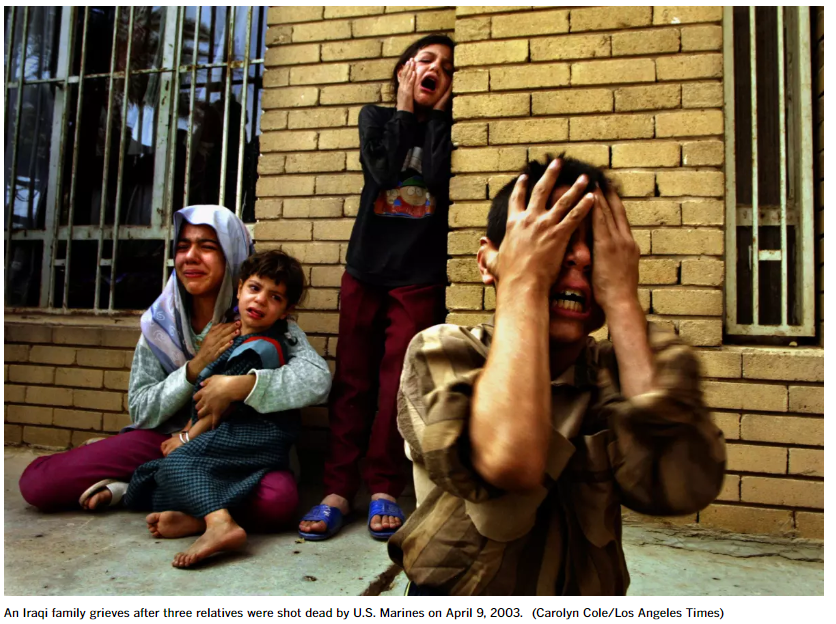
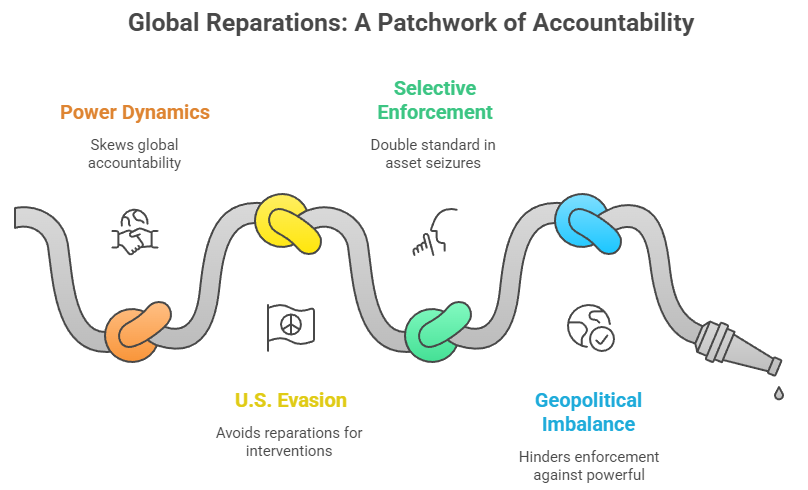
As the world navigates a turbulent geopolitical landscape in 2025, the issue of reparations—financial or material amends for historical wrongs—has resurfaced with renewed urgency. From Iraq’s historic settlement with Kuwait to the United States’ steadfast refusal to compensate nations like Cuba, Iran, and others it has intervened in, the global reparations culture reveals a patchwork of accountability, often skewed by power dynamics. This report, drawing on international law, recent developments, and public discourse examines the obligations and evasions country by country, offering a comprehensive look at a debate that continues to shape international relations.
Iraq and Kuwait: A Model of Resolution
In a rare success story, Iraq finalized its reparations payments to Kuwait on January 13, 2025, marking the end of a 30-year process overseen by the United Nations Compensation Commission (UNCC). The settlement, totalling $52.4 billion, addressed damages from Saddam Hussein’s 1990 invasion and occupation, with 1.5 million of 2.7 million claims deemed valid. Initially facing a potential liability of $352.5 billion, Iraq’s payments—funded through oil revenues and international loans—demonstrate a rare instance of multilateral enforcement.
The UNCC, chaired by Ireland during a special session, praised Iraq’s perseverance despite economic strain, signalling a closure to a chapter that began with the Gulf War. Yet, this success contrasts sharply with Iraq’s own unaddressed claims against the United States for the 2003 invasion, where the U.S. extracted $400 million via the UNCC for American claimants, leaving Iraqi demands for $1 trillion in damages unresolved.
Israel and the Palestinian Authority: A Contentious Stalemate
The Israel-Palestinian reparations dynamic is less about direct payments and more about indirect financial leverage. In February 2025, Palestinian Authority (PA) President Mahmoud Abbas reformed the PA Martyrs Fund, shifting stipends from sentence-based support for families of those killed or imprisoned in conflicts with Israel to a needs-based model. This change aligns with the 2018 U.S. Taylor Force Act, which cut $300 million in annual aid to pressure the PA over payments deemed to support “terrorism.”
Israel, which has received $90 billion from Germany since 1952 for Holocaust survivors and $318 billion (inflation-adjusted) from the U.S. since 1948, faces accusations of benefiting indirectly as the PA reallocates funds. Critics, including Hamas, call it capitulation, while Israeli officials and groups like the Foundation for Defence of Democracies allege covert PA funding persists via the Palestinian postal system.
United States: A Reluctant Debtor
The United States, a global superpower, has consistently avoided reparations for its military interventions, creating a stark asymmetry in the reparations landscape.
- Iraq: Post-2003 invasion, the U.S. has paid no reparations despite Iraqi claims of $1 trillion in damages, including infrastructure destruction and civilian casualties. Instead, the U.S. secured $400 million from Iraq via the UNCC for American nationals and $633 million for corporations like Halliburton, a move critics label as “reparations in reverse.”
- Afghanistan: Since the 2021 Taliban takeover, the U.S. has withheld $3.5 billion of Afghanistan’s foreign reserves, redirecting funds to 9/11 victim compensation. Afghan civil society groups demand repatriation and war damages, but no legal obligation exists as of 2025.
- Iran: The U.S. froze $12 billion in Iranian assets post-1979 revolution, seizing $2 billion in 2018 for so called terrorism-related claims (e.g., 1983 Beirut bombing). The International Court of Justice (ICJ) ruled on March 30, 2023, that the U.S. violated the 1955 Treaty of Amity by freezing commercial assets, though it lacked jurisdiction over the $1.75 billion Bank Markazi case. Iran seeks $50 billion for sanctions damages, but no payments are mandated.
- Cuba: The U.S. pursues $1.9 billion (1972 FCSC figure, now $8 billion adjusted) for nationalized properties post-1959, while Cuba demands $144 billion for embargo damages. The UN General Assembly’s 2024 resolution (187-2) calls for compensation, but the U.S. resists, citing human rights concerns.
- Vietnam: Vietnam seeks reparations for chemical warfare Agent Orange, estimating $300 million annually in healthcare costs, but the 1973 Paris Peace Accords included no such provision. The U.S. has offered $400 million in aid since 2007, falling short of reparative justice.
- Haiti: Though not a direct U.S. obligation, the U.S. supported France’s $21 billion (adjusted) post-1804 indemnity on Haiti. A 2022 U.S. lawsuit targets France, but no U.S. reparations are pending.
- Libya: After Libya paid $4 billion for the 1988 Pan Am 103 bombing, the U.S.-led 2011 NATO intervention caused $60 billion in damages, with no compensation offered.
This pattern reflects a U.S. strategy of leveraging the UN Security Council veto and domestic laws like the Foreign Sovereign Immunities Act (1976) to avoid liability, contrasting with its enforcement of claims against adversaries.
Iran and Libya: Asymmetric Repayments
Iran and Libya illustrate the U.S.’s selective reparations approach. Iran lost $2 billion in 2018, with no reciprocal halt to its alleged terrorism support, while Libya’s $4 billion payment for Pan Am 103 followed its nuclear disarmament. These cases underscore a double standard where asset seizures fund U.S. claimants without addressing underlying grievances, a point raised in ongoing ICJ and UN debates.
The Legal and Cultural Framework
Reparations are governed by a robust legal framework, including the UN Basic Principles (2005), which outline restitution, compensation, rehabilitation, satisfaction, and non-repetition; the ICJ Statute for state disputes; and U.S. laws enabling claims against foreign entities. Historical examples—like Germany’s payments to Israel or Iraq’s to Kuwait—contrast with the U.S.’s evasion, fuelling a reparations culture.
Reparations remain a mirror to power. Iraq’s settlement with Kuwait offers hope, while U.S. refusals to Cuba, Iran, and others expose a geopolitical imbalance. With ICJ cases pending and public discourse intensifying, the question is not just whether reparations are owed, but whether the international community can enforce them against the powerful. For now, the ledger remains unbalanced, a testament to the enduring challenge of justice in a divided world.