News Desk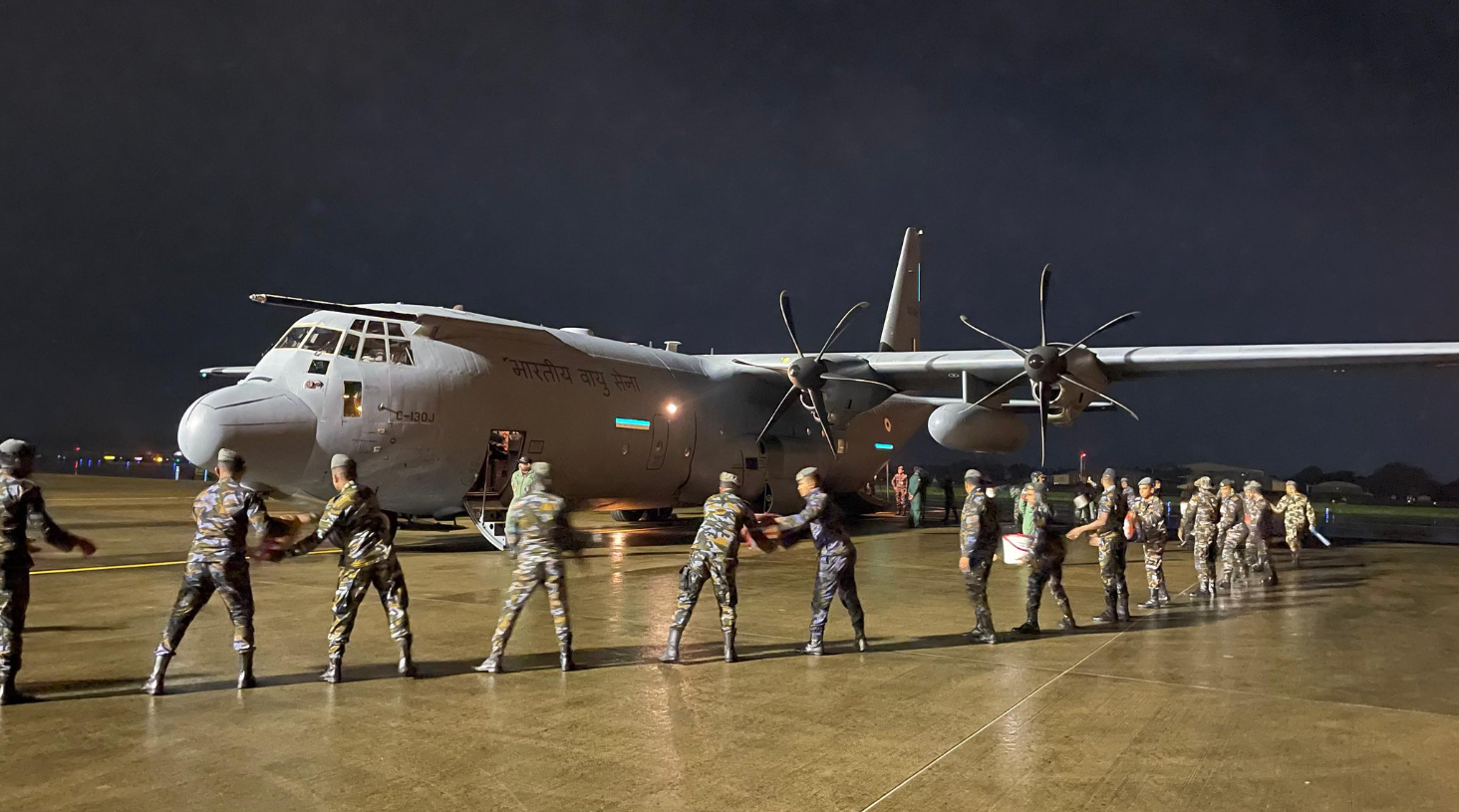
COLOMBO, Sri Lanka — When Cyclone Ditwah tore through Sri Lanka on November 27, leaving nearly 500 dead and more than 360 missing, the devastation was immediate and overwhelming. Roads collapsed, hospitals overflowed, and entire communities were cut off by floodwaters. Into this chaos, India moved quickly, mounting one of its most extensive humanitarian operations in recent years and underscoring its role as South Asia’s first responder.
Under Operation Sagar Bandhu, the Indian Navy and Air Force delivered more than 53 tonnes of emergency supplies — tents, blankets, hygiene kits, medicines, and surgical equipment. Helicopters conducted search-and-rescue missions, airlifting stranded civilians, including pregnant women and infants. A mobile field hospital staffed by 73 medical professionals was flown in aboard an IAF C‑17 Globemaster, while Bailey Bridge systems were dispatched to restore road connectivity in flood‑hit districts.
India’s relief effort extended beyond the central government. The Tamil Nadu state government sent 300 tonnes of food supplies worth USD one million, coordinated with the Indian Navy. Meanwhile, India evacuated more than 2,000 of its citizens and several foreign nationals stranded in Sri Lanka.
India’s contribution has been operational and logistical rather than monetary, reflecting its Neighbourhood First policy. By mobilizing personnel, hospitals, and infrastructure at speed, New Delhi has demonstrated its ambition to be seen not only as a neighbour but as a reliable partner in disaster relief.
Sri Lankan officials have welcomed the assistance. The President’s office noted that India’s medical aid arrived “at a critical time,” while the Indian High Commission in Colombo emphasized that the relief was designed to “augment ongoing humanitarian operations.”
India’s swift response to Cyclone Ditwah is not an isolated act. Over the past two decades, New Delhi has repeatedly positioned itself as a regional stabilizer in times of crisis:
- 2004 Indian Ocean Tsunami: India deployed its Navy to assist Sri Lanka, Maldives, and Indonesia, earning recognition for its ability to project humanitarian power across the region.
- 2015 Nepal Earthquake: Within hours, India launched Operation Maitri, sending rescue teams, medical supplies, and helicopters to Kathmandu, making it the largest foreign relief mission on the ground.
- COVID‑19 Pandemic: India supplied vaccines to neighbours under Vaccine Maitri, reinforcing its image as a health security provider.
- Maldives Floods and Water Crisis: India has repeatedly flown in desalination plants, drinking water, and relief teams, cementing its reputation as the Maldives’ most reliable partner in emergencies.
For India, humanitarian missions are more than gestures of goodwill. They are part of a broader strategy to reinforce its regional leadership and counterbalance other powers, particularly China, which has also pledged aid to Sri Lanka. By acting decisively, India signals that it is not only a neighbour but a security provider in South Asia.
Sri Lanka, facing an estimated $7 billion reconstruction bill, has found reassurance in India’s rapid intervention. For many Sri Lankans, the presence of Indian helicopters, doctors, and engineers is a reminder that in moments of crisis, India arrives first.
India’s relief mission in Sri Lanka reflects a consistent pattern — from tsunamis to earthquakes, pandemics to cyclones — of positioning itself as South Asia’s humanitarian anchor. In Colombo and beyond, the message is clear: when disaster strikes, India is there.