News Desk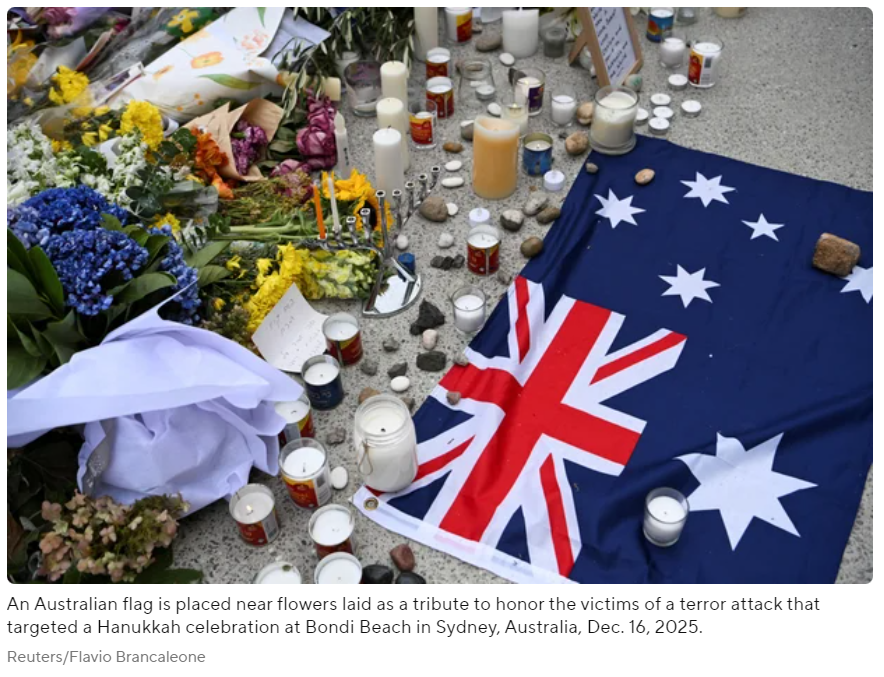
The Bondi Beach attack is, by any reasonable standard, a terrorist attack. A father and son opened fire on families gathered for a Hanukkah celebration, leaving at least 15 people dead and many more injured. Australian authorities have formally classified it as an ISIS‑inspired act of terrorism, citing improvised explosive devices (IEDs), ISIS flags, and recent travel to the Philippines as core indicators.
But when you move beyond the headline and look closely at what has been disclosed – and what has not – a more complicated picture appears. The question is not whether the attack was horrific or whether it qualifies as terrorism. It is: how strong is the specific label “Islamist extremist” in this case – and what is it built on?
This is an attempt to read the Bondi attack critically and carefully, without dismissing the reality of terrorism, and without passively accepting a pre‑packaged narrative.
What we know: the official frame
According to Australian officials and multiple media reports:
- Target: A Hanukkah celebration at Bondi Beach, specifically attended by Jewish Australians.
- Attackers: A father and son, identified as Sajid Akram (50) and his 24‑year‑old son, Naveed.
- Weapons and devices: Firearms used in the shooting; IEDs later found in a vehicle linked to the suspects.
- Symbols: Two homemade ISIS‑style flags found in the suspects’ car.
- Travel: The pair spent most of November in the Philippines, with Davao listed as their destination, in a region where multiple Islamist insurgent and ISIS‑linked groups have historically operated.
- Intelligence background: The younger suspect had previously been probed by ASIO in 2019 over close ties to an ISIS cell, according to Australian reporting.
This is the cluster of facts from which officials derive the classification: ISIS‑inspired Islamist terrorism.
Australian Prime Minister Anthony Albanese has stated the attack was “motivated by ISIS ideology,” and police have repeatedly emphasised the ISIS flags, bombs, and recent foreign travel as primary indicators.
The ISIS flags in the car: symbolism without context
One of the sharpest inconsistencies in the public narrative is the location and context of the ISIS flags.
Reports state that two ISIS‑style flags were recovered from the attackers’ vehicle, alongside IEDs. What has not been reported is any comparable cache of ideological material in their home, bedrooms, or digital lives.
In most well‑documented extremist cases, investigators reveal – sometimes within days:
- Online activity linked to extremist forums or channels
- Encrypted messaging with known radicals
- Downloaded propaganda or lectures
- Notes, drafts, or private writings indicating ideological commitment
So far, none of that has been publicly confirmed in the Bondi case.
This raises reasonable questions that do not undermine the terrorist classification but do interrogate its depth:
- Why are the flags only in the car, and not in their private living spaces?
- Why has there been no public reference to extremist content on their phones, laptops, or social media?
There are plausible, pattern-based explanations:
- Operational secrecy: They might have kept the flags in the car for use during or immediately after the attack.
- Family concealment: They might have been hiding their radicalisation from relatives at home.
- Recent acquisition: The flags could have been obtained close to the time of the attack, not yet integrated into their personal spaces. Then who printed it and from where was it bought?
But these are hypotheses, not evidence. Authorities have not publicly addressed this asymmetry: highly symbolic flags in a car, and silence about any broader ideological ecosystem.
Travel to the Philippines: a pointed detail with missing links
The suspects spent most of November in the Philippines, listing Davao as their destination. This region is historically adjacent to areas where Islamist insurgent groups like the Moro Islamic Liberation Front (MILF), Moro National Liberation Front (MNLF), and Abu Sayyaf have operated, some with historical or residual ties to ISIS.
Australian media, citing security sources, reported that the men underwent “military‑style training” during this trip. However, the public record remains thin.
What we know:
- Duration: They were in the Philippines from early to late November.
- Region: They listed a southern Philippine city associated with proximity to long-running Islamist insurgencies.
- Security narrative: Officials and some analysts frame this as a likely training trip linked to extremist networks.
What we do not know:
- Names or identities of any alleged trainers
- The exact camp or location where training supposedly occurred
- Photographic, video, or documentary evidence
- Surveillance details or intelligence that led to this conclusion
- Whether Philippine authorities intercepted, monitored, or flagged them during the trip
One terrorism researcher quoted by CBS News also warns that connections between foreign visitors and local militant groups in the Philippines are “often overblown,” noting that many of these groups now operate as fragmented networks with limited operational direction from ISIS itself.
So again, the pattern is suggestive: two men, later involved in a terror attack, spend a month in a region with historic Islamist militancy. But travel alone is not proof of radicalisation. Without more transparent evidence, “they travelled to Mindanao” functions more as an indicator than a demonstrated causal link.
The missing story of the gun
In almost every high‑profile terrorist case, one question surfaces early and is often addressed in detail: how did they get the weapon?
In the Bondi case, the public knows that:
- Sajid was reportedly a licensed firearm owner with multiple guns, and weapons used in the attack were recovered by authorities.
But major gaps remain:
- Which specific gun or guns were used in the attack?
- Were they legally owned, illegally acquired, or modified?
- Did any criminal networks supply additional weapons?
- Were financial transactions – debit cards, cash withdrawals, transfers – linked to weapon purchases?
These details matter because they help distinguish between:
- A long‑time legal gun owner who radicalised and used what he already had
- A person who actively entered a weapons pipeline associated with extremist or criminal networks
The silence here is striking. It might be operational – authorities often hold back information while investigating suppliers – but the absence of even a basic outline leaves a key part of the radicalisation and preparation story untold.
If the attack is framed as part of an “ISIS‑inspired” plot, understanding the gun’s path becomes crucial to mapping any broader network beyond the attackers themselves.
“Military‑style training”: a claim waiting for detail
Reports that the attackers received “military‑style training” in the Philippines come from unnamed security sources, amplified through media. That phrase is powerful – it signals seriousness, organisation, and a higher level of threat.
But so far, what is missing is everything that would turn that phrase from narrative into documented fact:
- The type of training (weapons handling, explosives, tactics, ideology)
- The group or individuals who provided it
- How they were recruited or connected to those trainers
- How this training specifically shaped the Bondi operation
A terrorism scholar quoted in coverage of the Philippines context notes that while Islamist insurgent and ISIS linked groups exist, their connections to foreign plots are often exaggerated, and many operate as small, fragmented entities focused on local goals such as kidnapping for ransom.
Without clearer detail, “military‑style training” functions more as a narrative device than a verifiable component of the case. It supports the Islamist extremist frame but does not yet stand on open evidence.
Indicators versus proof: why the “Islamist” label is still contested
The Bondi attack clearly fits many elements associated with jihadist‑style terrorism:
- Symbolic target: A Jewish religious gathering during Hanukkah.
- Preparedness: Use of firearms and the presence of IEDs, suggesting planning beyond spontaneous violence.
- Symbols: Homemade ISIS flags in the suspects’ vehicle.
- Travel: Recent stay in a region associated with longstanding Islamist militancy and residual ISIS affinity.
- Prior suspicion: A documented prior ASIO probe into the younger suspect’s connections to an ISIS cell.
On these grounds, authorities argue that the attack is ISIS‑inspired. In political and legal terms, that may be sufficient to apply an “Islamist terrorism” label.
But if we compare Bondi against the pattern of more fully evidenced Islamist extremist cases, a more mixed picture appears:
| Criterion | Typical Islamist attack | Bondi case |
| Ideological manifesto | Usually: Present or hinted at | None publicly reported |
| Online extremist activity | Usually: Documented | None disclosed so far |
| Group affiliation | Sometimes: Clear links | None confirmed |
| Weapons sourcing transparency | Usually: Publicly detailed | Largely unknown |
| Training evidence | Often: Specific details released | Reported but not detailed |
| Flags or extremist symbols | Sometimes: Present | Yes, in vehicle only not in bedroom |
| Target selection | Often: Symbolic | Yes, Jewish Hanukkah event |
| Planning and logistics | Usually: Evident | Some evidence (IEDs, travel) |
Sources: Public reporting and official statements on the Bondi case.
Check: Firstpost Fox News CBS News
The result is not a conclusion that the Bondi attack was “not Islamist” or “not terrorism.” The facts support a terrorist classification and a likely ideological dimension.
Rather, the result is a subtler, more honest assessment:
- The Islamist extremist label is built on strong indicators (flags, target, IEDs, prior ASIO interest, travel),
- but many of the usual evidentiary pillars – digital footprint, training specifics, network mapping, weapons sourcing – are either undisclosed or underdeveloped in the public record.
Why this distinction matters
You can accept that Bondi was a terrorist attack and still insist on a more careful reading of how narratives are constructed.
There are at least three reasons this matters:
- Accountability and transparency
When governments invoke terrorism, especially “Islamist terrorism,” they trigger wide‑ranging powers, expanded surveillance, and shifts in public policy. The strength and clarity of evidence used to justify those labels should be open to scrutiny, not treated as sacrosanct. - Analytical accuracy
If every attack with a flag and a foreign trip is treated as fully networked, ideologically saturated jihadism, we risk overstating coordination and understanding less about mixed, messy motives: grievance, alienation, identity, personal breakdown, and opportunistic adoption of global symbols. - Impact on communities
For Muslim communities in Australia and beyond, the rush to label without transparent evidence can deepen stigma and fear. For Jewish communities, whose members were the direct targets, an over‑simplified ISIS narrative can obscure the specific dynamics of antisemitism, local radicalisation, and security failures.
A critical reading, not a denial
To dissect the Bondi attack critically is not to deny its nature as terrorism, nor to downplay its brutality, nor to absolve the attackers. It is to say:
- Yes, this was a terror attack, likely influenced by ISIS imagery and narratives.
- Yes, some of the indicators align with Islamist extremist patterns.
- But, there are serious gaps: the flags in the car and nowhere else, the opaque story of the guns, the unsubstantiated “training” claims, the missing digital trail.
In other words, the Bondi attack is both:
- A real, devastating act of terror against Jewish Australians; and
- A case study in how quickly a complex, partly evidenced event can be compressed into a narrow label – “Islamist terrorist attack” – that is not fully explained.
A responsible reading does not reject the label outright. It keeps it but keeps asking questions.