News Desk
FUVAHMULAH, Maldives — Through the narrow lanes of the island, Ali Masih moved easily among the islanders, the fishermen — greeting shopkeepers, pausing for long conversations, listening more than he spoke. It is a rhythm he has honed over decades, and one he now hopes will carry him to the mayor’s office.
Maseeh, contesting on the PNC ticket, is running on a promise that sounds deceptively simple: planned development. In a community where growth has often unfolded in fits and starts — shaped by circumstance more than strategy — he argues that the next chapter must be deliberate, coordinated and rooted in the everyday realities of the people who live here.
“What is needed is planned development,” he said in an interview. “We cannot keep doing things ad hoc. Real progress comes only when you work closely with the people.”
For Maseeh, 43, that message is not a slogan but a distillation of a career that has zigzagged through education, tourism and public administration. He holds an MBA, spent 11 years as a lecturer, a decade in the tourism sector and 12 years in senior council roles. The breadth of that experience, he says, has given him a granular understanding of how institutions work — and how they fail.
His supporters describe his background as “roundabout,” a word that in this context is meant as praise: a life lived in many corners of the island, absorbing its contradictions and its aspirations. His stories, as one resident put it, “have shells” — layers of lived detail that make them feel less like campaign lines and more like memories.
At the centre of his platform is an economic vision that begins with people. Fuvahmulah’s registered population stands at roughly 14,000, though only about 9,000 reside on the island full‑time. Maseeh argues that the island’s economic potential cannot be unlocked without increasing that number to between 15,000 and 20,000 — a scale he believes would support stronger local businesses, a more resilient private sector and a more vibrant civic life.
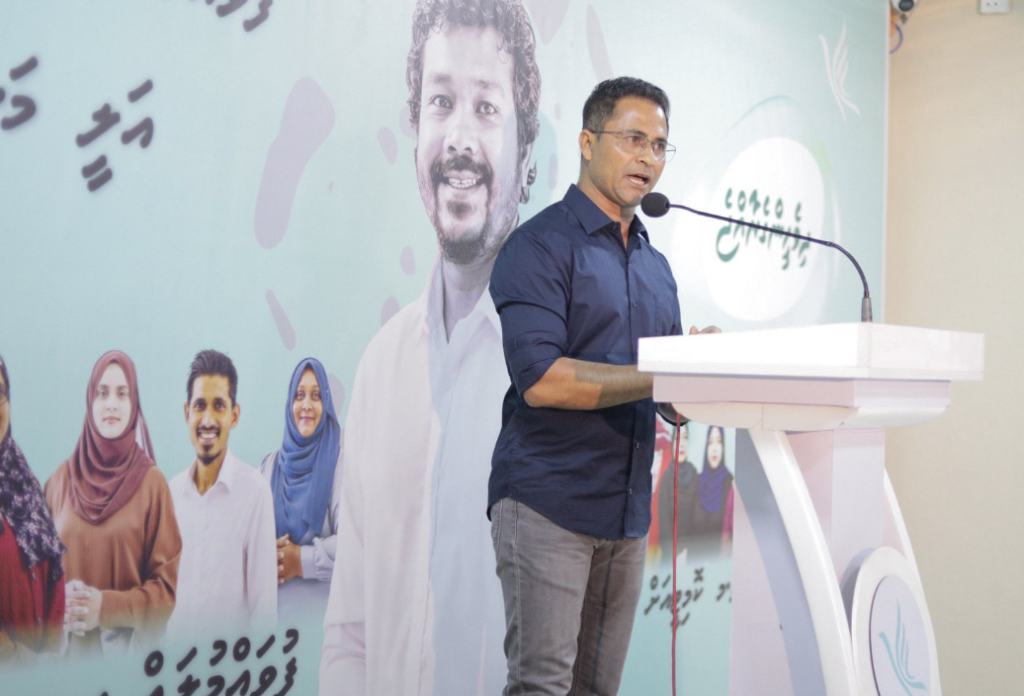
He speaks often about creating a “green environment” for small enterprises, a phrase he uses to describe both literal greenery and a regulatory climate that encourages entrepreneurship. He envisions a Fuvahmulah where local businesses thrive, where tourism is elevated to a new level and where the island becomes an educational hub — a place that attracts students, teachers and investment.
His proposals are unusually specific for a local race. He talks about strengthening transport links with Fuvahmulah, developing the tourism zone in Fuvahmulah and expanding opportunities for small and medium‑sized businesses. He insists that none of this is abstract. “If you focus on the right things in the right way,” he said, “you can achieve results.”
Maseeh’s critics say his ambitions may exceed the island’s capacity. But even they acknowledge his reputation for methodical thinking — a trait that has earned him a following among younger voters who want development without losing the island’s character.
As he moves through the campaign, Maseeh returns repeatedly to the same idea: that progress is not a miracle but a method. “People want results,” he said. “They want to see that their lives can change.”
Whether voters agree will become clear soon enough. For now, as dusk settles over Fuvahmulah and the island’s lights flicker on, Mr. Masih continues his rounds — one conversation, one promise, one plan at a time.