 News Desk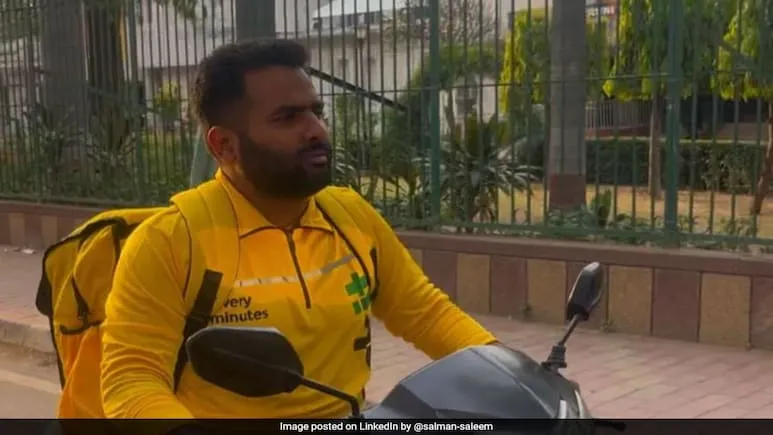
In the 76 years since India broke free from colonial rule, the country has seen transformative changes — none more powerful than those sparked by education. Schools, universities, and literacy campaigns have lifted millions out of poverty, redefined ambition, and carved space for voices once confined to the margins. But even as classrooms filled and degrees multiplied, some of society’s deepest prejudices have merely adapted rather than disappeared.
Salman Saleem, a Delhi-based creative professional, recently decided to trade his air-conditioned office for a day in the life of a Blinkit delivery agent. The goal? To understand firsthand the lives behind the rapid delivery timelines and the orange-and-black uniforms zipping through traffic.
What he discovered was a reality that sharply contrasted with the ideals taught in schools — a society that has grown more literate but not necessarily more humane.
“Untouchability isn’t only about caste anymore,” he wrote in a viral post. “This profession is still struggling to earn its rightful dignity.”
As he navigated traffic, climbed stairs to avoid being allowed in “main” elevators, and stood outside apartments of the well-off, Saleem encountered a familiar yet modern form of exclusion. Discrimination, it seems, has changed its vocabulary — from caste to class, from inherited to assigned.
This shift echoes a broader contradiction in India’s post-independence journey. Education has undoubtedly created change: it has enabled social mobility, brought marginalised voices into boardrooms and parliaments, and produced a generation that speaks the language of rights and inclusion. Yet, these very spaces — elite housing complexes, tech startups, gated societies — often mirror the same old hierarchies under a new guise.
Many of those who denied Saleem access to lifts were not illiterate or uninformed. They were professionals, college graduates, possibly fluent in the rhetoric of equity. But when faced with someone they saw as ‘less than’ — a delivery worker, a gig driver — their behavior betrayed learned prejudice.
It raises the question: Can education alone reshape attitudes?
In post-independence India, education was seen as the ultimate equaliser. And in many ways, it has been. Dalit scholars now teach at universities, women from rural villages run panchayats, and first-generation learners write civil service exams. But dignity — the sense of mutual respect in public life — has not kept pace.
Saleem’s suggestion that companies like Blinkit and Zepto lead awareness campaigns isn’t just about improving gig work conditions. It’s a call to re-educate the educated — to remind them that progress isn’t measured in GDP or delivery times, but in the everyday civility we extend to one another.
Because as long as we continue to separate who uses the main lift and who takes the stairs, the work of independence — and the promise of education — remains incomplete.