 News Desk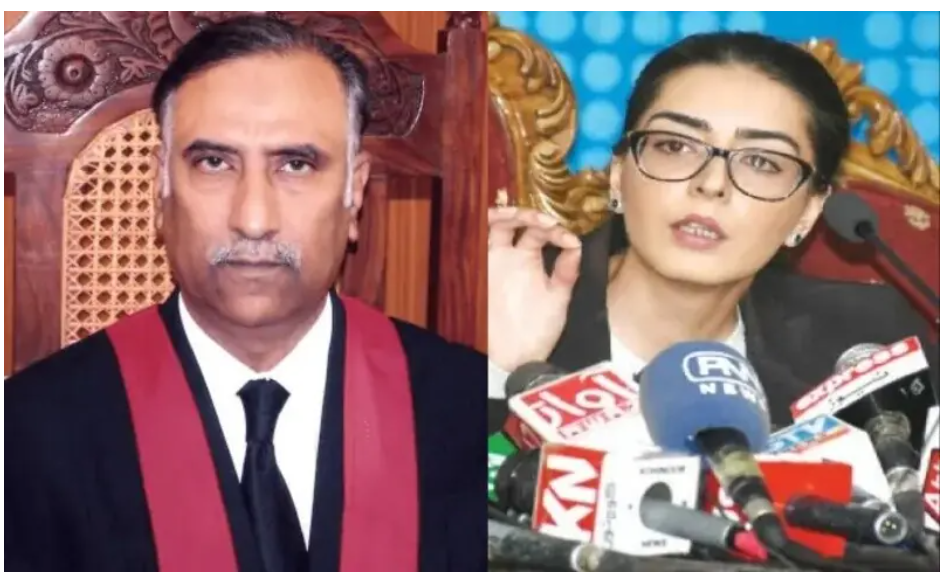
ISLAMABAD, Pakistan — A seemingly routine court hearing in Pakistan’s capital has spiraled into a national controversy, laying bare deep-seated tensions over sexism, judicial authority, and the boundaries of free speech in the country’s legal system. At the center of the storm is Imaan Zainab Mazari-Hazir, a prominent human rights lawyer, and Sardar Muhammad Sarfraz Dogar, the Chief Justice of the Islamabad High Court, whose remarks during a recent hearing have triggered widespread outrage and calls for his removal.
The confrontation unfolded during a hearing when Justice Dogar, reacting to what he claimed was Mazari calling him a “dictator,” issued a stern warning of contempt proceedings. In a moment that would ignite public fury, he reportedly turned to Mazari’s husband, Hadi Ali, and said, “Make her understand; if I get a hold of her someday…” The remarks, perceived as both threatening and patronizing, set off a firestorm.
Dogar later sought to clarify his comments, insisting they were taken out of context. He described Mazari as “just like a daughter” and said he was merely offering advice as an elder. But the explanation did little to quell the backlash. Mazari, a fierce advocate known for her work on human rights and her outspoken criticism of institutional overreach, rejected the judge’s paternalistic framing. “I am a professional lawyer,” she declared in a statement, accusing Dogar of harassment and sexist behavior. She invoked her constitutional right to freedom of expression, framing the incident as an assault on her professional dignity and a broader attack on women in the legal profession.
The legal community in Pakistan, often fractured along political and ideological lines, responded with rare unity. The Lahore High Court Bar Association, Karachi Bar Association, and Balochistan Bar Council issued scathing statements condemning Dogar’s conduct as a violation of judicial ethics.
A group of 41 women lawyers, including prominent Supreme Court advocates, released a joint letter describing the remarks as “unbecoming of a judge” and “deeply patriarchal.” They called for immediate accountability, urging the Supreme Judicial Council, Pakistan’s judicial oversight body, to investigate. The Women’s Action Forum, a leading feminist organization, echoed the demand for an unconditional apology and disciplinary action, framing the incident as emblematic of systemic gender bias in Pakistan’s judiciary.
Advocate Khadija Siddiqi, a vocal critic of patriarchal practices in the legal system, pointed to the overwhelming male dominance in Pakistan’s legal fraternity—where men hold 99 percent of leadership roles—as a factor amplifying the harm of such remarks. “When a judge uses his position to belittle a woman lawyer, it sends a chilling message to all women in the profession,” Siddiqi said in an interview.
Beyond the legal community, the controversy resonated widely. Politicians, journalists, and activists rallied behind Mazari. Mariana Babar, a veteran journalist, praised Mazari’s courage, while Akhtar Mengal, leader of the Balochistan National Party, likened her defiance to that of Asma Jahangir, the late human rights lawyer who remains a towering figure in Pakistan’s fight for justice.
On social media platforms netizens amplified the call for accountability, with hashtags like #JusticeForImaan and #EndJudicialMisconduct trending in Pakistan.
The incident has sparked a broader conversation about the intersection of gender, power, and accountability in Pakistan’s judiciary. Mazari’s invocation of her constitutional right to free speech has highlighted a recurring tension in Pakistan’s legal system: the use of contempt of court laws to silence criticism. Legal scholars argue that such laws, rooted in colonial-era statutes, are often wielded to shield judges from scrutiny rather than to protect the integrity of the judiciary. “This case shows how contempt laws can be misused to suppress dissent, particularly when it comes from women challenging authority,” said Reema Omer, a legal adviser for the International Commission of Jurists.
The controversy also underscores the precarious position of women in Pakistan’s legal profession. Despite progress in recent decades, women remain vastly underrepresented, making up less than 15 percent of practicing lawyers, according to data from the Pakistan Bar Council. Incidents like this one, advocates say, reinforce a culture of intimidation that discourages women from entering or staying in the field. “The judiciary should be a bastion of fairness, not a perpetuator of patriarchy,” said Nighat Dad, a digital rights lawyer and activist.
The unified response from Pakistan’s bar associations marks a significant moment. The Karachi Bar Association, in a strongly worded resolution, called for Dogar’s immediate removal, arguing that his conduct undermined the dignity of the legal profession. The Lahore High Court Bar Association went further, urging the Supreme Judicial Council to suspend Dogar pending a full investigation. Such public demands for judicial accountability are rare in Pakistan, where the judiciary has historically been insulated from criticism. Yet the path to accountability remains uncertain.
The Supreme Judicial Council, tasked with overseeing judicial conduct, has a mixed record of addressing complaints against senior judges. In 2018, it took no action against a judge accused of similar misconduct, citing a lack of evidence. Legal experts warn that without swift and transparent action in this case, public trust in the judiciary—already eroded by allegations of political interference and corruption—could suffer further damage.
For Mazari, the incident is both personal and emblematic of a larger struggle. The daughter of Shireen Mazari, a former human rights minister, she has long been a polarizing figure, admired for her tenacity and criticized by some for her confrontational style. Her defiance in the face of Dogar’s remarks has drawn comparisons to Asma Jahangir, whose legacy looms large in Pakistan’s human rights landscape. “Imaan is carrying forward the torch of fearless advocacy,” Mengal said in a post on X. “This is about more than one judge—it’s about the soul of our justice system.”
As the controversy unfolds, it has become a flashpoint in Pakistan’s ongoing struggle for gender equity and judicial reform. The outpouring of support for Mazari reflects a growing public appetite for accountability, amplified by digital platforms that have given voice to marginalized groups. Yet the incident also highlights the challenges of confronting entrenched power structures in a country where tradition and authority often clash with demands for equality.
For now, all eyes are on the Supreme Judicial Council and the broader judicial system. Will Dogar face consequences, or will the incident fade into the background, as so many before it have? For Mazari and her supporters, the fight is far from over. “This isn’t just about me,” she said in a recent statement. “It’s about every woman who dares to speak truth to power.”