 News Desk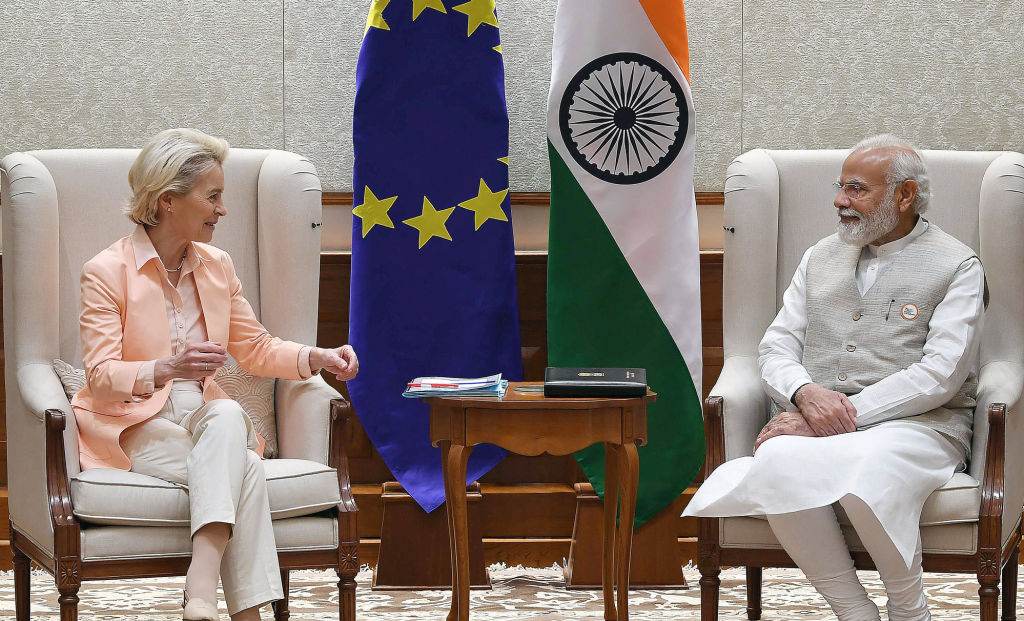
As European Commission President Ursula von der Leyen continues her visit to India, New Delhi is deepening engagement with the European Union in artificial intelligence and Indo-Pacific security. With a 22-member delegation of EU Commissioners—the largest such contingent to visit India—this trip underscores Europe’s renewed strategic focus on the region and highlights the growing importance of India as a global player in trade, technology, and security.
At the heart of discussions is artificial intelligence, an area where both India and the EU see opportunities for collaboration. Prime Minister Narendra Modi’s recent engagement at a global AI summit in France signaled India’s commitment to shaping the technology’s future. Meanwhile, the EU has been setting AI norms through its landmark Artificial Intelligence Act, aimed at regulating AI to ensure ethical and responsible development.
For India, aligning with the EU’s regulatory framework could open avenues for cooperation in research, talent exchange, and governance models that balance innovation with oversight. Given India’s burgeoning AI ecosystem, this partnership could also enable Indian startups and enterprises to integrate with European markets more effectively.
Beyond technology, security in the Indo-Pacific remains a key agenda item. With the EU having formalized its Indo-Pacific strategy, there is interest in enhancing naval coordination, particularly as European nations seek a stronger security footprint in the region. The increasing presence of European naval forces, including joint exercises with India, signals a shift toward greater operational synergy. While current India-EU military cooperation remains largely informal, sources suggest that discussions could lead to more structured agreements between naval forces. Given the increasing geopolitical competition in the Indo-Pacific, deeper EU involvement could align with India’s efforts to counterbalance China’s expanding influence. India, which has been actively expanding its maritime security partnerships, views the EU’s strategic engagement as a welcome development that could enhance regional stability.
Trade and investment discussions are also pivotal. The EU remains India’s largest trading partner, with bilateral trade in goods surging to $135 billion in 2023-24, marking a 90% increase over the past decade. The latest Trade and Technology Council (TTC) meeting is focusing on three key pillars of cooperation: digital technologies, green energy, and resilient supply chains—sectors that are critical for both economies. India, eager to position itself as a global manufacturing hub, is pitching itself as the natural partner for European companies looking to scale operations in a cost-effective market. European firms, which excel in high-end technology but often struggle with scalability, see India as a vital market for expanding production capacities.
Additionally, the EU’s interest in strengthening supply chains comes amid global disruptions, making India a viable alternative to China for key sectors such as semiconductors, pharmaceuticals, and electric vehicles.
Despite ongoing geopolitical tensions, Indian officials insist that the visit is not a reaction to any single global event but a reflection of the broader strategic importance of India-EU ties. With India’s economic and technological ascent, European policymakers see an opportunity to recalibrate relations in ways that are not only commercially viable but also politically significant.
The EU’s cumulative Foreign Direct Investment (FDI) inflows into India have reached $117.4 billion, representing 16.6% of India’s total FDI equity inflows since 2000, further highlighting the depth of economic engagement.
As von der Leyen’s visit progresses, the challenge will be to convert shared interests into tangible agreements that sustain long-term cooperation. With both sides looking to deepen collaboration across multiple sectors, the engagement marks a pivotal moment in India-EU relations—one that could shape the trajectory of their partnership for years to come. Agencies