News Desk
RIYADH, Saudi Arabia — As Prime Minister Narendra Modi prepares to embark on a high-stakes visit to Saudi Arabia in 2025, the trip promises to build on a decade of deepening ties between New Delhi and Riyadh. Since Modi took office in 2014, the India-Saudi relationship has evolved from a transactional energy partnership into a multifaceted strategic alliance, marked by soaring trade, robust defense cooperation, and a vibrant diaspora connection. With the Strategic Partnership Council (SPC) as its cornerstone, this partnership is poised to shape the geopolitical and economic landscape of West Asia and beyond.
Modi’s upcoming visit, expected to focus on energy security, technology transfers, and regional stability, comes at a critical juncture. The India-Middle East-Europe Economic Corridor, announced during Crown Prince Mohammed bin Salman’s 2023 visit to India, looms large as a potential game-changer for global trade. Against this backdrop, Modi’s trip could cement India’s role as a key player in Saudi Arabia’s Vision 2030, while addressing shared concerns like maritime security and counterterrorism.
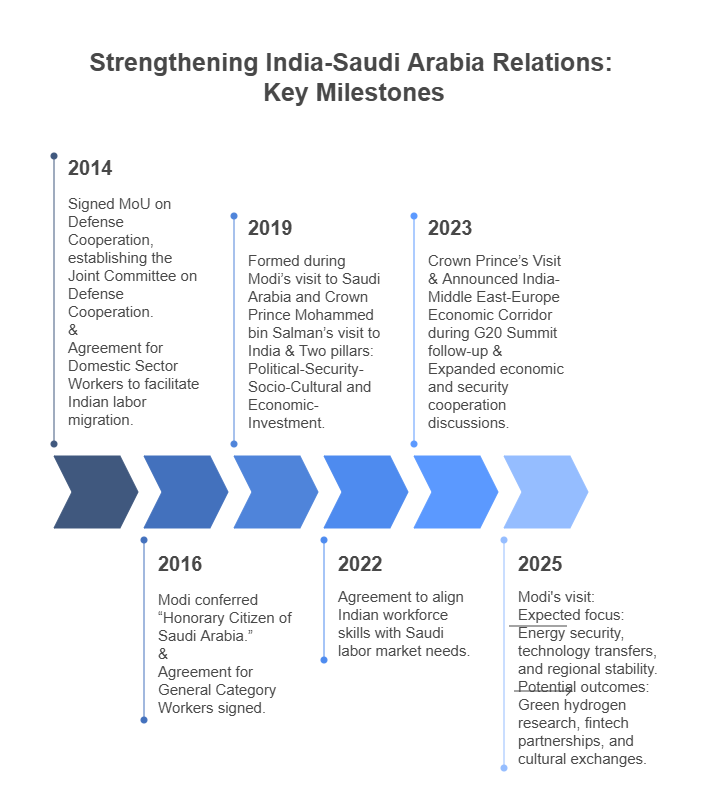
Since Modi’s first term began in May 2014, India and Saudi Arabia have forged a relationship defined by frequent high-level engagements. His 2016 visit to Riyadh, where he was conferred the prestigious “Honorary Citizen of Saudi Arabia,” set the tone for closer ties. In 2019, Modi’s second visit coincided with Crown Prince Mohammed’s trip to New Delhi, culminating in the establishment of the SPC—a framework that has since guided cooperation in politics, security, economics, and culture.
The Crown Prince’s 2023 visit to India, following the G20 Summit, was another landmark. It underscored the growing alignment between New Delhi and Riyadh, with both sides announcing plans to expand economic and security ties. These visits have not been mere photo ops; they’ve produced tangible outcomes, from labor agreements to defense pacts, reflecting a shared commitment to mutual prosperity.
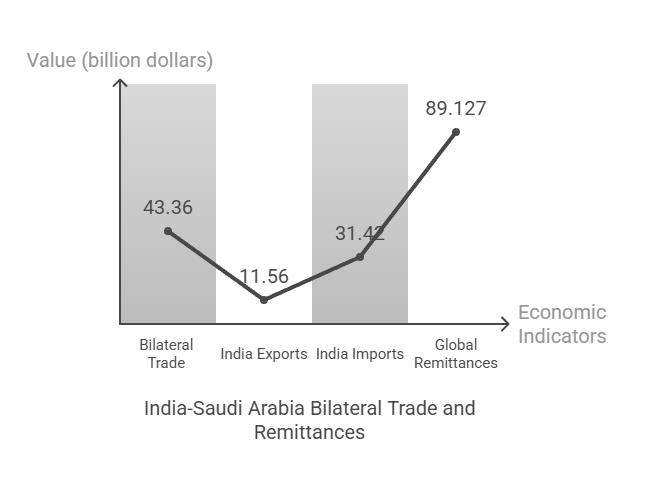
The economic relationship between India and Saudi Arabia is a cornerstone of their partnership. Bilateral trade has surged, reaching $43.36 billion in the 2023-24 fiscal year. India’s exports to Saudi Arabia—ranging from cars and rice to copper wire—grew from $6.19 billion in 2018 to $11.56 billion in 2023, a robust 13% annualized growth rate. Meanwhile, Saudi exports to India, dominated by crude petroleum, rose from $28.7 billion to $34.8 billion over the same period, making the kingdom India’s fifth-largest trading partner.
Energy remains the bedrock of this relationship. Saudi Arabia supplies over 18% of India’s crude oil, fueling the world’s third-largest energy consumer. But the partnership is diversifying. Indian companies are eyeing opportunities in Saudi Arabia’s Vision 2030, which aims to reduce oil dependency through investments in renewable energy, infrastructure, and technology. The SPC’s Economic-Investment pillar has facilitated joint working groups in agriculture, industry, and infrastructure, signaling a shift toward broader economic collaboration.
Modi’s upcoming visit is likely to focus on attracting Saudi investment into India’s burgeoning tech and renewable energy sectors. With Saudi Arabia’s Public Investment Fund already eyeing Indian markets, analysts expect announcements on joint ventures in solar energy and digital infrastructure, aligning with India’s ambitious climate goals.
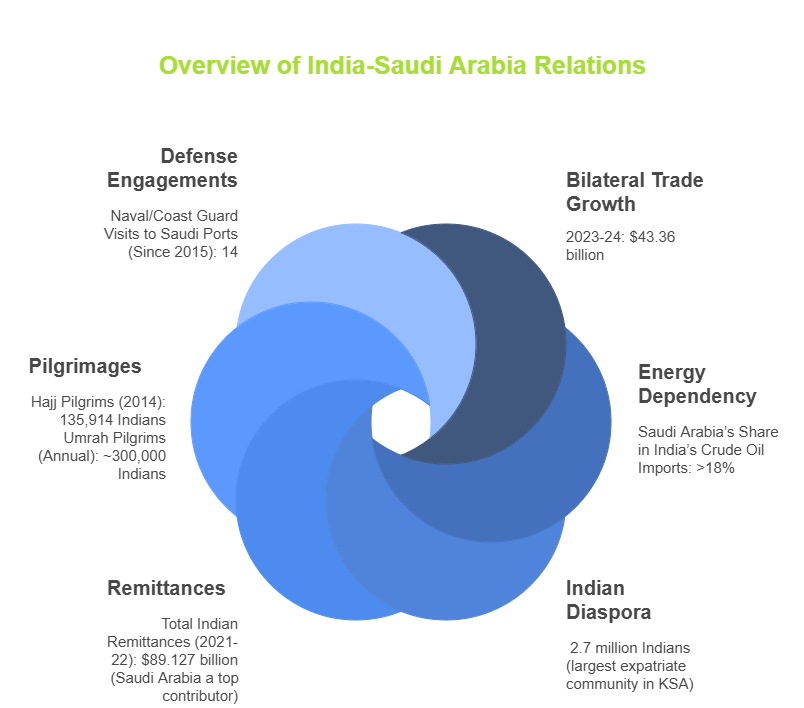
Defense cooperation has emerged as a critical pillar of India-Saudi relations since the 2014 Memorandum of Understanding (MoU) on Defense Cooperation. The Joint Committee on Defense Cooperation, established under the MoU, has met regularly—in 2012, 2016, 2017, and 2019—to advance training, capacity building, and maritime security. Indian Navy and Coast Guard vessels have made 14 goodwill visits to Saudi ports since 2015, a testament to growing trust.
The two nations share concerns about regional stability, particularly in the Indian Ocean and the Gulf. Maritime security cooperation has gained urgency as both countries seek to counter piracy and secure vital trade routes. Discussions under the SPC in 2023 hinted at potential joint military exercises, a significant step for a relationship historically focused on economics.
As Modi prepares to meet Saudi leaders, defense talks are expected to explore technology transfers and co-production of defense equipment. India’s push for self-reliance in defense manufacturing could find a willing partner in Saudi Arabia, which is diversifying its defense supply chains under Vision 2030.
The 2.7 million-strong Indian diaspora in Saudi Arabia—the kingdom’s largest expatriate community—is a living bridge between the two nations. Indian workers, from skilled professionals to laborers, play a vital role in Saudi Arabia’s economy, contributing to its construction, healthcare, and service sectors. In return, their remittances bolster India’s economy, with Saudi Arabia ranking among the top sources of inward remittances.
In 2021-22, India received a record $89.127 billion in remittances, with Saudi Arabia’s contribution significant due to its large Indian workforce. While exact figures for bilateral remittances since 2014 are hard to pin down, the kingdom’s $39.35 billion in total remittance outflows in 2021 underscores its importance to India’s economy. These funds support millions of Indian families, fueling consumption and investment back home.
Labor agreements signed in 2014 and 2016, along with the 2022 Skill Verification Program, have streamlined migration and improved working conditions for Indian workers. Modi’s visit could see further initiatives to protect migrant rights and align Indian skill development with Saudi labor market needs, especially as Vision 2030 demands a more skilled workforce.
Cultural ties also thrive through the diaspora. Each year, around 300,000 Indians undertake the Umrah pilgrimage, while 135,914 participated in Hajj in 2014 alone. These religious connections, coupled with community contributions, strengthen people-to-people ties, a focus area under the SPC’s Socio-Cultural pillar.
Despite the progress, challenges remain. India’s reliance on Saudi oil exposes it to global price volatility, prompting calls for greater investment in renewables. Labor rights issues, while improved, continue to concern Indian workers in the kingdom. Geopolitically, India must navigate Saudi Arabia’s rivalry with Iran, another key energy supplier, while maintaining its strategic autonomy.
Yet the opportunities are vast. The India-Middle East-Europe Economic Corridor, unveiled in 2023, could transform trade connectivity, positioning India as a hub for goods flowing between Asia and Europe. Saudi Arabia’s push for economic diversification aligns with India’s expertise in IT, pharmaceuticals, and renewable energy, creating fertile ground for collaboration.
Modi’s visit is likely to prioritize these opportunities, with potential announcements on joint research in green hydrogen, fintech partnerships, and enhanced connectivity through the corridor. The trip could also see progress on cultural exchanges, with initiatives to promote Indian art, cuisine, and yoga in Saudi Arabia, further deepening ties.
As Modi prepares to board his flight to Riyadh, the stakes are high. His visit comes at a time when India and Saudi Arabia are redefining their roles on the global stage—India as an emerging economic powerhouse and Saudi Arabia as a reforming kingdom with ambitious goals. The Strategic Partnership Council, now a well-oiled mechanism, provides a platform to translate high-level commitments into action.
From trade to defense, energy to diaspora the India Saudi relationship has grown remarkably since 2014. Modi’s trip could mark a new chapter, one where shared interests in technology, security, and sustainability drive a partnership that resonates far beyond their borders.