 News Desk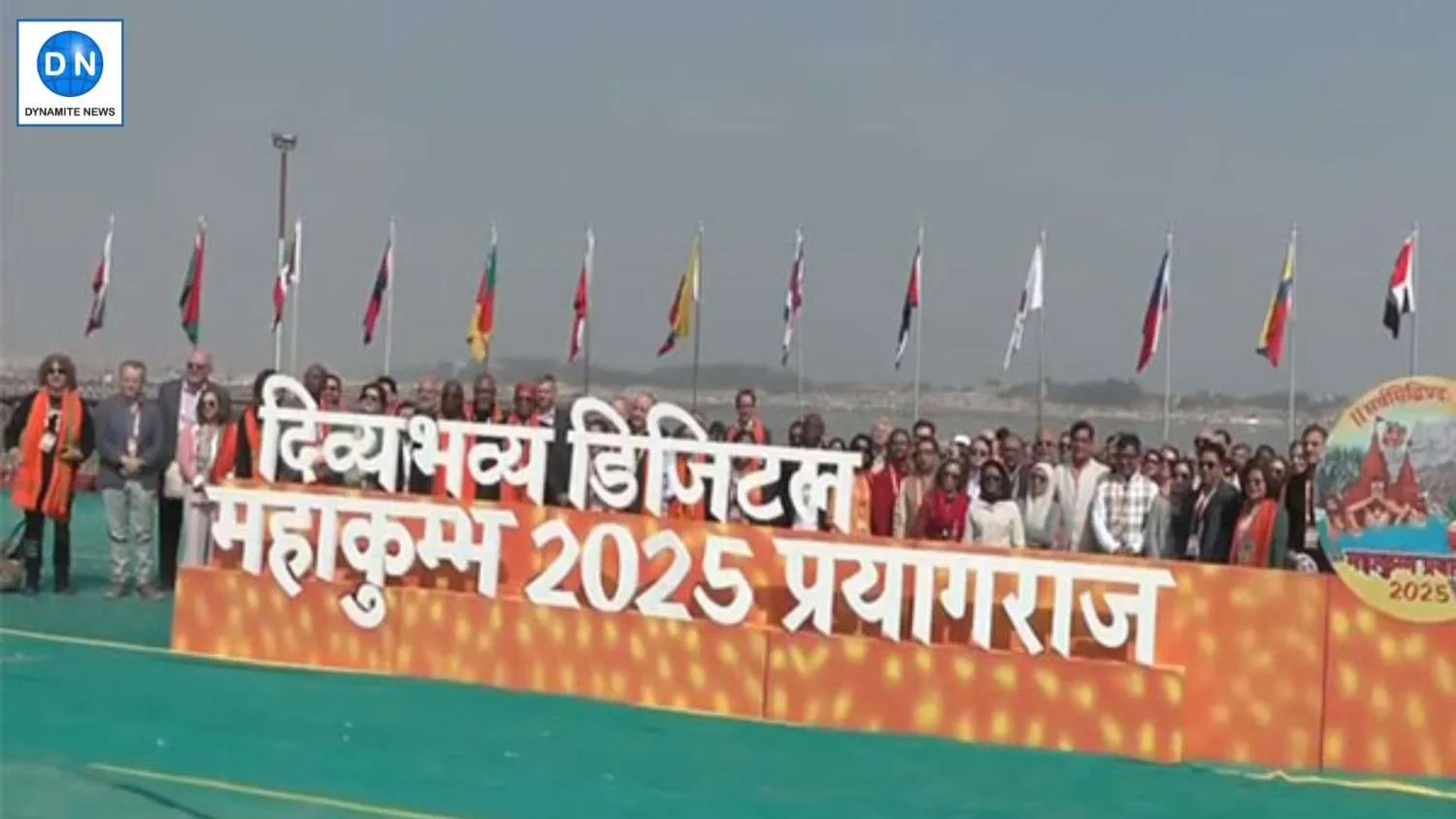
PRAYAGRAJ, India — The waters of the Ganges, Yamuna, and the mystical Saraswati shimmered under the weight of devotion. On Saturday, amid the sea of saffron-clad sadhus and millions of pilgrims seeking spiritual renewal, a different kind of congregation arrived at the Maha Kumbh Mela: 118 diplomats from 77 nations.
For many, this was their first encounter with an event that unfolds on a scale incomprehensible to much of the world. Held once every 144 years, the Maha Kumbh Mela is more than a pilgrimage; it is a civilization in motion—India’s ancient soul manifesting in the present.
“I am very excited. I want to congratulate your government for organizing this great spiritual event,” said Robert Maxian, Slovakia’s ambassador to India. “India is like my second home.”
Mariano Caucino, Argentina’s envoy, echoed a sentiment that many foreign dignitaries expressed: awe at the continuity of tradition. “I am very happy to take part in this important ceremony and follow the traditions,” he said.
The scale of Maha Kumbh is staggering. On the same day the diplomats arrived, over 5.42 million devotees immersed themselves in the Triveni Sangam, the sacred confluence of rivers. By the end of January, over 314 million had already taken the ritual dip. But the event is more than just numbers—it is an enduring testament to a civilization whose cultural imprint extends far beyond its borders.
For India, the presence of international diplomats at Maha Kumbh is not incidental. It is part of a broader diplomatic narrative—one where cultural heritage is leveraged as a form of soft power. “Diplomatic life is also about pursuing cultural and public diplomacy. This is cultural diplomacy where we seek to understand India deeply,” said Stella Nkomo, Zimbabwe’s ambassador to India.
Christian Villarreal, Bolivia’s Head of Mission, noted the significance of the invitation extended to diplomats. “I had the privilege of being invited to Diwali 1.5 years ago, but nothing compares to this occasion. Not even my sons will be able to visit such an event which happens once in 144 years,” he said.
India has long positioned itself as the custodian of one of the world’s oldest continuous cultures, but today, it is increasingly branding that heritage on the global stage. Festivals like Diwali, Holi, and the Maha Kumbh are no longer merely religious observances; they are diplomatic assets, offering a lesson in cultural cohesion at a time when the world is marked by division.
The Maha Kumbh, in particular, carries an unspoken message: tradition and modernity are not always in conflict. Here, the past is not just remembered but lived. India’s embrace of its spiritual and cultural past—while simultaneously forging ahead in technology, economy, and global politics—presents a model for nations struggling to balance identity and progress.
It is no accident that 118 diplomats stood at the banks of the Ganges this weekend, witnessing one of humanity’s oldest rituals. In a world increasingly fractured by nationalism and cultural divides, India’s message is clear: the ties that bind a civilization are often more powerful than those that separate it.
This feature includes information from ANI.