News Desk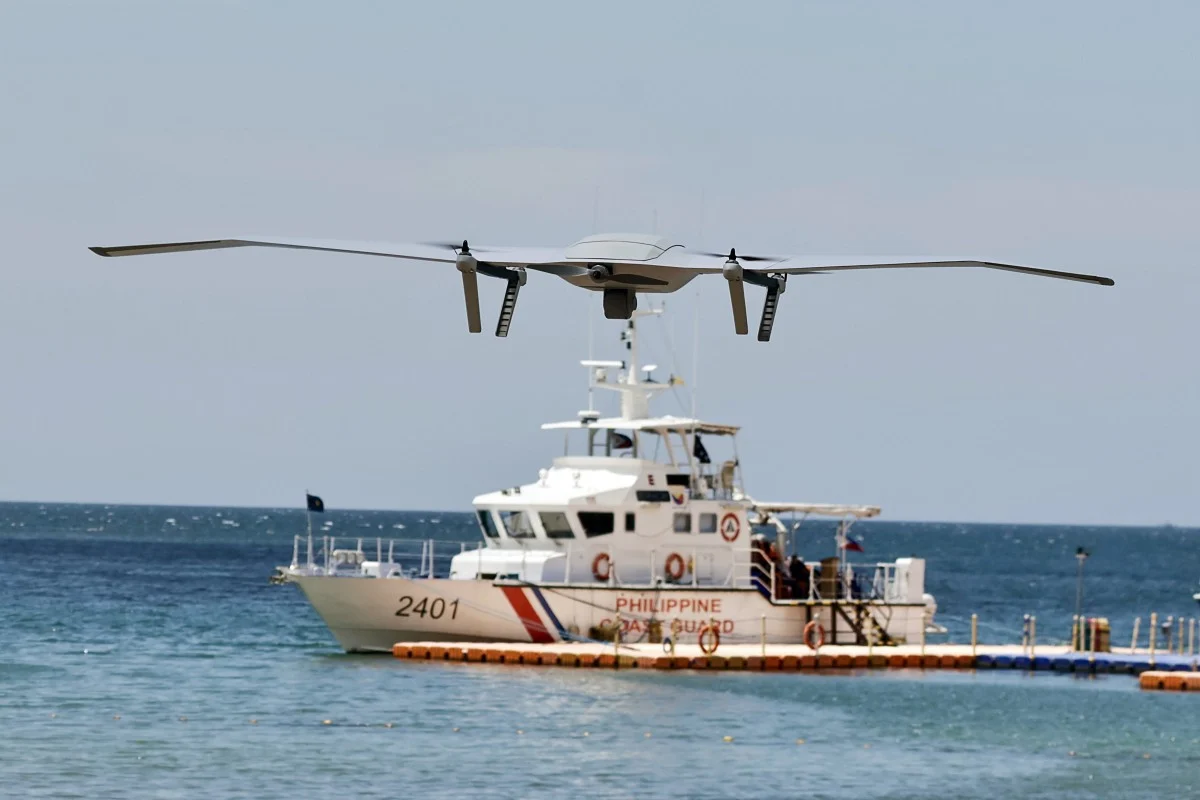
MARIVELES, Philippines — On a sunlit Tuesday morning in Bataan province, Australia handed over 20 state-of-the-art drones to the Philippine Coast Guard, a $592,000 gift aimed at sharpening Manila’s eyes over the contested waters of the South China Sea. The ceremony, held on April 8, came just days after yet another near-collision between Philippine and Chinese coastguard vessels, a stark reminder of the escalating tensions in a region where Beijing’s sweeping territorial claims have long drawn international rebuke.
The drones, a mix of short-, medium-, and long-range models, are more than just hardware. They come with four days of training for 30 Philippine Coast Guard members, led by specialists from Australia’s Department of Climate Change, Energy, the Environment and Water. For the Philippines, an archipelagic nation struggling to patrol its vast maritime borders, this infusion of technology is a lifeline. “It will boost our ability to pursue our rights and obligations more precisely,” said Admiral Ronnie Gil Gavan, the coastguard’s commandant, standing beside Australia’s ambassador, Hae Kyong Yu.
Yu framed the donation as a “tangible example” of Canberra’s deepening ties with Manila, part of a broader push to counter China’s aggressive posture in the Indo-Pacific. The package, worth 34 million pesos, fits into a larger $11.3 million maritime cooperation plan Australia has pledged through 2029, doubling its previous commitment. Alongside the drones, the partnership includes vessel repairs, scholarships, marine protection efforts, and annual Law of the Sea courses—quiet but deliberate steps to shore up a rules-based order that China routinely flouts.
The timing couldn’t be more pointed. Just weeks ago, on March 5, a Chinese coastguard vessel rammed a Philippine boat near Sabina Shoal, injuring four crew members and sparking outrage in Manila. It was the latest in a string of provocations—collisions near Second Thomas Shoal in October 2023, another ramming incident on August 25, 2024—all part of Beijing’s “gray zone” tactics to harass without firing a shot. China claims nearly the entire South China Sea, a $3 trillion trade corridor, dismissing a 2016 international ruling that invalidated its “nine-dash line.” Instead, it deploys coastguard ships and maritime militias to muscle out smaller neighbors like the Philippines.
For Manila, the drones offer a chance to better track these incursions, from illegal fishing to oil spills, and perhaps avoid the missteps that fuel escalation. “We’re an archipelagic country with complex obligations,” Gavan said. “This helps us see what’s happening out there.”
Australia’s move is no solo act. It echoes the broader strategy of the Quad—India, United States, Australia, and Japan—a coalition increasingly vocal about checking China’s ambitions. The Indo-Pacific, a sprawling theater of economic and military rivalry, has become a testing ground for this alliance.
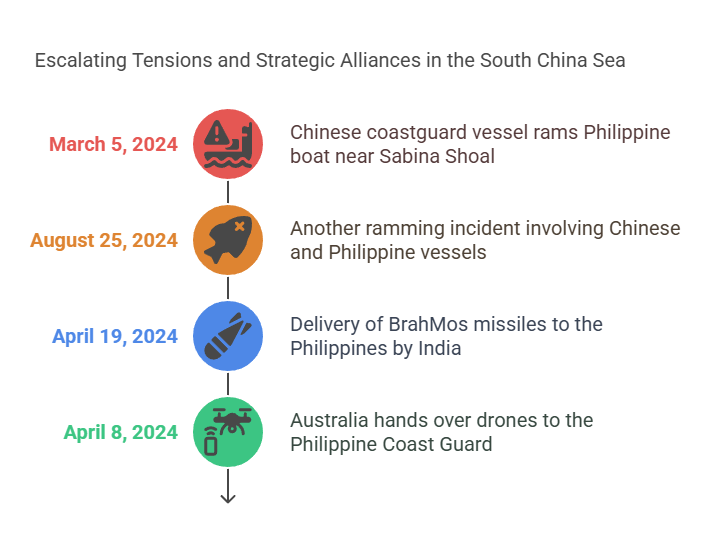
India, too, has stepped up as a key player in the Philippines’ defense against China’s maritime overreach, delivering a powerful boost with the BrahMos supersonic cruise missile. In a landmark $375 million deal signed in January 2022, New Delhi agreed to supply Manila with three batteries of this shore-based, anti-ship weapon, co-developed with Russia and renowned for its precision and speed. The first batch touched down in the Philippines on April 19, 2024, flown in by an Indian Air Force C-17, marking India’s debut as a major arms exporter. For the Philippines, these missiles—now being deployed by the Marine Corps along its vulnerable coastlines—promise a sharper deterrent in the South China Sea, where Beijing’s aggression looms large. It’s a win for India’s growing stature in the Indo-Pacific, reinforcing its Quad partnership and showcasing its commitment to a rules-based order with cutting-edge technology.
India, with its own maritime stakes and a growing naval presence, has been a critical one, advocating for freedom of navigation in waters Beijing seeks to dominate. The Quad’s focus on maritime security, from joint exercises to technology sharing, looms large behind these endeavors.
The Philippines, under President Ferdinand Marcos Jr., has pivoted hard from its predecessor’s softer stance on China. Marcos has welcomed U.S. troops under an expanded defense pact and leaned on allies like Australia to bolster his country’s hand. The United States, bound by a mutual defense treaty with Manila, has watched China’s moves warily, knowing a spark in these waters could ripple globally.
Beijing, predictably, hasn’t stayed silent. After past incidents, it’s accused Philippine vessels of “deliberately ramming” its ships, a narrative that flips the script on Manila’s complaints of reckless aggression. Chinese state media often paint such aid from Western nations as meddling, a charge likely to resurface here. Yet Australia has taken pains to insulate its gift, with Yu stressing the drones carry “minimal foreign influence risk” under Canberra’s security rules—a nod to concerns about tech vulnerabilities in a geopolitically charged region.
For now, the drones are a small but symbolic win for the Philippines, a nation outgunned and outnumbered in its own backyard. They’ll help spot trouble—whether it’s a Chinese militia boat or an environmental hazard—but they won’t rewrite the power imbalance. That will take more than hardware; it’ll take the staying power of allies like Australia, the United States, and the Quad’s broader orbit, including India, to hold the line against China’s relentless push.
As the ceremony wrapped up in Bataan, the drones sat ready, their promise hanging in the air: clearer sight in a sea of conflict, and a signal that Manila isn’t facing Beijing alone.