 News Desk
CAIRO — For generations, the story of Egyptian hieroglyphs has been told as a triumph of European scholarship. Jean-François Champollion, the French philologist, is celebrated as the man who unlocked the Rosetta Stone in the 1820s, finally giving voice to the silent monuments of ancient Egypt. But long before Champollion, an Iraqi alchemist and historian named Ibn Wahshiyya had already grasped a crucial truth: hieroglyphs were not mere mystical symbols, but a language with phonetic values.
In the 9th or 10th century, Ibn Wahshiyya — or perhaps Hasan ibn Faraj, whose work he copied — compiled Kitāb Shawq al-mustahām fī maʿrifat rumūz al-aqlām (“The Book of the Desire of the Maddened Lover for the Knowledge of Secret Scripts”). The manuscript catalogued 89 ancient scripts, including Egyptian hieroglyphs. What set it apart was its recognition that hieroglyphs combined ideographic meaning with phonetic sound — a conceptual leap that European scholars would not make for centuries.

At the time, European thinkers like Athanasius Kircher in the 17th century insisted hieroglyphs were purely symbolic, esoteric codes of hidden wisdom. Ibn Wahshiyya’s text, by contrast, treated them as a structured writing system, closer to how modern linguists understand them.
The manuscript did not remain confined to the Arabic-speaking world. In 1806, Austrian orientalist Joseph von Hammer-Purgstall translated it into English under the title Ancient Alphabets and Hieroglyphic Characters Explained. This translation circulated among European scholars, including Antoine Isaac Silvestre de Sacy, mentor to Champollion. Whether Champollion himself drew directly from Ibn Wahshiyya’s insights remains debated. Some historians argue that the Arabic tradition provided a framework for recognizing phonetic elements and linking hieroglyphs to Coptic, the descendant of ancient Egyptian.
The question of who “discovered” hieroglyphs is not merely academic. It reflects the politics of knowledge transmission between the Islamic Golden Age and Europe’s Enlightenment. To credit only European scholars is to erase centuries of intellectual labour in Baghdad, Damascus, and Cairo, where manuscripts circulated and ideas about language were tested long before the Rosetta Stone was unearthed.
The narrative of Champollion as the solitary genius fits neatly into a European triumphalist arc. Yet Ibn Wahshiyya’s work complicates that story, showing that the foundations of Egyptology were laid in Arabic long before they were celebrated in French.
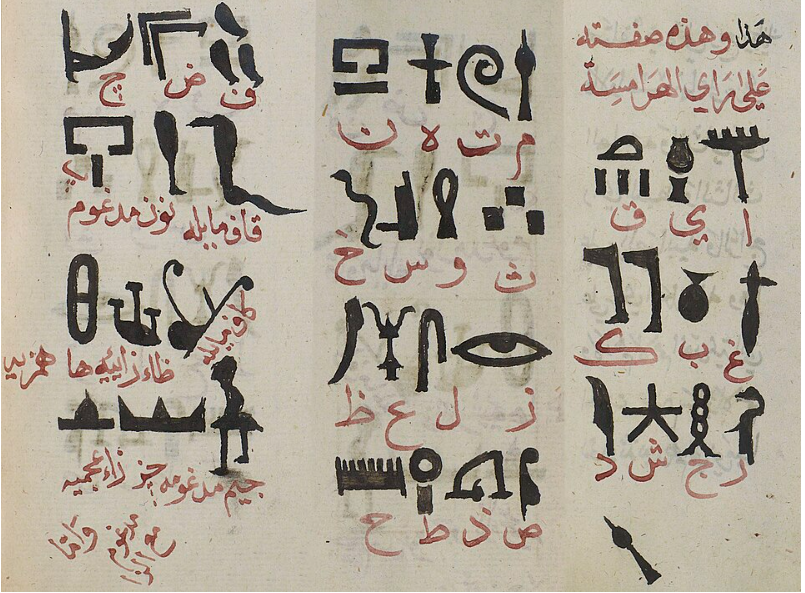
Even if Ibn Wahshiyya’s specific translations were flawed, his recognition of hieroglyphs as a mixed system of phonetic and symbolic signs was groundbreaking. It anticipates the very principle that allowed Champollion to succeed. For scholars of intellectual history, his manuscript is evidence of a broader truth: knowledge is rarely the product of a single culture, but of centuries of transmission, translation, and reinterpretation.
Today, as historians revisit the global history of science, Ibn Wahshiyya’s contribution is being reassessed. He stands as a pioneer of Egyptology in the Islamic Golden Age — a reminder that the decipherment of hieroglyphs was not a European invention, but part of a much older, interconnected story.