News Desk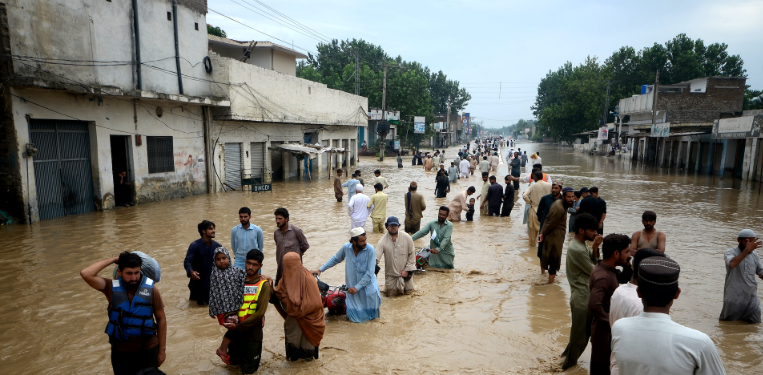
Islamabad – Tensions within Pakistan’s federal cabinet erupted in the National Assembly on Tuesday during a heated debate on the ongoing flood crisis, as Railways Minister Hanif Abbasi publicly rebuked Defence Minister Khawaja Mohammad Asif for his critical remarks on the government’s disaster response. The public spat exposed deep fissures within the ruling coalition, while the opposition Pakistan Tehreek-e-Insaf (PTI) boycotted the session, staging a parallel “public assembly” outside Parliament House to protest alleged political persecution.
Without naming him directly, Abbasi targeted Asif’s Monday speech, where the defence minister labeled the floods a “man-made disaster” caused by unchecked encroachments on waterways, illegal housing societies, and hotels built on riverbeds. Asif had also criticized his own party’s Punjab government for failing to hold local government elections and pointed fingers at a “contracting company” for exacerbating flood devastation in his constituency, Sialkot.
Abbasi, a Rawalpindi MNA, hit back, accusing some politicians of attacking institutions for social media clout. “If all they do is criticize parliament and abuse the bureaucracy for publicity, they should leave the government benches and join the opposition,” he said, indirectly urging Asif to resign from the cabinet. He added that blaming the entire bureaucracy was unfair and called the obsession with going viral a “disease” in politics. “I’ve seen ministers resign when fingers are pointed at them, but they stay loyal to the party,” Abbasi remarked, taking a pointed jab at Asif, who had already left the assembly hall. Abbasi also defended his constituency’s oversight, questioning whether contractors in Rawalpindi could get away with substandard work. “It’s our job as MNAs to ensure accountability,” he said, challenging Asif’s narrative.
Amid the political drama, Federal Minister for Water Resources Mueen Wattoo addressed the flood crisis, announcing ongoing surveys to assess losses to crops, livestock, and homes. He assured that compensation would be provided to affected families once estimates are finalized, emphasizing the government’s commitment to timely relief.
The opposition PTI escalated tensions by boycotting the National Assembly session, accusing the government of “fascist” policies and political victimization. PTI leader Asad Qaiser, before leading a walkout, expressed solidarity with flood victims and said party workers were already assisting in affected areas. Outside Parliament, PTI held a “public assembly” to amplify their dissent. PTI Chairman Barrister Gohar Ali Khan, speaking to reporters after meeting jailed former Prime Minister Imran Khan at Adiala Jail in Rawalpindi, reaffirmed the party’s decision to resign from parliamentary standing committees, calling it “final and irreversible.” Quoting Khan, he said the PTI leader fully endorsed the boycott of by-elections and committee resignations, signaling a deepening rift between the opposition and the government.
The public feud within the cabinet and PTI’s aggressive protest highlight Pakistan’s fragile political unity at a time when the nation grapples with a devastating flood crisis. Asif’s remarks on systemic failures, while sparking controversy, underscore the urgent need for accountability and reform in disaster management. However, the ruling coalition’s infighting and the opposition’s defiance threaten to derail coordinated efforts to address the crisis, leaving flood victims caught in the crossfire of political brinkmanship. As surveys continue and compensation plans take shape, the question remains whether Pakistan’s leaders can set aside their differences to prioritize the millions affected by the floods—or if the nation’s political fault lines will deepen further in the face of this humanitarian emergency.