 News Desk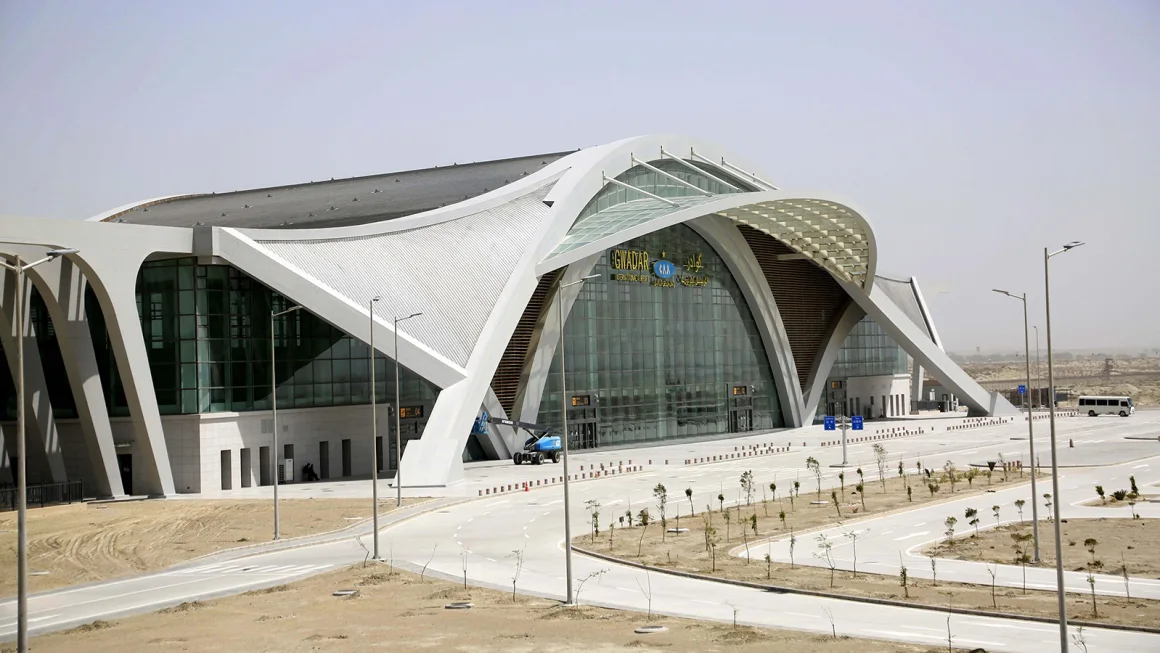
GWADAR, Pakistan — The ribbon-cutting at Gwadar International Airport in October 2024 was a spectacle of optimism. Fireworks lit up the Balochistan sky, dignitaries clapped, and Pakistan’s government hailed it as a triumph: the nation’s largest airport, a $230 million “gift” from China, with a runway stretching 3,658 meters—long enough for an Airbus A380—and a terminal built to handle a million passengers a year.
When the first flight touched down in January 2025, a Pakistan International Airlines jet greeted by water cannons, I stood among the onlookers, wondering if this might finally be Gwadar’s turning point. A month later, on this late February day in 2025, the tarmac is eerily silent. No hum of engines, no bustle of travelers—just a cavernous terminal baking under the desert sun, its glass facade reflecting a promise that’s yet to take flight.
This wasn’t how it was supposed to be. Gwadar International was pitched as the linchpin of the China-Pakistan Economic Corridor (CPEC), a $62 billion infrastructure gambit meant to stitch Pakistan into China’s global trade web. The airport would connect the languishing Gwadar Port to the world, ferrying in tourists to marvel at the Arabian Sea, traders to fuel a free-trade zone, and investors to spark an economic boom in one of Pakistan’s most neglected corners.
“A game-changer for Balochistan,” Prime Minister Shehbaz Sharif declared at the opening, echoing a decade of CPEC hype. But as the weeks tick by, the reality is stark: there are no regular commercial flights, no crowds, and certainly no profit. The question hangs heavy—who, exactly, is this airport for?
The numbers—or lack thereof—tell a damning tale. The Pakistan Civil Aviation Authority announced a tentative schedule of one weekly flight starting in March, but airlines are balking. PIA, the national carrier, cites high operating costs and low demand; private players like AirSial haven’t even bothered to weigh in.
Gwadar’s population of 85,000, mostly fishermen and laborers, can’t fill a plane, and the port—meant to be the airport’s economic lifeline—handles a pitiful 600,000 tons of cargo over 18 months, a fraction of its capacity. Karachi’s port, by contrast, churns through 50 million tons annually.
“There’s no ecosystem to support this,” says Azeem Khalid, an assistant professor at COMSATS University Islamabad, who’s tracked CPEC’s stumbles for years. “No feasibility study worth its salt would’ve built an airport this size without a functioning port or a local economy to justify it. It’s a trophy project—pure optics.”
The $230 million price tag came as a rare grant from China, a glimmer of generosity in a CPEC framework dominated by loans—$67.2 billion worth from 2000 to 2017, per AidData, often at 3.76% interest, steeper than Western terms. Yet even this “freebie” doesn’t lighten Pakistan’s load.
The country’s external debt has swelled to $124.5 billion—42% of GDP—by early 2025, with China holding $24.7 billion of it as of 2021, a share that’s only grown. Annual debt servicing drains reserves, now scraping below $9 billion, and the airport’s operating costs—staff salaries, maintenance, security in a restive region—loom as an unquantified burden.
Balochistan’s cash-strapped government, which collects no direct revenue from the project, won’t see a rupee to offset it. “China builds, we bleed,” Khalid told me last week over a crackling phone line. “The grant’s a distraction from the bigger trap.”
Locals feel the disconnect most acutely. In Gwadar’s dusty bazaar, a shopkeeper named Rehmat, his face weathered by decades under the sun, scoffed when I asked about the airport last month. “They built a runway, not jobs,” he said, gesturing at the half-empty stalls around him. He’s not wrong.
Unemployment in Balochistan hovers at 30%, double the national average, and the airport’s staff—security guards, cleaners, a skeleton crew—mostly hail from Punjab or Sindh, not the province itself.
The promised influx of 200,000 CPEC jobs province-wide has fizzled; AidData estimates less than 10% materialized locally, with many roles snatched up by Chinese workers or outsider Pakistanis. “It’s a shiny toy for someone else,” Rehmat muttered, turning back to his ledger.
China, meanwhile, spins a different narrative. State media called the airport a “testament to unbreakable friendship,” a symbol of Beijing’s commitment to Pakistan’s rise. But the silence on the tarmac feels more like a photo op gone stale. Security concerns don’t help—Baloch separatists, who see CPEC as a plunder of their land, bombed a nearby checkpoint in December, killing two soldiers. Investors and tourists aren’t lining up to fly into a war zone. The port’s failure to attract shipping only deepens the isolation; without cargo or commerce, Gwadar remains a backwater, not a hub.
Pakistan’s leaders keep cheering, undeterred. Sharif’s administration touts the airport as a long-term bet, a seed that’ll sprout when CPEC’s grand vision clicks into place. But that optimism rings hollow against the evidence. AidData’s research on Chinese investments highlights a pattern: oversized projects that dazzle but don’t deliver, leaving host nations to foot the bill. Gwadar International fits the mold—a $230 million fantasy, its runways stretching toward a prosperity that’s nowhere in sight. For now, it’s a monument to ambition over reason, a runway to nowhere in a nation drowning in debt.