 News Desk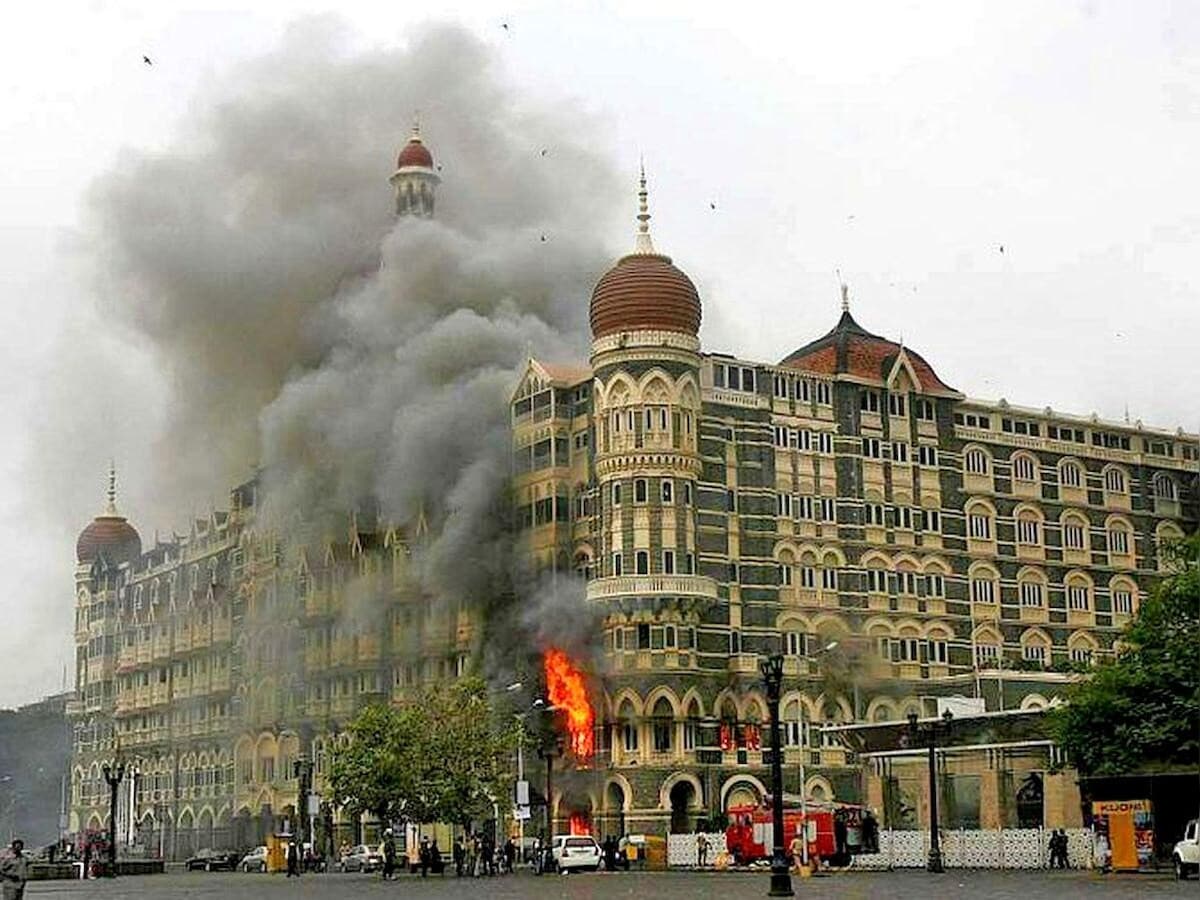
The extradition of Tahawwur Hussain Rana, a Canadian-Pakistani businessman, to India on April 10, 2025, marks a pivotal moment in the long pursuit of justice for the 2008 Mumbai terror attacks, which claimed 166 lives and injured over 238.
As Rana sits in a high-security cell at the National Investigation Agency (NIA) headquarters in New Delhi, his interrogation is peeling back layers of one of India’s most devastating terrorist incidents. Central to this probe is the alleged involvement of Pakistan’s Inter-Services Intelligence (ISI), with two shadowy figures—Major Iqbal and Major Sameer Ali—emerging as key links between state actors and the Lashkar-e-Taiba (LeT), the Pakistan-based terror group behind the attacks. While the evidence points to a complex web of coordination, questions remain about the extent of Pakistan’s official complicity and the reliability of the accusations.
Rana’s Role: Facilitator or Mastermind?
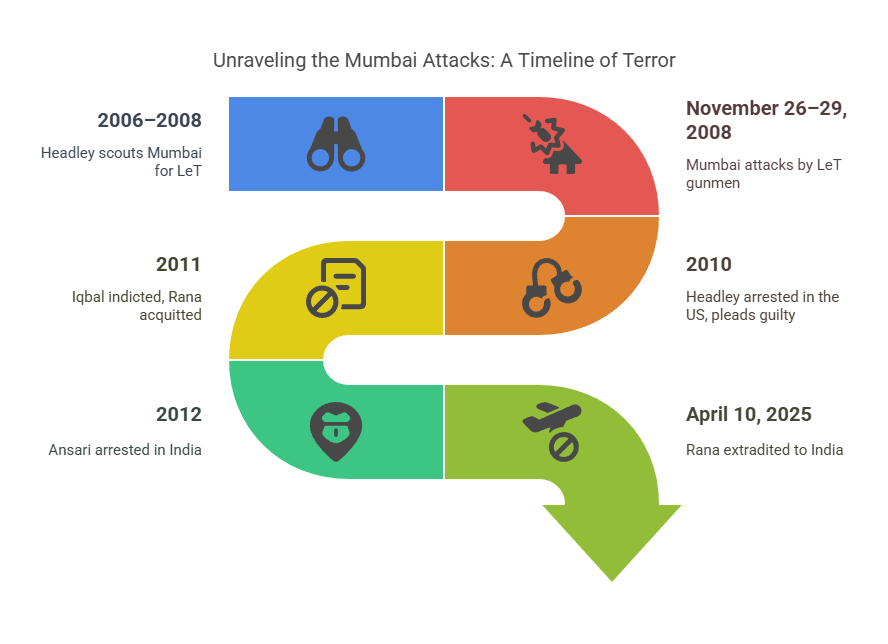
Tahawwur Hussain Rana, a 64-year-old former Pakistani army doctor, is accused of playing a critical role in the Mumbai attacks by providing logistical support to his childhood friend, David Coleman Headley, a Pakistani-American LeT operative. Rana’s immigration consultancy in Chicago served as a front, allegedly enabling Headley to secure visas and pose as a legitimate businessman while conducting reconnaissance in Mumbai. Headley’s scouting of targets like the Taj Mahal Palace Hotel, Chabad House, and Chhatrapati Shivaji Terminus was instrumental in the precision of the November 26–29, 2008, siege.
According to the US Department of Justice, Rana expressed chilling approval of the attacks, allegedly telling Headley, “Indians deserved it,” and suggesting that the nine LeT terrorists killed during the operation should receive Pakistan’s highest gallantry award, the Nishan-e-Haider. These statements, intercepted by US authorities, paint Rana as ideologically aligned with the attackers, though his exact level of involvement—whether as a passive enabler or an active conspirator—remains under scrutiny. The NIA, granted 18 days of custody, is probing whether Rana had broader plans to target other Indian cities, as suggested by his travels to Kochi, Delhi, and Ahmedabad in November 2008.
Rana’s interrogation has so far yielded limited cooperation, with initial disclosures confirming his background: born in Chichawatni, Pakistan, educated at Cadet College Hasanabdal (where he met Headley), and later a medical officer in the Pakistani army. His continued ties to Pakistan’s military establishment, evidenced by his habit of wearing army fatigues during meetings with LeT operatives and alleged ISI officers, raise questions about how deep his connections ran.
The ISI Connection: Major Iqbal and Major Sameer Ali
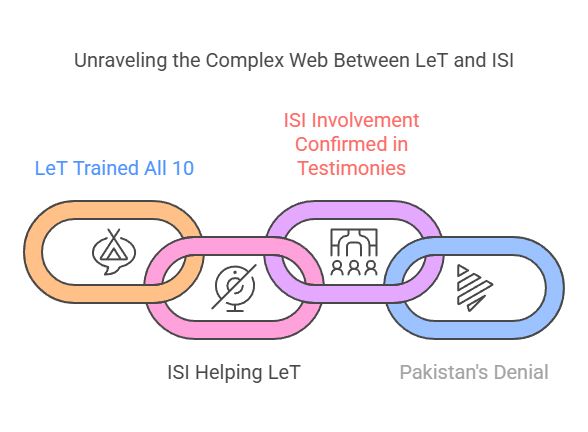
The most explosive aspect of the Rana probe is its focus on the ISI’s alleged role, with Major Iqbal and Major Sameer Ali named as key operatives. David Headley’s 2010 testimony, given after he pleaded guilty to avoid the death penalty, provides the primary evidence linking the ISI to the attacks. Headley described Major Iqbal as his “primary handler,” accusing him of financing, directing, and micromanaging reconnaissance missions. A 2010 US indictment charged Iqbal, identified as a serving ISI officer, with aiding terrorism and murder, alleging he funneled funds to LeT. Over 20 email exchanges between Headley and an alias, “Chaudhery Khan,” reportedly Iqbal, discussed surveillance equipment and potential covers, such as exploiting a Shiv Sena member for access to political targets.
Major Sameer Ali, meanwhile, is accused of overseeing the attacks in real time from an LeT control room in Karachi’s Malir Cantonment, a military area. Zabiuddin Ansari (alias Abu Jundal), arrested in 2012, claimed Ali issued directives to LeT commander Zaki-ur-Rehman Lakhvi during the siege. Interpol’s Red Notice lists Ali as a Lahore-born operative wanted for terrorism, but Pakistan’s denial of his existence—dismissing him as a “fictitious character”—complicates efforts to verify his role. Reports of Pakistan’s Federal Investigation Agency destroying the Karachi control room post-attack further muddy the waters, suggesting a possible cover-up.
The NIA hopes Rana’s interrogation will clarify whether he coordinated directly with Iqbal and Ali. His alleged meetings with Iqbal, sometimes in Pakistani army uniform, and his contacts with Sajid Mir, a designated LeT terrorist accused of directing the Chabad House siege, suggest Rana was a conduit between LeT and ISI operatives. Mir, for whom the US offers a $5 million reward, remains at large, and an audio submitted by India to the UN allegedly captures him coordinating with attackers.
Pakistan’s Role: Complicity or Rogue Elements?
The accusations against the ISI hinge on the idea that state actors facilitated a non-state terror group, LeT, to execute a sophisticated attack. Headley’s testimony implicates a “trio” of ISI officials, with Iqbal as the linchpin, while Jundal’s claims point to a broader infrastructure, including control rooms in military zones. Rana’s ties to both LeT and Harkat-ul-Jihad-al-Islami (HuJI), another terror group, allegedly forged in the presence of ISI and military personnel, bolster the narrative of state sponsorship. The NIA’s interest in an elusive “Dubai man” who met Rana before the attacks hints at a wider network, possibly involving ISI-backed operatives abroad.
However, the evidence is not ironclad. Pakistan has consistently denied ISI involvement, and the absence of explicit ISI references in the 2010 US indictment raises questions about whether Iqbal and Ali were rogue agents or part of an official operation. Headley’s plea deal, which spared him extradition to India, and his history as a US informant before 2008, invite skepticism about his reliability. Could he have exaggerated ISI involvement to secure leniency? Similarly, Jundal’s testimony, extracted under interrogation, lacks independent corroboration. Pakistan’s destruction of the alleged control room and its arrest of Lakhvi could be interpreted as damage control—or as evidence that only fringe elements were involved, not the state itself.
Critical Questions and Broader Implications
As the NIA interrogates Rana under tight security, led by DIG Jaya Roy and IG Ashish Batra, several questions loom. First, can Rana provide concrete evidence of ISI coordination, or will his uncooperative stance limit revelations? Second, why has Pakistan’s response—denying Ali’s existence and downplaying Rana as a Canadian national—been so dismissive, and what does it conceal? Third, the US’s role raises eyebrows: why did it shield Headley from extradition, and why was Rana acquitted of Mumbai-related charges in a 2011 US trial, only to be extradited now?
The Mumbai attacks exposed vulnerabilities in India’s security and strained India-Pakistan relations. If Rana’s probe substantiates ISI involvement, it could reignite diplomatic tensions, especially given Pakistan’s nuclear status and geopolitical weight. The NIA’s focus on Rana’s LeT and HuJI links, alongside his ISI contacts, suggests a multi-pronged investigation.
Tahawwur Hussain Rana’s extradition is a breakthrough, but it’s only one piece of a complex puzzle. The alleged ISI-LeT nexus, embodied by figures like Major Iqbal, Major Sameer Ali, and Sajid Mir, points to a disturbing possibility: that Pakistan’s intelligence apparatus enabled a massacre on Indian soil. Yet, gaps in evidence and Pakistan’s denials demand caution.