News Desk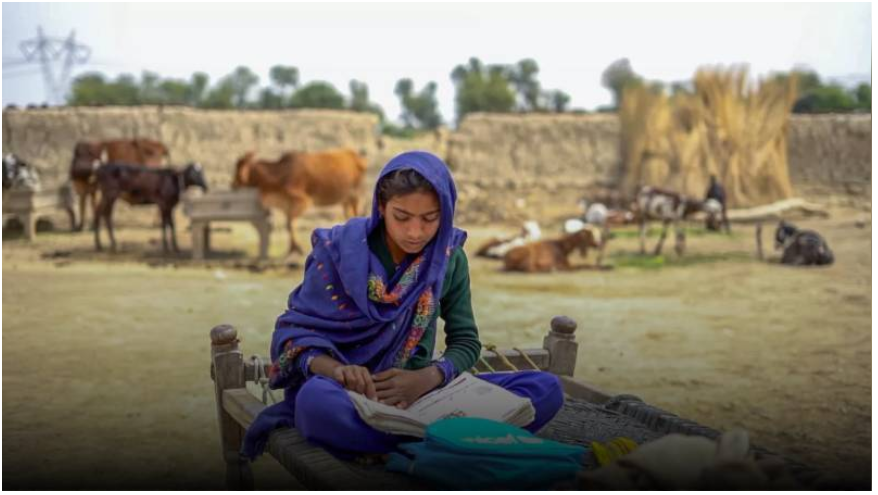
UMERKOT, Pakistan — In a village classroom still damp from last year’s floods, a group of girls recite multiplication tables with a confidence that belies the chaos outside. Their voices carry a quiet defiance: against poverty, against disaster, and against the odds that have long stacked against rural education in Pakistan.
For decades, schooling in Pakistan’s countryside has been fragile, vulnerable to political neglect and economic hardship. Yet in recent years, researchers tracking learning outcomes have found something remarkable: girls are not only staying in school, but they are also outperforming boys, even in mathematics — a subject where gender gaps have historically been stark.
That progress, however, is now under siege. The floods of 2022 washed away homes, schools, and livelihoods across Sindh and Punjab. This year, another wave of climate-driven inundation has left classrooms shuttered, teachers stranded, and families forced to choose between survival and schooling.
After the COVID-19 pandemic, rural schools showed signs of resilience. By 2024, learning levels had largely rebounded, according to the LEAPS study, which has tracked education in villages for nearly two decades. The length of school closures mattered less than the support children received at home. Families that carved out study time, even amid economic strain, saw their children bounce back faster.
But recovery was uneven. Children in public schools — often from the poorest households — lagged behind their peers in private institutions. Private schools, with closer ties to families and more flexible staffing, adapted quickly. Public schools, weighed down by household income losses and limited resources, struggled to keep pace.
Amid these disparities, one trend stood out: girls surged ahead. In village after village, they scored higher than boys, challenging long-held assumptions about gender and learning. Their success was bolstered by a quiet revolution in the teaching workforce. More young, local women entered classrooms, particularly in private schools, reshaping the culture of rural education.
“Girls are proving that when given the chance, they excel,” said one education researcher. “The challenge is ensuring those gains aren’t washed away by the next flood.”
The floods have exposed the fragility of Pakistan’s education system. Schools became shelters for displaced families. Teachers, themselves victims of disaster, could not reach classrooms. Parents, struggling to rebuild homes and livelihoods, pulled children out of school to work or care for siblings.
The danger is not just temporary disruption. Repeated shocks risk permanent dropout, child labour, and the erosion of hard-won gains. Each flood compounds inequality, widening the gap between families who can afford private schooling and those who rely on overstretched public institutions.
Education experts warn that treating floods and pandemics as isolated emergencies misses the deeper reality: Pakistan’s rural schools are caught in a cycle of crisis. Without structural investment — in resilient infrastructure, teacher support, and social safety nets — each disaster will undo years of progress.
For families in villages like Umerkot, the stakes are clear. “We rebuilt our home twice,” said a mother of three daughters. “But if the school closes again, I don’t know if my girls will return.”
Pakistan’s future hinges on whether it can protect these fragile gains. Girls’ education has become a rare success story in rural development. Preserving it will require more than rebuilding classrooms; it will demand a vision that sees education not as charity, but as the cornerstone of resilience in a climate-threatened nation.
As the waters recede, the question remains: will the voices of girls reciting their lessons still echo in the classrooms of rural Pakistan — or will they be drowned out by the next flood?