 News Desk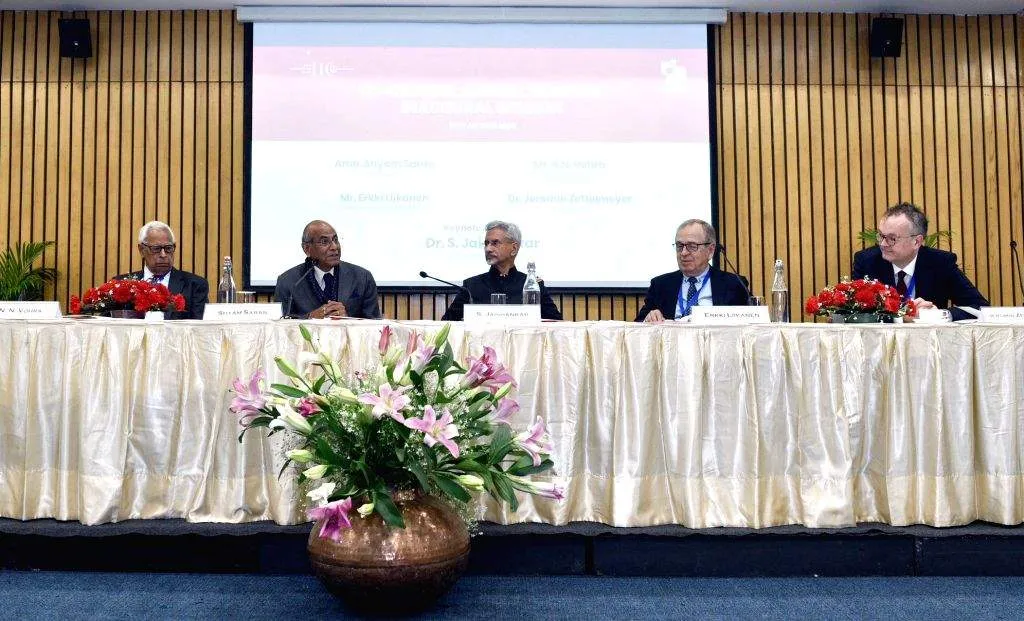
New Delhi: In his address, India’s External Affairs Minister S. Jaishankar framed the ongoing shifts in the international order, stressing that the “world order is unravelling,” but insisted that the underlying consensus has been in flux for much longer. “The fact is that the consensus which underpinned it, has done so well before,” he remarked, hinting at a deepening disillusionment with old power structures.
Addressing the inaugural session of the IIC-Bruegel annual seminar in New Delhi on Tuesday, Jaishankar underlined that the evolving geopolitical climate has made this partnership even more critical than before.
In a broad-ranging speech at the event, which runs from February 4-5 at the India International Centre (IIC), Jaishankar touched on a variety of global issues, ranging from international law to trade and climate action. He highlighted the selective application of democratic principles, particularly referencing the differing standards applied to neighboring countries in Asia, without naming any specific nations.
He emphasized the need for new policies and responses, acknowledging the world is entering an era of multipolarity, one in which India and the European Union must find common ground to thrive.
“At the end of the day, we are political democracies, pluralistic societies, and market economies,”
External Affairs Minister S. Jaishankar
“There are North-South contradictions as much as there is an East-West divide. In fact, even these broad characterisations are no longer tenable in an era of sharper nationalism,” Jaishankar observed, calling for a recalibration of economic and political logics that once defined global interactions.
Addressing the global tensions fueling instability, the External Affairs Minister stressed that India and Europe share significant interests and values, despite differences in priorities and specifics. “At the end of the day, we are political democracies, pluralistic societies, and market economies,” Jaishankar said, suggesting that these shared foundations will be key to deeper cooperation in the coming years.
While Jaishankar did not directly name any countries, his comments seemed to allude to recent geopolitical tensions, particularly in Europe’s neighborhood. “In our own continent, international law has been disregarded with significant consequences,” he remarked, calling attention to uneven applications of global principles, especially regarding democracy and military rule.
Jaishankar also recognized Europe’s growing strategic role on the global stage, noting that the continent’s renewed strategic awareness could drive further collaboration between India and the EU. “India is cognisant of the greater strategic awakening of Europe in the last few years. That too can serve as a driver of deeper engagement,” he said.
In his concluding remarks, Jaishankar affirmed that the future of the India-EU relationship is one of increased convergence, with shared democratic values and mutual strategic interests serving as a foundation for cooperation. “We are truly entering a time of multipolarity and rebalancing, the sooner we come to terms with this reality, the better for all of us,” he concluded, underlining the importance of both sides acknowledging the new dynamics at play in global politics.
The seminar, which runs through February 5, is being held at the India International Centre (IIC), providing a platform for dialogue on the future of India-EU relations amidst changing geopolitical realities.