News Desk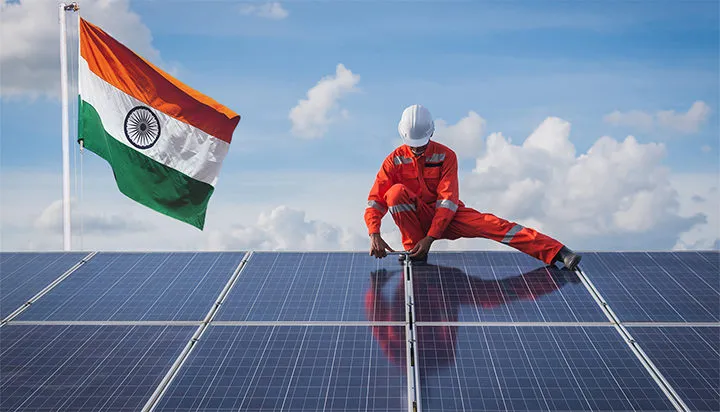
In a world racing to embrace cleaner energy, India is emerging as a radiant leader, harnessing the sun’s power to fuel its future while championing global cooperation through the International Solar Alliance (ISA). A recent report from the International Energy Agency (IEA) underscores a dazzling milestone: global renewable energy capacity soared by 50% in 2023, reaching nearly 510 gigawatts, with solar power driving the charge. As the planet pivots away from fossil fuels—a shift cemented at the COP28 summit in Dubai, where nearly 200 nations rallied for a historic transition—India’s bold strides in solar energy are lighting the way.
The IEA’s findings paint an electrifying picture of progress. Solar photovoltaic (PV) systems accounted for three-quarters of the world’s new renewable capacity in 2023, with India playing a pivotal role in this surge.
By early 2025, India’s installed solar capacity has rocketed to over 100 gigawatts, a staggering leap from just 2.82 gigawatts in 2014, according to the Ministry of New and Renewable Energy. This 35-fold increase reflects a nation determined to power its booming economy sustainably, with solar panels now dotting rooftops, sprawling across arid landscapes, and even floating on reservoirs.
At the heart of India’s solar revolution is the International Solar Alliance, a visionary initiative co-founded by India and France in 2015. With 116 member countries, the ISA is a beacon of hope for solar-rich nations, particularly in the developing world, aiming to mobilize $1 trillion in investments by 2030 to make solar energy affordable and accessible.
India’s leadership in the alliance has not only turbocharged its own renewable ambitions but also inspired a global movement. “The ISA is about turning sunlight into opportunity,” said Prime Minister Narendra Modi at a recent summit, emphasizing its mission to empower nations between the tropics—often dubbed “sunshine states”—with clean energy solutions.
The numbers tell a story of relentless momentum. In 2024 alone, India added 24.5 gigawatts of solar capacity, more than doubling the previous year’s additions, propelled by innovative policies like the PM Suryaghar Yojana, which has installed over 1.09 million rooftop solar units since its launch. With a budget of $9 billion, the program aims to bring solar power to 10 million households by 2027, slashing electricity bills and carbon footprints alike. Meanwhile, massive solar parks—like the 100-megawatt floating project in Telangana—showcase India’s knack for blending technology with ingenuity, preserving land while generating power.
Globally, the IEA report highlights a renewable renaissance, with giants like China, Europe, and the United States posting record gains. China’s solar installations in 2023 matched the world’s total from the year prior, while wind power surged by 66%. Yet India stands out not just for its growth but for its generosity—sharing expertise and resources through the ISA to uplift nations with untapped solar potential. “India’s success is a blueprint,” said IEA chief Fatih Birol, who praised the country’s cost-effective solar and wind projects, now cheaper than most fossil fuel alternatives.
Under current trajectories, global renewable capacity is set to balloon by 2.5 times by 2030, a trajectory Birol calls promising but shy of the COP28 tripling goal. For India, the target is even more ambitious: 500 gigawatts of renewable capacity by decade’s end, with solar as the cornerstone. The nation’s $16.5 billion investment in renewables in 2024—an 83% jump from the prior year—signals unwavering commitment. Add to that $190 billion to $215 billion earmarked through 2030, and India’s green vision is as bold as it is bright.
Challenges remain, from financing hurdles in emerging economies to grid integration at home. Yet India’s optimism is unshakable. With the ISA as its global megaphone, the country is not just chasing its net-zero goal by 2070—it’s redefining what’s possible under the sun. As Birol noted, “The tools are there; the will is there.” For India, the future is solar-powered, and the world is watching in awe.