News Desk
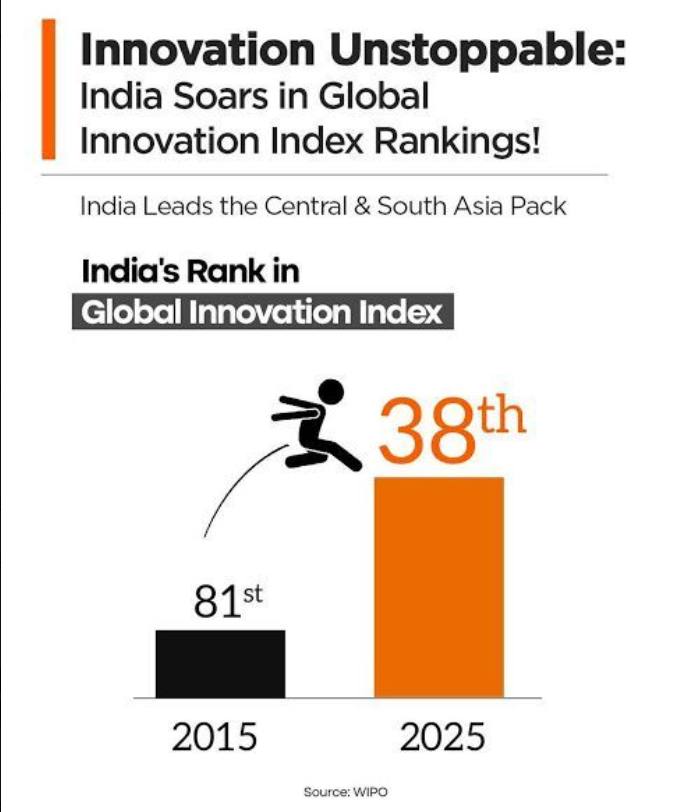
NEW DELHI — In a remarkable ascent that underscores its growing prowess on the global stage, India has surged 10 spots to claim the 38th position in the 2025 Global Innovation Index (GII), according to the World Intellectual Property Organization (WIPO). This leap from 81st in 2015 to 38th this year marks a decade of transformative progress, positioning the world’s most populous nation as a dynamic hub of creativity and technological advancement.
The milestone, celebrated widely, reflects India’s strategic investments in research and development, bolstered by initiatives like “Make in India,” under PM Modi’s leadership, which has catalyzed a 30% rise in patent filings since 2015. With a young, skilled workforce of over 1.4 billion and a thriving startup ecosystem—home to more than 100 unicorns—India is rewriting its narrative from a land of “jugaad” improvisation to a genuine innovator. The country now leads Central and South Asia in the GII rankings, outpacing regional peers and signaling its emergence as a knowledge economy.
Driving this progress is a concerted push to modernize infrastructure and education, even as challenges persist. The government’s focus on easing business regulations and fostering public-private partnerships has paid dividends, with sectors like information technology and renewable energy leading the charge. India’s modest research and development expenditure—hovering between 0.6% and 0.7% of GDP—pales in comparison to leaders like Israel (6.3%) or South Korea (5%). Yet, its ability to maximize impact with limited resources speaks to a resilient spirit and innovative mindset that experts hail as uniquely Indian.
This rise coincides with India’s economic ascent to the third-largest economy by purchasing power parity, a feat acknowledged by the World Bank. The GII’s metrics—encompassing patents, research output, and technological adoption—may favor established innovators, but India’s progress suggests a redefinition of innovation tailored to its context. From affordable healthcare solutions to space exploration feats like Chandrayaan, the country is proving that ingenuity knows no bounds.
As India marks this achievement, the road ahead involves scaling up R&D investment and addressing educational disparities. Yet, the story of its GII climb is one of optimism—a nation harnessing its vast potential to shine brightly on the world stage. For a country often defined by its diversity and challenges, this leap is a powerful reminder of what is possible when ambition meets opportunity.