News Desk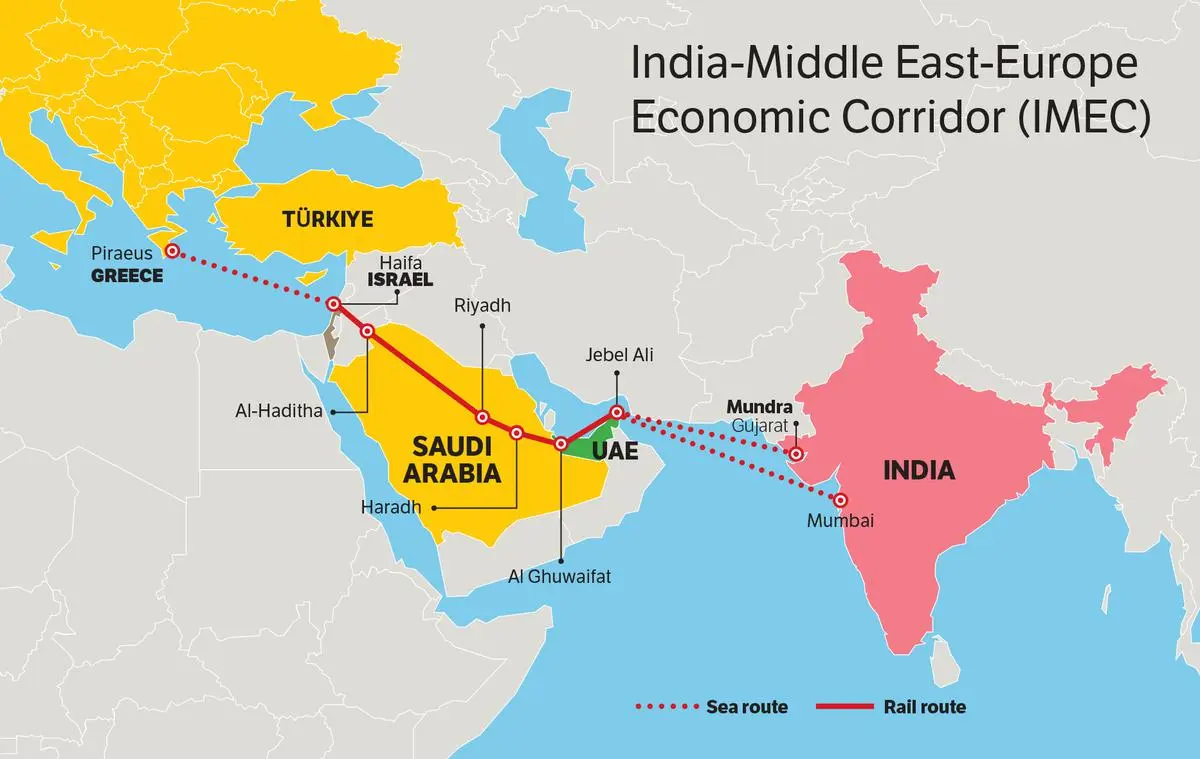
JERUSALEM — Heightened hostilities between Israel and Iran, now complicated by U.S. military engagement, are imperiling an ambitious economic corridor designed to link India with Europe. The India-Middle East-Europe Economic Corridor (IMEC), launched at the 2023 G20 Summit in New Delhi, seeks to transform global trade by connecting Indian ports to European markets via the Persian Gulf. But with the Middle East on edge, the project’s viability is increasingly uncertain.
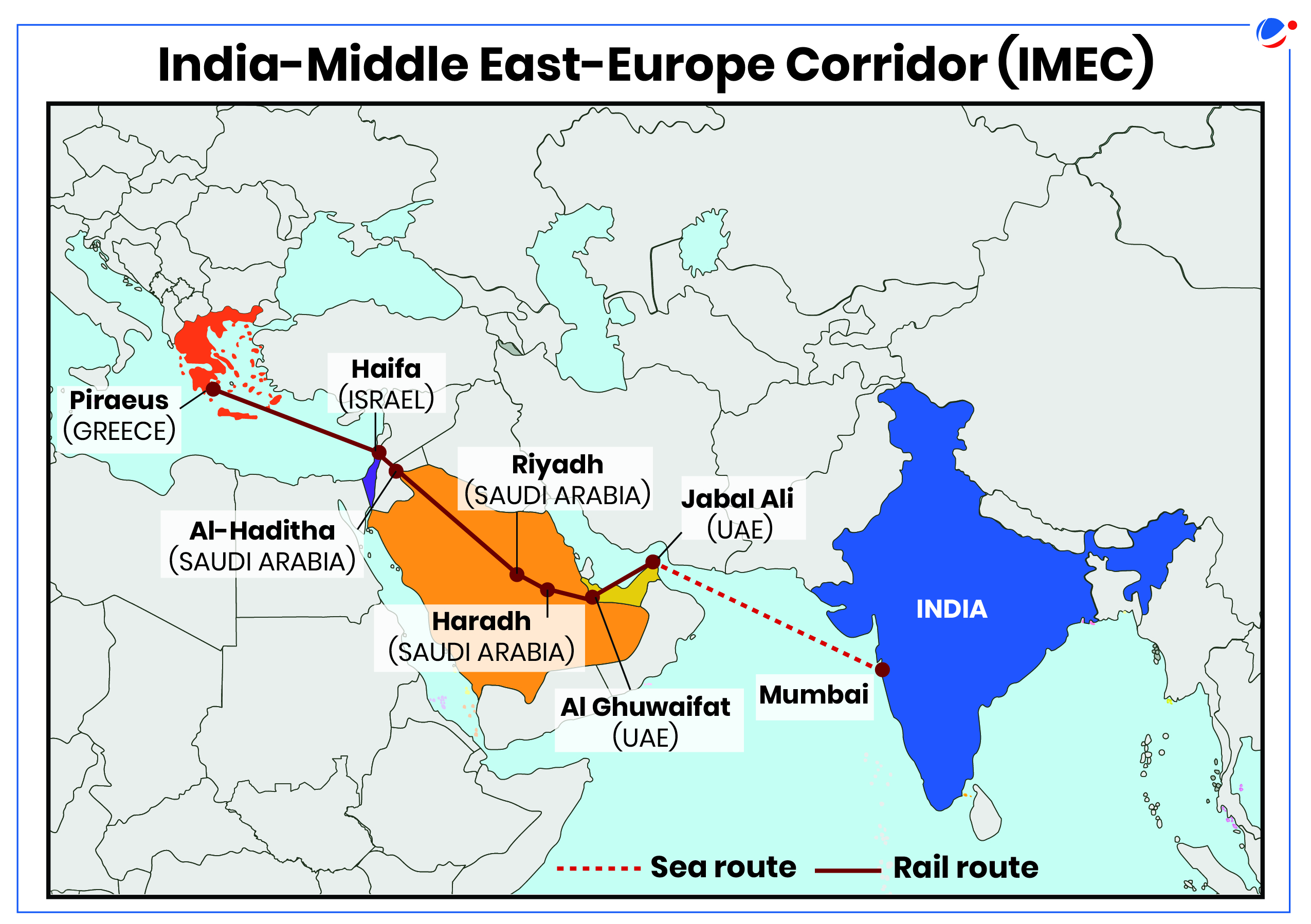
IMEC envisions a network starting at Indian ports like Mundra, with goods shipped to the United Arab Emirates, then moved by rail through Saudi Arabia and Jordan to Israel’s Haifa port, operated by Indian Tycoon Adani. From there, maritime routes would deliver cargo to European hubs in Greece or France. The corridor could cut transit times by 30% and costs by 40% compared to the Suez Canal, while undersea data cables and hydrogen pipelines bolster digital and energy connectivity.
“This corridor is a game-changer for supply chain resilience,” said Amit Bhandari, a trade analyst at Gateway House in Mumbai. “But it’s hostage to regional stability.” For India, IMEC supports its export-driven economy, enhancing access to the European Union, its largest trading partner, with $136 billion in trade in 2022-23. Saudi Arabia, diversifying beyond oil, has committed $20 billion to rail and port upgrades, while the UAE is investing in regional links.
Drawing on ancient trade routes that once connected Indian merchants to the Mediterranean through Gulf ports, IMEC reimagines a historic pathway. Yet, modern obstacles loom large. India’s ports need upgrades, and West Asia’s rail infrastructure is incomplete. Most critically, the corridor hinges on stability in Israel, now embroiled in escalating tensions with Iran, including recent cross-border strikes. The U.S.’s entry into the fray, with increased military support for Israel, has further inflamed the region. “The Israel-Iran-U.S. standoff is a major roadblock,” said an Indian analyst.
IMEC also navigates competition with China’s Belt and Road Initiative, which has invested over $1 trillion in global infrastructure. Unlike China’s centralized approach, IMEC relies on each nation funding its segment, risking delays from coordination challenges. Egypt and Turkey, excluded from the plan, are vocal critics. Egypt fears revenue losses from the Suez Canal, while Turkey promotes a rival Iraq-based rail route. “Bypassing regional powers creates resentment,” said a European diplomat.
Despite the risks, diplomatic momentum persists. Prime Minister Narendra Modi’s recent Gulf outreach and a February 2025 joint statement with President Donald Trump reaffirm commitment. European leaders, including European Commission President Ursula von der Leyen, back IMEC, with Greece and France competing to host its European endpoint.
As global trade faces Red Sea disruptions and supply chain bottlenecks, IMEC’s potential to diversify routes is critical. But with Israel-Iran tensions, now amplified by U.S. involvement, threatening regional stability, the corridor’s bold vision faces a daunting path.