News Desk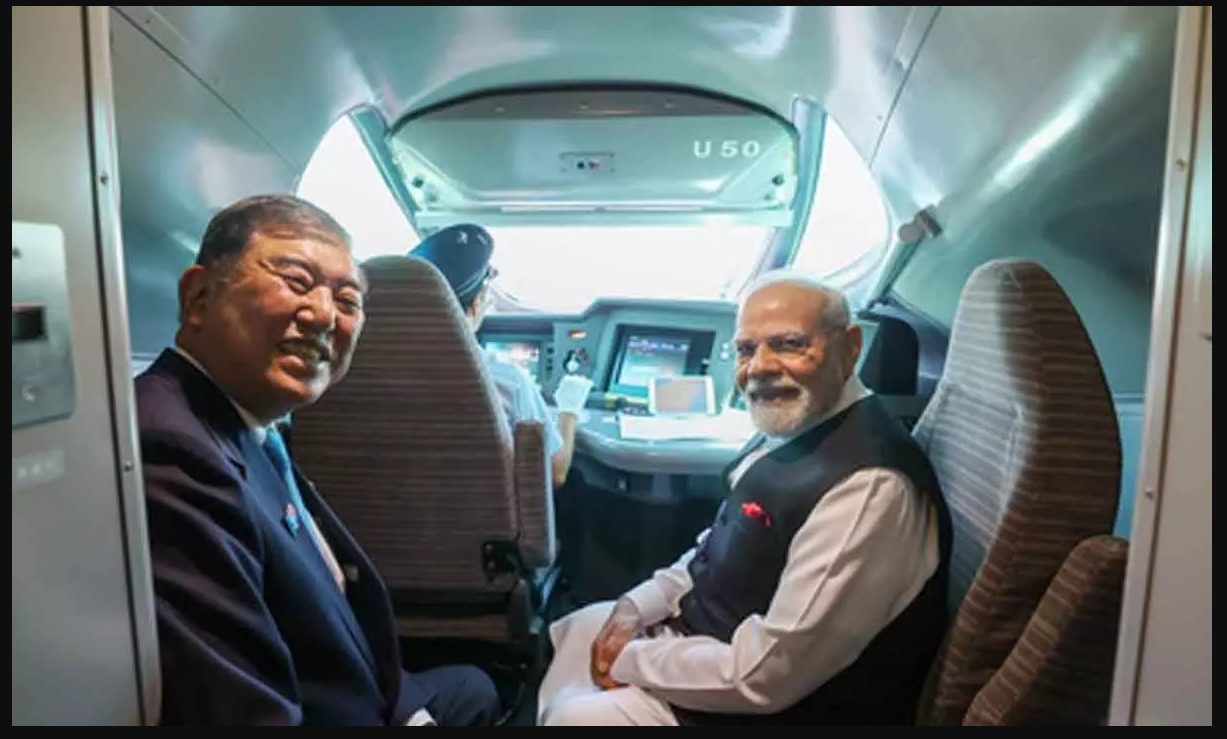
In a striking symbol of technological diplomacy, Indian Prime Minister Narendra Modi and Japanese Prime Minister Shigeru Ishiba traveled together aboard Japan’s Tohoku Shinkansen on Saturday, engaging in a wide-ranging conversation about railways, innovation, and the future of high-speed connectivity between their nations.
The hour-and-a-half journey from Tokyo to Sendai was more than ceremonial—it was a rolling summit that underscored the deepening strategic partnership between India and Japan. Modi, who has long championed infrastructure-led development, experienced firsthand the precision and comfort of Japan’s bullet train system, including a visit to the driver’s cab of the E5 Series Shinkansen, which reaches speeds of up to 320 km/h.
“This was Prime Minister Modi’s first ride on the Tohoku Shinkansen,” Ishiba told reporters. “He was deeply engaged, asking about safety, speed, and how such systems could transform India’s vast geography.”
The leaders also viewed Japan’s next-generation test train, the ALFA-X, and discussed the upcoming E10 Shinkansen model—designed to reach speeds of 400 km/h. In a landmark decision, Japan confirmed that the E10 will be introduced simultaneously in both countries, with India’s Mumbai–Ahmedabad bullet train corridor serving as its international debut.
India’s high-speed rail ambitions, anchored by the Mumbai–Ahmedabad corridor, are entering a transformative phase. The project, built with Japanese technical and financial support, is the first of its kind in South Asia. It will connect 12 stations across Gujarat, Maharashtra, and Dadra & Nagar Haveli, reducing travel time to just over two hours for limited-stop services.
Japan’s commitment to India extends beyond rail. During the recent summit, Tokyo pledged a 10 trillion yen investment (approximately ₹60,000 crore) over the next decade, spanning infrastructure, semiconductors, clean energy, and digital industries. Modi and Ishiba also toured the Tokyo Electron Miyagi semiconductor plant, highlighting India’s growing role in global tech supply chains4.
“Japanese technology and Indian talent are a winning combination,” Modi said during the visit, emphasizing the synergies driving innovation, manufacturing, and mobility across both nations.
The collaboration includes training Indian engineers in Shinkansen operations, adapting earthquake-resistant systems for Indian terrain, and exploring future corridors beyond Mumbai–Ahmedabad. A 7,000-kilometer high-speed rail network is envisioned under India’s Make in India initiative, with Japanese firms invited to participate.
The journey also carried personal resonance. Ishiba recalled Modi’s early years traveling overnight trains to New Delhi, describing railways as “a festival of movement” where strangers become companions—a sentiment both leaders shared.
As India accelerates toward a future of smart infrastructure and global partnerships, Saturday’s ride was more than symbolic. It was a reaffirmation of India’s place in the world: ambitious, collaborative, and ready to move at bullet speed.