News Desk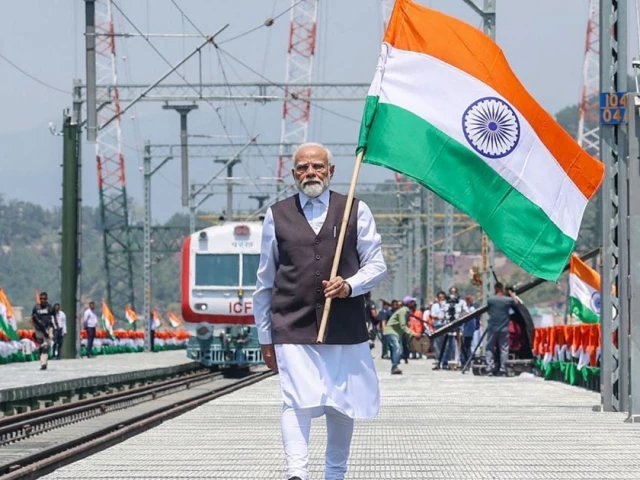
Prime Minister Narendra Modi stood atop the Chenab Rail Bridge, the world’s highest single-arch railway bridge, waving India’s tricolor flag with a fervor that resonated across the nation. The inauguration of this engineering marvel, alongside the 272-kilometer Udhampur-Srinagar-Baramulla Rail Link (USBRL) and two Vande Bharat Express trains, marked a historic milestone for Jammu and Kashmir, a region long plagued by conflict but now poised for transformation. With projects worth over $5.5 billion unveiled, Modi’s visit underscored India’s commitment to integrating Kashmir more fully into its economic and cultural fabric, a move that could redefine the region’s future for a global audience watching closely.
The Chenab Bridge, soaring 359 meters above the riverbed in Reasi district, is more than a feat of engineering; it’s a symbol of India’s ambition to bridge geographical and emotional divides. For decades, Kashmir’s rugged terrain and political volatility have isolated it from the rest of the country. The USBRL, completed at a cost of $5.2 billion, changes that narrative. It connects the Kashmir Valley to India’s vast railway network, slashing travel time between Katra and Srinagar to under three hours. This is no small achievement in a region where weather and security challenges have long disrupted connectivity. The Vande Bharat trains, India’s homegrown high-speed marvels, will ferry passengers and goods, from Kashmir’s famed apples to tourists seeking its scenic beauty, directly to mainland markets. This signals India’s ability to execute complex infrastructure projects in sensitive regions, a testament to its growing prowess.
Modi’s government has framed the rail link as a step toward economic empowerment. Speaking at a rally in Katra, the base for pilgrims visiting the Vaishno Devi shrine, he emphasized how the projects would boost local industries. “Apples from Kashmir will now reach big markets at low cost and on time,” he said, highlighting the potential for agricultural exports to flourish. Tourism, a lifeline for many Kashmiris, is also set to benefit.
The rail link makes the Valley’s snow-capped peaks and serene lakes more accessible, potentially reviving an industry battered by years of unrest and a recent terrorist attack in Pahalgam that killed 26 tourists. Modi’s vision is clear: infrastructure as a catalyst for peace and prosperity. This approach mirrors successful development models in other post-conflict regions, where connectivity fosters stability.
The timing of Modi’s visit, his first to Kashmir since the Pahalgam attack in April, carries deep significance. That tragedy, which India attributes to Pakistan-backed groups, escalated tensions between the nuclear-armed neighbors, leading to a brief but intense exchange of missile and drone strikes. Modi’s presence in Katra, flanked by Lieutenant Governor Manoj Sinha and Chief Minister Omar Abdullah, sent a message of resilience. He called the attack an assault on “insaniyat” (humanity) and “Kashmiriyat” (Kashmiri identity), accusing Pakistan of trying to destabilize the region’s economy and communal harmony. Yet, his tone was not merely confrontational. By focusing on development, Modi signaled India’s intent to move beyond cycles of violence, a strategy that resonates with global calls for de-escalation in South Asia.
The $5.5 billion investment package includes not just the rail link but also a new medical college and other development projects in Katra. The USBRL, with its 36 tunnels and 943 bridges, was a logistical triumph, completed despite daunting geological challenges. Union Minister Jitendra Singh credited Modi’s leadership for pushing the project forward, noting that it gained momentum under his tenure. The Chenab Bridge, built for $178 million over eight years, stands taller than the Eiffel Tower, a point Modi highlighted to underscore India’s engineering ambitions. This achievement places India alongside nations like China, which have leveraged infrastructure to assert global influence.
The rail link’s strategic importance cannot be overstated. By providing an all-weather connection, it reduces Kashmir’s reliance on vulnerable road networks, enhancing security and economic integration. The Vande Bharat trains, with their modern amenities, symbolize India’s push for self-reliance in technology, a cornerstone of Modi’s “Make in India” campaign. For global investors, this signals a stable and forward-looking India, capable of delivering on ambitious projects in challenging environments. The presence of Chief Minister Omar Abdullah at the inauguration also suggests a degree of local buy-in, crucial for the project’s long-term success.
The rail link’s inauguration fulfills a decades-old dream of connecting Kashmir to Kanyakumari, India’s southern tip, by rail. For Kashmiris, it promises jobs, tourism, and access to markets. For India, it’s a step toward unifying a diverse nation. And for the world, it showcases a rising power’s ability to transform a contested region through infrastructure and vision. As Modi walked the Chenab Bridge, flag in hand, he embodied a nation looking forward, determined to turn a turbulent past into a connected future.