 News Desk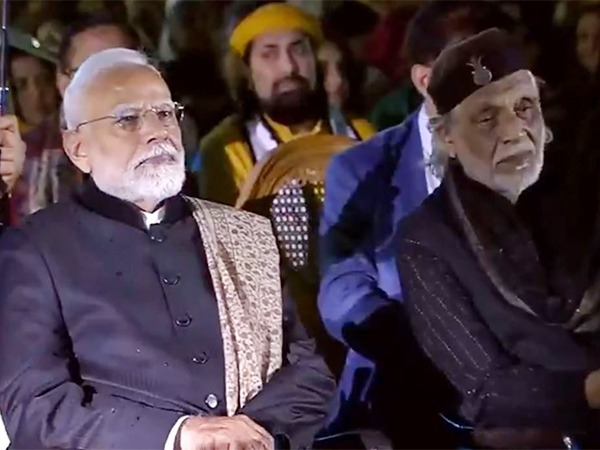
On a drizzling Friday evening in New Delhi, Indian Prime Minister Narendra Modi stepped onto the stage at the Jahan-e-Khusro festival, invoking the verses of Rumi, Amir Khusro, and Ghalib. As he spoke of love, unity, and the universality of Sufi thought, the rain continued to fall—a poetic backdrop to what was ostensibly an evening of mysticism and cultural reverence.
Yet, beneath the literary flourish, Modi’s embrace of Rumi and Sufism raises questions. Is this a genuine appreciation of Islamic spiritual heritage, or is it part of a broader political strategy—one that seeks to appropriate select aspects of Muslim culture while simultaneously sidelining India’s Muslim community?
The Jahan-e-Khusro festival, organized by the Rumi Foundation and hosted by filmmaker Muzaffar Ali, is an annual celebration of Sufi poetry and philosophy. Modi, known for his hardline Hindu nationalist credentials, did not merely attend—he dominated the stage, framing Sufism as intrinsically Indian and aligning it with his government’s foreign policy doctrine of Vasudhaiva Kutumbakam (the world is one family).
“This thought aligns completely with India’s Vedantic covenant,” Modi declared, weaving Rumi’s universalism into his narrative of India as a land of spiritual inclusivity. He quoted the Persian poet’s famous line: “Raise your arguments, not your voice. A flower blossoms in rain, not in sound of thunder.” The audience—comprised of Delhi’s cultural elite and foreign dignitaries—was captivated. But outside the polished confines of the festival, the picture is far more complicated.
Modi’s invocation of Rumi and Sufism fits into a pattern: a strategic engagement with aspects of Islamic heritage that are deemed palatable, while disassociating them from the broader Muslim experience in India today. It is no secret that Modi’s tenure has been marked by policies and rhetoric that have fueled anxiety among India’s nearly 200-million-strong Muslim population.
The ruling Bharatiya Janata Party (BJP) has openly championed Hindu nationalism, with a legislative record that includes the revocation of Kashmir’s special status, the passage of the Citizenship Amendment Act (CAA), and the recent inauguration of the Ram Temple on the ruins of the Babri Masjid. The government’s silence—or outright complicity—when it comes to rising anti-Muslim hate crimes and calls for economic boycotts of Muslim businesses stands in stark contrast to the Prime Minister’s poetic musings on Islamic mysticism.
This is not an isolated pattern. Modi has previously praised figures like Dara Shikoh—the Mughal prince who translated Hindu scriptures into Persian—while consistently omitting rulers like Aurangzeb, whose legacy is less convenient for his narrative. Rumi, with his message of universal love, is an easy figure to embrace. But his embrace does little for the millions of Indian Muslims who see their rights and representation eroded.
Modi’s reference to Rumi’s Masnavi and Amir Khusro’s legacy at the festival reflects a broader effort to elevate Sufism as the “acceptable” face of Islam in India. Within the BJP’s ideological framework, Sufi Islam is often presented as a peaceful, spiritual alternative to the so-called “orthodox” or “political” Islam that the party frequently criticizes.
This distinction is convenient but historically simplistic. Sufism in India has never existed in a vacuum; it has been deeply intertwined with Muslim social and political life. Figures like Hazrat Nizamuddin Auliya and Khwaja Moinuddin Chishti were not only spiritual guides but also voices of resistance, often challenging the ruling elite. By stripping Sufism of its historical complexities and presenting it as merely a soft, apolitical tradition, the BJP reduces it to a cultural ornament—useful for diplomacy and optics but disconnected from the lived realities of Indian Muslims.
Rumi’s influence, as Modi noted, extends far beyond India. The Prime Minister traced the poet’s connection to the subcontinent through Shamsuddin of Tabriz, who is believed to have had Indian ancestry. He also cited Allama Iqbal, the philosopher-poet who considered Rumi his spiritual guide. Yet, Iqbal’s vision of Rumi was not one of passive mysticism—it was of a revolutionary thinker whose ideas could mobilize societies.
Interestingly, Iqbal’s poetry, infused with Rumi’s philosophy, played a significant role in shaping the political consciousness that led to the creation of Pakistan—a historical reality that does not fit neatly into Modi’s narrative of Sufi inclusivity.
For all the literary grandeur of Modi’s speech, the question remains: What does this symbolic embrace of Sufi Islam mean for Muslims in India today? Will quoting Rumi soften the impact of policies that many see as exclusionary? Will it change the reality of bulldozed homes, discriminatory laws, and the normalization of anti-Muslim rhetoric?
The BJP’s cultural maneuvering is clear: embrace a version of Islamic heritage that can be seamlessly integrated into its vision of Hindu nationalism while simultaneously othering Muslims in political and social discourse. It is a delicate balancing act—one that allows Modi to appear inclusive on an international stage while continuing to consolidate a domestic political base that thrives on religious polarization.
Rumi may belong to the world, as Modi suggests, but in contemporary India, his legacy is being repackaged for an audience that often does not see the full picture. The verses resonate, but the reality remains unchanged.