News Desk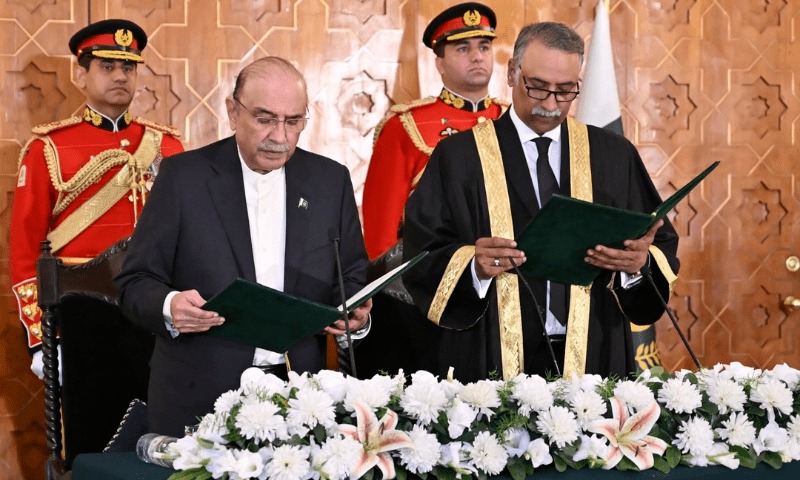
ISLAMABAD — Pakistan’s judiciary has been thrust into fresh turmoil after five judges of the Islamabad High Court (IHC) and leading legal associations publicly rejected the appointment of Justice Sardar Mohammad Sarfraz Dogar as the court’s acting chief justice, alleging political interference in the judicial process.
The controversy erupted as the dissenting judges, Justices Mohsin Akhtar Kayani, Tariq Mehmood Jahangiri, Babar Sattar, Sardar Ejaz Ishaq Khan, and Saman Rafat Imtiaz, boycotted the swearing-in ceremony held on Friday at the Presidential Palace. The absence of these senior judges signaled growing unrest within the judiciary over what is widely seen as an attempt by the government to manipulate judicial appointments. President Asif Ali Zardari administered the oath, but the ceremony took place under the shadow of a deepening constitutional dispute.
At the core of the issue is the government’s decision to transfer Justice Dogar from the Lahore High Court (LHC) to the IHC, bypassing senior judges and altering the court’s hierarchy.
Justice Kayani, previously the next in line for the top judicial position, was effectively demoted in seniority, losing key roles within the judiciary’s committees and being relegated to third place in ranking. The move triggered immediate backlash, with the five dissenting judges filing a complaint to Pakistan’s Chief Justice, Yahya Afridi, arguing that Justice Dogar’s transfer violated constitutional provisions meant to safeguard judicial independence.
Under Article 200 of Pakistan’s Constitution, a high court judge can only be transferred with their consent and in consultation with the chief justices of both the sending and receiving courts. The dissenting judges contend that a transferred judge must take a fresh oath under Article 194, which would place them at the bottom of the seniority list; not at the top, as in Justice Dogar’s case. Despite these concerns, then-IHC Chief Justice Aamer Farooq upheld the seniority reshuffling, dismissing the objections raised by his colleagues.
Legal associations in the federal capital have also condemned Justice Dogar’s appointment, describing it as a direct attack on judicial integrity. The Islamabad High Court Bar Association (IHCBA), the Islamabad Bar Council (IBC), and the District Bar Association Islamabad (DBAI) have called the appointment an “intrusion” and accused the government of handpicking judges to serve its political interests.
The legal community has warned of launching nationwide protests against what they view as a dangerous encroachment by the executive into the judiciary.
At an IHCBA gathering on Friday, held at the same time as the contentious oath-taking, Justice Jahangiri emphasized the importance of merit in judicial appointments. “I have never sought recommendations for any position,” he stated, urging young lawyers to prioritize professional integrity over political patronage.
Prominent lawyers have also voiced concerns over the broader implications of the move. IBC member Raja Aleem Abbasi criticized the 26th constitutional amendment, claiming it has been exploited for political gain. He suggested that the Supreme Court’s larger bench may ultimately be forced to review the matter, indicating that legal battles over the appointment are likely to follow.
IHCBA President Riasat Ali Azad dismissed Justice Dogar’s transfer as unlawful. “He is not a judge of the IHC,” Azad asserted, arguing that Dogar was essentially serving on deputation and that his appointment had unfairly disrupted the seniority order of 15 sitting judges.
He likened the situation to Pakistan’s judicial crisis of 2007, when then-Chief Justice Abdul Hameed Dogar took his oath under General Pervez Musharraf’s Provisional Constitutional Order, prompting a historic lawyers’ movement that ultimately led to his removal.
The timing of Justice Dogar’s transfer has fueled speculation that he is being positioned to assume the permanent role of IHC chief justice. His appointment comes just days before the Judicial Commission of Pakistan (JCP) is set to finalize new Supreme Court justices, with the current IHC Chief Justice Aamer Farooq expected to be elevated. If Farooq is promoted, Dogar would be next in line; something the dissenting judges see as a deliberate maneuver to weaken judicial independence.
A day before the controversial appointment, the five IHC judges sent a letter to Chief Justice Afridi and other senior judicial figures, warning that Justice Dogar’s elevation would undermine judicial norms. The letter, signed by Justices Kayani, Jahangiri, Sattar, Khan, and Imtiaz, expressed deep concerns about growing executive influence over the judiciary. Notably, while two other IHC judges, Justices Miangul Aurangzeb and Arbab Tahir, were named in the letter, they did not sign it.
This latest standoff has heightened tensions between Pakistan’s judiciary and the executive, reviving long-standing fears of judicial compromise. With nearly half of the IHC bench openly challenging the appointment and the country’s legal fraternity preparing for possible protests, the crisis threatens to escalate further. Pakistan’s lawyers have historically played a decisive role in resisting government interference in the judiciary; whether they will succeed again remains an open question.