News Desk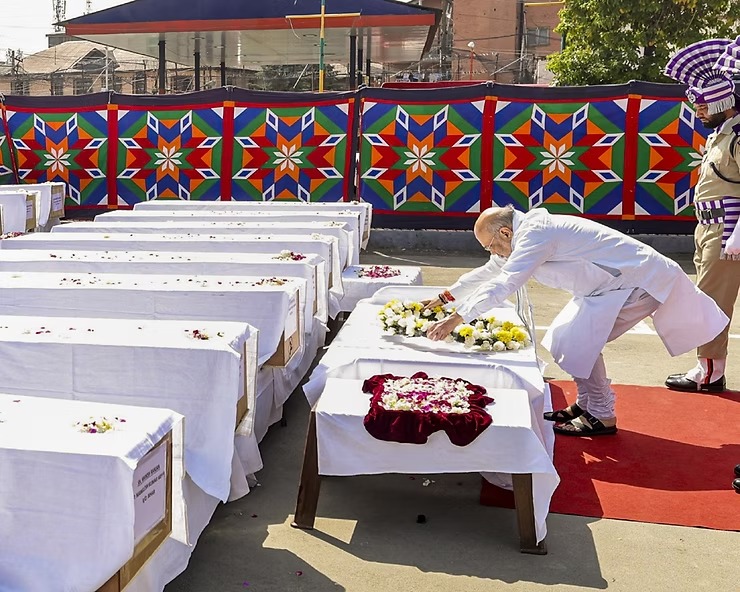
ISLAMABAD — In a move that has sent ripples across South Asia, Pakistan’s government has elevated General Syed Asim Munir to the rank of field marshal, a rare and symbolic honor that underscores his grip on power but also amplifies concerns about escalating tensions with neighboring India. The promotion, announced on Tuesday, comes on the heels of a deadly terrorist attack in Pahalgam, Indian-administered Kashmir, and a subsequent military confrontation that has brought the nuclear-armed neighbors to the brink. While Pakistan hails Munir as a hero of its “historic victory” in the conflict dubbed Marka-i-Haq, critics argue his provocative rhetoric and strategic gambits have deepened regional instability.
A Provocative Speech and a Deadly Attack
The current crisis traces back to April 16, when General Munir, addressing a gathering of overseas Pakistanis in Islamabad, invoked the divisive two-nation theory, emphasizing irreconcilable differences between Hindus and Muslims. Calling Kashmir Pakistan’s “jugular vein,” he pledged unwavering support for the Kashmiri cause, framing it as a struggle against Indian “occupation.” The speech, laced with anti-Hindu rhetoric, was a departure from the usual diplomatic restraint, alarming Indian officials who saw it as a signal to Pakistan-based militant groups.
Just six days later, on April 22, the idyllic town of Pahalgam in Indian-administered Kashmir became the site of a horrific massacre. Five armed militants, later linked to the Resistance Front—a group widely believed to be a front for the Pakistan-based Lashkar-e-Taiba—opened fire on Hindu tourists in Baisaran Valley, killing 26 civilians. The attackers reportedly singled out non-Muslims, checking religious identities in a chilling act of targeted violence. India’s response was swift and resolute: Prime Minister Narendra Modi, cutting short a trip to Saudi Arabia, vowed to bring the perpetrators to justice, while security forces launched a massive operation to track down the militants.
Indian authorities pointed to digital traces leading to safe houses in Muzaffarabad and Karachi, alleging support from Pakistan’s Inter-Services Intelligence (ISI). While Pakistan denied involvement, the timing of Munir’s speech and the attack fueled suspicions of a coordinated effort to inflame tensions. “This was not a random act,” said Rajya Sabha MP Kapil Sibal, noting the proximity of Munir’s remarks to the attack. “It was a well-planned terrorist strike, obviously state-sponsored.”
From Balakot to Pahalgam: Munir’s Rise
General Munir’s journey to Pakistan’s military pinnacle began decades ago. Commissioned in 1986 into the Frontier Force Regiment via the Officers Training School in Mangla, Munir rose steadily through the ranks. His career gained prominence during the 2019 Balakot crisis, as director general of Military Intelligence in 2017 and briefly as head of the ISI in 2018, Munir was at the heart of the terror attack that happened in Indian soil.
His tenure as ISI chief was cut short after eight months, reportedly due to tensions with then-Prime Minister Imran Khan. Munir then commanded the Gujranwala Corps before becoming quartermaster general at General Headquarters. In November 2022, he was appointed army chief, consolidating power in a country where the military keeps the sword high on the civilian leadership. His crackdown on Khan’s supporters after riots in May 2023, including the arrest of former ISI chief Lt. Gen. Faiz Hameed, signaled a ruthless approach to consolidating authority.
Escalation and Operation Bunyanum Marsoos
The Pahalgam attack set off a chain of events that pushed India and Pakistan into direct military confrontation. On May 6-7, India launched Operation Sindoor, a series of precision strikes targeting terror infrastructure in Pakistan’s Punjab and Pakistan occupied Kashmir (POK). The operation, named after the vermilion mark worn by married Hindu women, was a pointed response to the targeting of Hindu tourists, whose women became widows. Indian strikes destroyed nine terror launch pads, killing around 100 militants, including key figures from Jaish-e-Mohammed and Lashkar-e-Taiba, groups long accused of operating under Pakistan’s patronage.
Pakistan retaliated with Operation Bunyanum Marsoos, part of the broader conflict termed Marka-i-Haq (Battle of Truth), saw Pakistan launch drone and missile strikes on Indian military bases. The escalation, marked by tit-for-tat strikes, culminated in a mutually agreed ceasefire on May 10, upon Pakistan’s request, without any foreign intervention, contrary to what US President claimed.
A Promotion Amid Defeat
Despite Pakistan’s claims of a “historic victory,” analysts argue Operation Bunyanum Marsoos was a strategic failure. India’s strikes exposed vulnerabilities in Pakistan’s air defenses, neutralizing drones and missiles while hitting targets in major cities like Karachi and Lahore. Yet, on May 20, Pakistan’s federal cabinet, led by Prime Minister Shehbaz Sharif, approved Munir’s promotion to field marshal, a rank previously held only by General Mohammad Ayub Khan in 1959. The Prime Minister’s Office cited Munir’s “exemplary courage and determination” in defending Pakistan’s sovereignty during Marka-i-Haq.
Critics see the promotion as a desperate bid to bolster Munir’s image, and Sharief family’s hold on power against the Bhutto- Zardari clan, amid domestic and military setbacks. Pakistan’s economy is in tatters, armed rebellions simmer in Balochistan and Khyber-Pakhtunkhwa, and the military’s popularity has waned. “Munir’s elevation is less about victory and more about projecting strength to a fractured nation,” said a Western diplomat. Social media posts on X echoed this sentiment, with users, accusing Munir of dragging Pakistan into war to boost his image while exposing its vulnerabilities.
India’s Measured Resolve
India, by contrast, has emerged from the crisis with a renewed sense of purpose. Operation Sindoor demonstrated its military precision and diplomatic clout, with global leaders, including U.S. President Donald Trump and EU chief Ursula von der Leyen, condemning the Pahalgam attack and expressing solidarity. India’s commitment to rooting out terrorism, coupled with its restraint in agreeing to the ceasefire, has bolstered its image as a responsible regional power. “India’s response was proportionate and targeted,” said Joshua T. White, a South Asia expert at Johns Hopkins University in media comments. “It sent a clear message without escalating to full-scale war.”
As Pakistan celebrates Munir’s promotion with gun salutes and patriotic fervor on Youm-e-Tashakur (Day of Gratitude), questions linger about the cost of his gambit. His rhetoric, once a rallying cry, now risks isolating Pakistan diplomatically while emboldening militant proxies. For India, the path forward involves balancing vigilance with diplomacy, ensuring that the sacrifices of Pahalgam’s victims fuel a resolve to secure peace without compromising justice.