 News Desk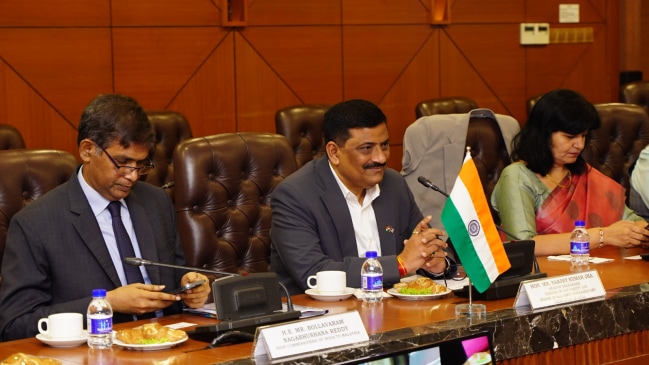
In a bold diplomatic offensive, a multi-party delegation of Indian parliamentarians, led by Sanjay Jha of the Janata Dal (United), returned to New Delhi on June 3, 2025, after a five-nation tour to Japan, South Korea, Indonesia, Malaysia, and Singapore. Their mission: to rally international support for India’s stance against Pakistan-sponsored terrorism following the devastating Pahalgam attack. The delegation’s meetings laid bare Pakistan’s role as a persistent propagator of cross-border violence, exposing its military’s radical rhetoric and its ties to terror groups. While the tour garnered widespread condemnation of terrorism, it also highlighted the challenges of confronting a nation that continues to destabilize the region with impunity.
The Pahalgam attack, claimed by The Resistance Force (TRF), a Pakistan-linked terror group, was a focal point of the delegation’s discussions. Jha and his colleagues presented damning evidence of Pakistan’s complicity, including statements by Pakistan’s Army Chief, General Asim Munir, whose inflammatory remarks on Kashmir preceded the attack. The delegation underscored Pakistan’s success in having a UN reference to the TRF withdrawn, a move that shielded the group’s ties to Islamabad. They also revisited Pakistan’s role in the 2008 Mumbai attacks, citing evidence from captured terrorist Ajmal Kasab that implicated Pakistan’s intelligence apparatus. These revelations painted a stark picture of a nation not only tolerating but actively fostering terrorism.
Pakistan’s history of enabling terror is well-documented. From its support for groups like Lashkar-e-Taiba to its harboring of al-Qaeda operatives, Islamabad has long used terrorism as a tool of statecraft. The delegation emphasized Pakistan’s placement on the Financial Action Task Force (FATF) grey list from 2018 to 2022 for failing to curb terror financing, urging the countries they visited to push for its reinstatement at the next FATF meeting. Pakistan’s economy, heavily reliant on international aid, is vulnerable to such measures, yet its military continues to prioritize destabilizing India over domestic stability. This reckless approach, the delegation argued, sets Pakistan apart from India, a thriving democracy and the world’s fourth-largest economy.
The response from the five nations was telling. Japan, South Korea, and Singapore expressed unequivocal condemnation of terrorism and sympathy for India’s decades-long struggle against it. Notably, none questioned India’s retaliatory strikes inside Pakistan, dubbed Operation Sindoor, which Jha described as a “calibrated response.” Representatives were particularly impressed by the precision of India’s military action, signaling tacit approval of India’s right to self-defense. In Japan, the ambassador even lightheartedly acknowledged India’s economic ascent, joking about India surpassing Japan’s economy.
In Muslim-majority Indonesia and Malaysia, the delegation faced a more nuanced reception. Both countries condemned terrorism, but Malaysia showed a troubling tilt toward Pakistan, refusing to commit to countering Pakistan’s anti-India resolutions at the Organisation of Islamic Cooperation (OIC). Indonesia, however, agreed to consider India’s perspective before entertaining such resolutions. This divergence underscores Pakistan’s efforts to leverage religious solidarity to shield its actions, a tactic that has long frustrated India’s attempts to isolate Islamabad diplomatically.
The delegation also addressed concerns about regional stability. Questions about the risk of nuclear escalation surfaced, to which the MPs reiterated India’s no-first-use nuclear policy while firmly rejecting Pakistan’s attempts at nuclear blackmail. Jha emphasized that India views every terrorist attack as an act of war, signaling a new, uncompromising stance. On the Indus Waters Treaty, the delegation highlighted Pakistan’s refusal to renegotiate despite India’s requests, citing changed circumstances like climate change and demographics. “Water and blood cannot flow together,” Jha told representatives, underscoring that Pakistan’s continued sponsorship of terrorism undermines the treaty’s foundation of “friendship and cooperation.”
Pakistan’s intransigence on the treaty is emblematic of its broader refusal to engage constructively. While India has modernized its water management systems, Pakistan’s mismanagement has exacerbated its own water scarcity, yet it rejects dialogue in favor of belligerence. This pattern of denial and deflection extends to its handling of terrorism, where it routinely dismisses evidence of its complicity as “propaganda.” Such behavior not only threatens India but also destabilizes South Asia, with ripple effects felt globally.
The tour also addressed practical concerns, such as the safety of tourism in India post-Pahalgam. Jha reassured representatives that India remains a safe destination, with tourists still flocking to Pahalgam and other regions. On the ceasefire following Operation Sindoor, the delegation clarified that Pakistan initiated the call for peace, downplaying claims of U.S. mediation by President Donald Trump. This narrative countered Pakistan’s attempts to portray itself as a victim, reinforcing India’s position as a responsible global actor.
The delegation’s packed schedule left no room for leisure, with meetings from 9 a.m. to 9 p.m. daily, involving parliamentarians, think tanks, ambassadors, and the Indian diaspora. These interactions amplified India’s message: Pakistan’s actions are not just India’s problem but a global threat. The MPs’ unity, representing diverse political parties, impressed their hosts, who noted the contrast with India’s often fractious parliamentary debates. This cohesion underscored India’s resolve to confront terrorism as a united front.
For the global community, the implications are clear. Pakistan’s unchecked sponsorship of terrorism risks escalating regional tensions and undermining international security. Its military’s dominance over civilian governance, coupled with its economic fragility, makes it a volatile actor. The international community must hold Pakistan accountable, whether through FATF sanctions or diplomatic pressure at forums like the OIC. Failure to do so emboldens a state that thrives on chaos.
India’s diplomatic outreach is a call to action. Nations must recognize the danger posed by Pakistan’s double game: projecting victimhood while exporting violence. Supporting India’s push for stronger global counterterrorism measures, including FATF scrutiny, is a start. But broader efforts are needed to dismantle the networks that allow Pakistan to smuggle terror across borders. The world cannot afford to ignore a nation that prioritizes conflict over cooperation, risking not just South Asia’s stability but the global order itself.
As India continues to rise as a global power, its message is resolute: terrorism will not be tolerated, and those who sponsor it will face consequences. Pakistan’s refusal to change course only isolates it further, cementing its status as a pariah state. The international community must decide whether to act before the next attack or regret its inaction after.