 News Desk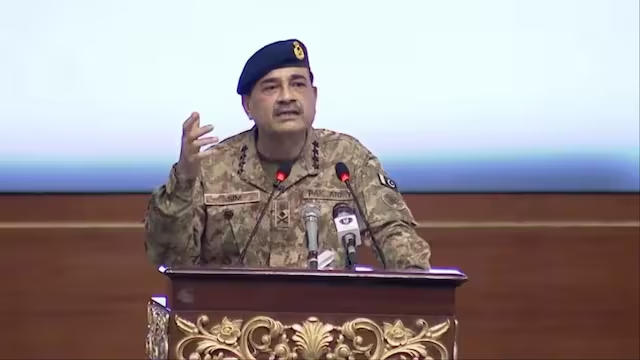
In a region where history and identity intertwine with faith, recent remarks by Pakistan’s army chief, General Asim Munir, have reignited debates over religious rhetoric and its implications for South Asia’s fragile communal harmony. Speaking on April 16, at the Overseas Pakistanis Convention in Islamabad, Munir emphasized the ideological chasm between Hindus and Muslims, invoking the two-nation theory that underpinned Pakistan’s creation in 1947.
His words, framing Pakistanis as fundamentally distinct in religion, culture, and ambition, have drawn sharp criticism, particularly in India, where they are seen as stoking anti-Hindu sentiment. Yet, this incident is not isolated. Across the border, India’s recent election cycles have witnessed speeches that similarly leverage religious differences, often spotlighting Muslim communities in discussions of cultural practices like beef consumption. Together, these episodes underscore a troubling trend in South Asia: the use of faith as a divisive tool in public discourse, raising questions about its roots and remedies.
Munir’s speech, as reported by outlets like The Times of India and India Today, was a call to preserve Pakistan’s founding narrative. By urging parents to pass down the story of partition, he framed the Hindu-Muslim divide as central to national identity.
The reaction was swift, with Indian media and social media platforms decrying the remarks as “hateful” and “propagandistic.”
A post from a prominent user, Dr. Palaniappan Manickam, captured the sentiment, labeling the speech “shameful.” Yet, within Pakistan, the response remains less documented, suggesting a need for deeper insight into how such rhetoric resonates domestically. The controversy highlights the military’s enduring role in shaping Pakistan’s ideological boundaries, a contrast to the political arenas where similar dynamics play out elsewhere in the region.
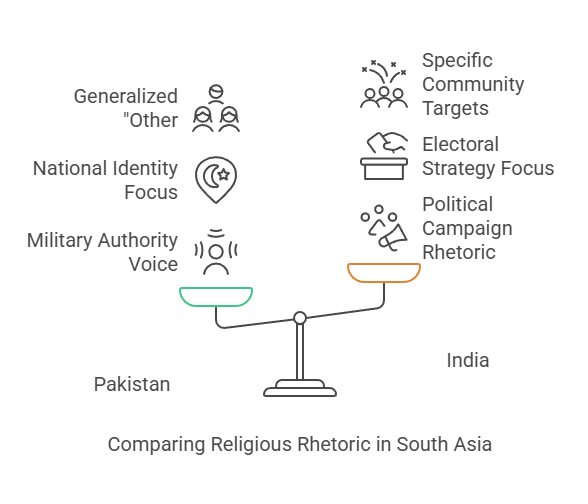
In India, election seasons often amplify religious rhetoric, with speeches targeting Muslim communities over issues like dietary practices, marriages or economic policies. Human Rights Watch noted in 2024 that campaign remarks frequently framed Muslims as threats to cultural or national interests, citing over 100 instances of divisive language in a single election cycle.
These speeches, aimed at mobilizing voters, differ from Munir’s in their electoral context but share a common thread: the use of religious identity to deepen societal divides. While Pakistan’s rhetoric reinforces a national narrative rooted in partition, India’s focuses on immediate political gains, often exploiting cultural flashpoints. Both, however, risk entrenching mistrust in a region already scarred by historical grievances.
South Asia’s religious radicalism is not confined to one faith or nation. From Pakistan’s post-9/11 struggles with Islamic extremism to Sri Lanka’s Buddhist-led violence against Muslims, lynching of Muslims in India, and more recently the attacks on Hindus in Bangladesh, this religious extremist region grapples with a collective challenge.
The Oxford Research Encyclopedia describes this as a growing security concern, fueled by nationalism and amplified by social media.
Pew Research Center data suggests mixed attitudes toward religious diversity, with support for pluralism coexisting alongside tensions in plural societies. This complexity challenges simplistic narratives about any single community’s role, pointing instead to systemic factors like political opportunism and historical legacies.
Interpreting these trends requires a nuanced lens. Munir’s speech and India’s election rhetoric serve as political tools, rallying constituencies by invoking identity. They reflect the enduring shadow of partition, which continues to shape narratives of “us” versus “them.”
Social media, meanwhile, acts as an accelerant, transforming local remarks into global controversies. Yet, beneath the rhetoric lies a shared challenge: addressing socio-economic disparities and historical wounds that fuel division. Solutions are not straightforward, but fostering dialogue, promoting education on shared histories, and strengthening institutions to curb hate speech offer a path forward.
As South Asia navigates these turbulent waters, the stakes are high. Religious rhetoric, whether from a military podium or a campaign stage, shapes not just domestic perceptions but also regional stability. The challenge lies in balancing national identity with communal harmony, a task that demands leadership willing to bridge divides rather than deepen them. For now, the region watches, wary of the next speech that might tip the delicate balance.