 News Desk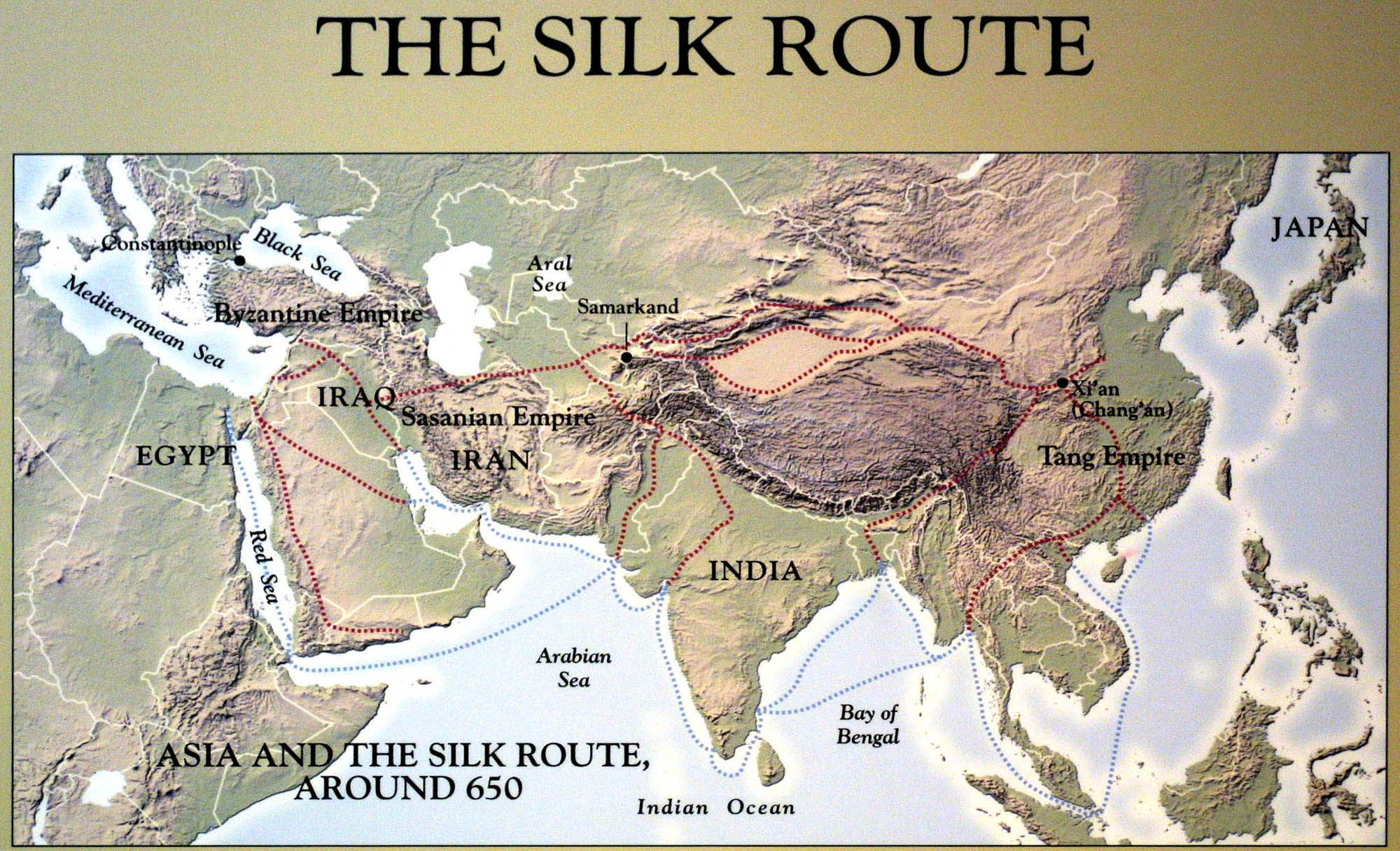
In the popular imagination, the Silk Road summons visions of camel caravans threading through deserts and over peaks, their packs heavy with silk and spices, stitching the Far East to the West in a timeless saga of trade. For readers abroad, it’s a shorthand for ancient globalization, a romantic link between distant worlds. But peel back the myth, and the Silk Road reveals itself as something younger and less grand—a term coined just 148 years ago, shaped by European scholars and now wielded by China to burnish its global ambitions. Its true story, and India’s overlooked role within it, cuts through the nostalgia to show how history is both remembered and remade.
The phrase “Silk Road” first appeared in 1877, when Prussian geographer Ferdinand von Richthofen published China: The Results of My Travels and the Studies Based Thereon. In its pages, he introduced “Seidenstraße”—“Silk Road” in German—to describe the overland routes tying China to the Mediterranean. Richthofen wasn’t charting a single path but a sprawling network, alive with goods and ideas crisscrossing Eurasia. His timing was no accident: Europe, flush with industrial fervor and railway fever, craved tales of ancient connectivity. As historian Susan Whitfield notes in her 2015 book Life Along the Silk Road, the term fed a 19th-century hunger for “a past that mirrored the present,” even if the routes it described were far older—and far less unified—than the label suggested.
Those routes hummed with activity long before they had a name, but not in the seamless way we might imagine. Before the 13th century, when the Mongol Empire’s conquests briefly lashed East to West, trade was a patchwork affair. Marco Polo, whose late-1200s journey through Asia is often tied to the Silk Road mythos, never mentions the term in his Travels. He marvels at Chinese silks and Mongol markets but describes no grand corridor—only scattered exchanges. Earlier still, Rome’s trade with China was a sideshow. The 1st-century Roman writer Pliny the Elder, in his Natural History, gushes over Indian pepper and gems, barely nodding to Chinese silk as a rare luxury. Archaeologist Warwick Ball, in his 2007 study The Monuments of Afghanistan, estimates that India’s maritime trade with Rome dwarfed overland flows from China by a factor of ten, a testament to India’s bustling ports like Muziris, which thrived while China’s isolation kept it peripheral.
Richthofen’s coinage lingered in German academia until 1938, when Swedish explorer Sven Hedin’s The Silk Road thrust it into English-speaking parlance. Hedin’s bestseller painted the routes as a cultural lifeline, a view that took root as archaeologists and historians fleshed out the tale. Yet as Peter Frankopan argues in his 2015 book The Silk Roads: A New History of the World, much of this narrative is “a modern gloss on a fractured past,” with China cast as the star of a story it didn’t always lead. India, by contrast, emerges as a quieter giant—its sailors and merchants linking Asia to the world, its Buddhist missionaries seeding ideas along the way.
Today, China has seized the Silk Road’s legacy with its Belt and Road Initiative (BRI), a $4 trillion gambit, per a 2021 World Bank estimate, to forge new trade arteries across Asia, Europe, and Africa. The Yuxinou Railway, rumbling from Chongqing to Duisburg, Germany, is its poster child—a modern echo of ancient paths. Yet critics, like the Council on Foreign Relations in a 2023 report, call it “a silk glove over an iron fist,” noting debt traps ensnaring nations like Sri Lanka. India, meanwhile, opts for a different tack, championing projects like the International North-South Transport Corridor with Russia and Iran—less flashy, more cooperative, and free of Beijing’s shadow.
The Silk Road, then, is less a relic than a reflection—of how 19th-century Europe framed the past, and how China now molds it for the future. India’s vibrant trade legacy, sidelined in the overland myth, shines brighter in the real story. For a foreign audience, the lesson is clear: history isn’t just unearthed—it’s sculpted, and the chisel matters as much as the stone.
This booklet can be downloaded from here: